There is no single best seat on a plane. The best airplane seat is the one that matches what you actually want from the flight: a window seat to sleep and stay undisturbed, a row over the wings for the smoothest ride, an exit row or bulkhead row for legroom, an aisle seat near the front for fast deplaning, or a rear-cabin seat if you want space to yourself. Pick the goal first, then the location, and the choice takes about five minutes.
The tricky part is that seat 22A on one aircraft is nothing like seat 22A on another. Layout, pitch, noise and who sits in front of you all change between routes, so a rule like “always sit at the front” gets you nowhere. Here’s the method I use, and the same one that comes up again and again in r/Flights threads when people ask what to pick.
Table of Contents
- What You Need to Pick a Good Airplane Seat
- Step-by-Step
- 1. Match the Seat to Your Trip
- 2. Check the Aircraft and Seat Layout
- 3. Compare Legroom and Seat Comfort
- 4. Consider Noise, Movement, and Service
- 5. Evaluate the Practical Trade-offs
- 6. Check Availability and Price
- 7. Verify Before You Pay
- 8. Recheck Close to Departure
- Common Mistakes
- Frequently Asked Questions
- Is a window or aisle seat better?
- Are the first rows quieter and more comfortable?
- How do I find the best seat on a specific flight?
- Is an exit-row seat suitable for every passenger?
- Can I change my airplane seat after paying for it?
- Conclusion
What You Need to Pick a Good Airplane Seat
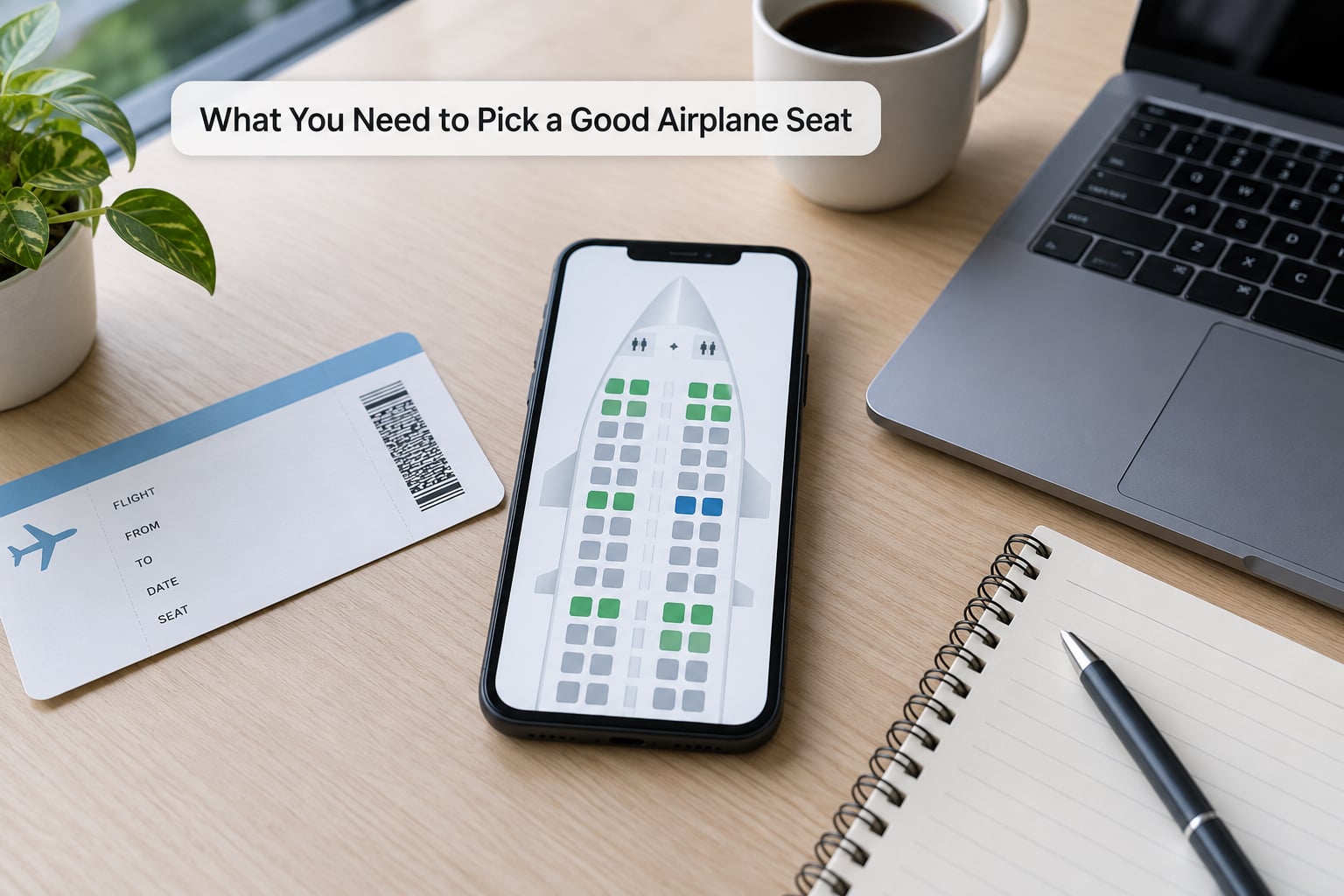
You need less than you think. Your flight number, a way to see the seat map for that specific aircraft, and an honest answer about which comfort matters most to you.
I’d check three things before I open the booking page. First, the flight number and date, because that’s what unlocks the seat map. Second, who is travelling with me, since a solo passenger, a couple and a family with an infant all need different rows. Third, my priority, ranked: sleep, legroom, quiet, quick exit, or cost.
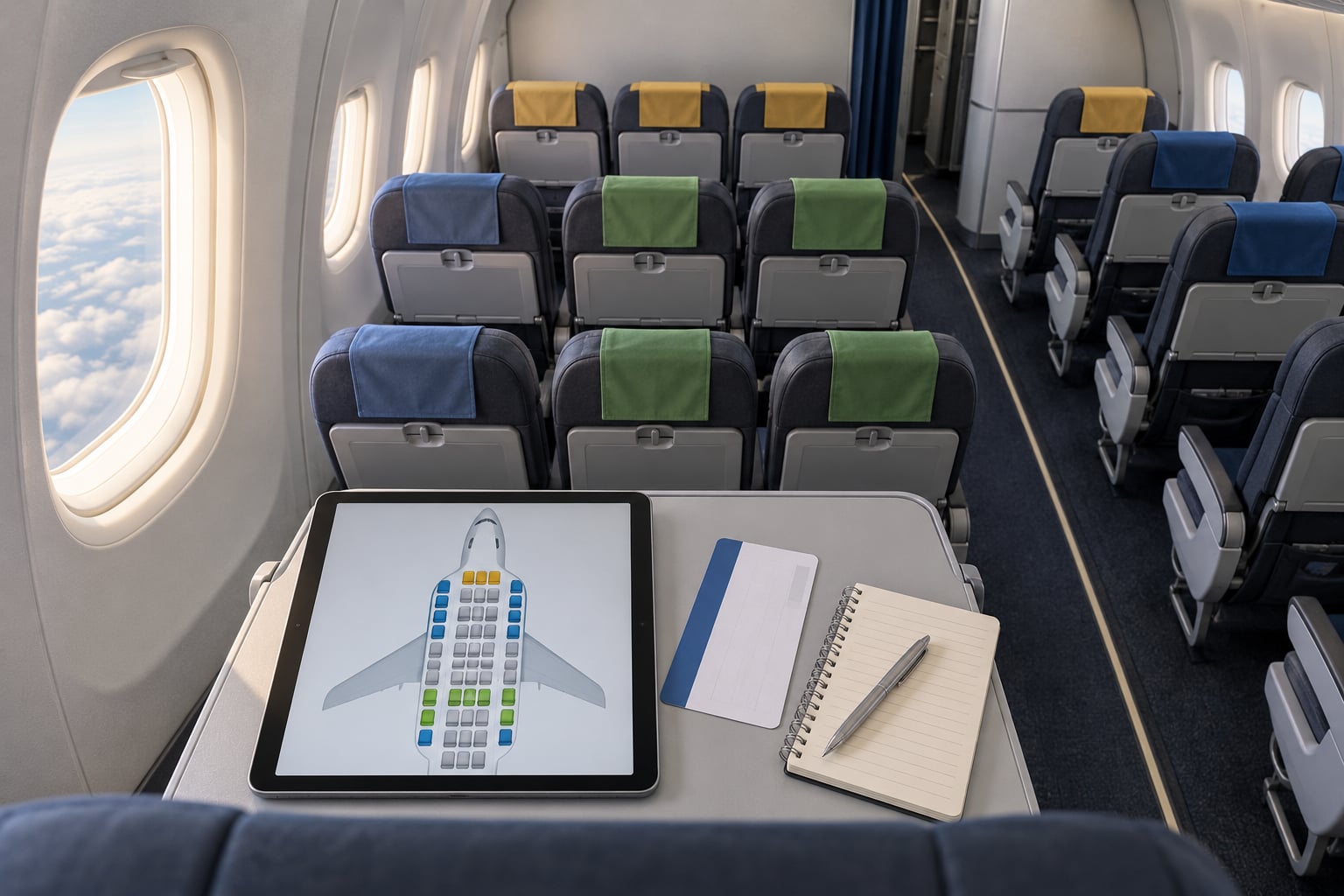
Then open the seat map in the airline’s own booking flow, and cross-check it against a free seat map tool if the airline’s version looks bare. Airline maps are accurate about availability and often thin on detail. Third-party maps tell you where the galley, lavatories, exits and bassinet rows are, which is exactly what you need to judge noise and access.
Step-by-Step
1. Match the Seat to Your Trip
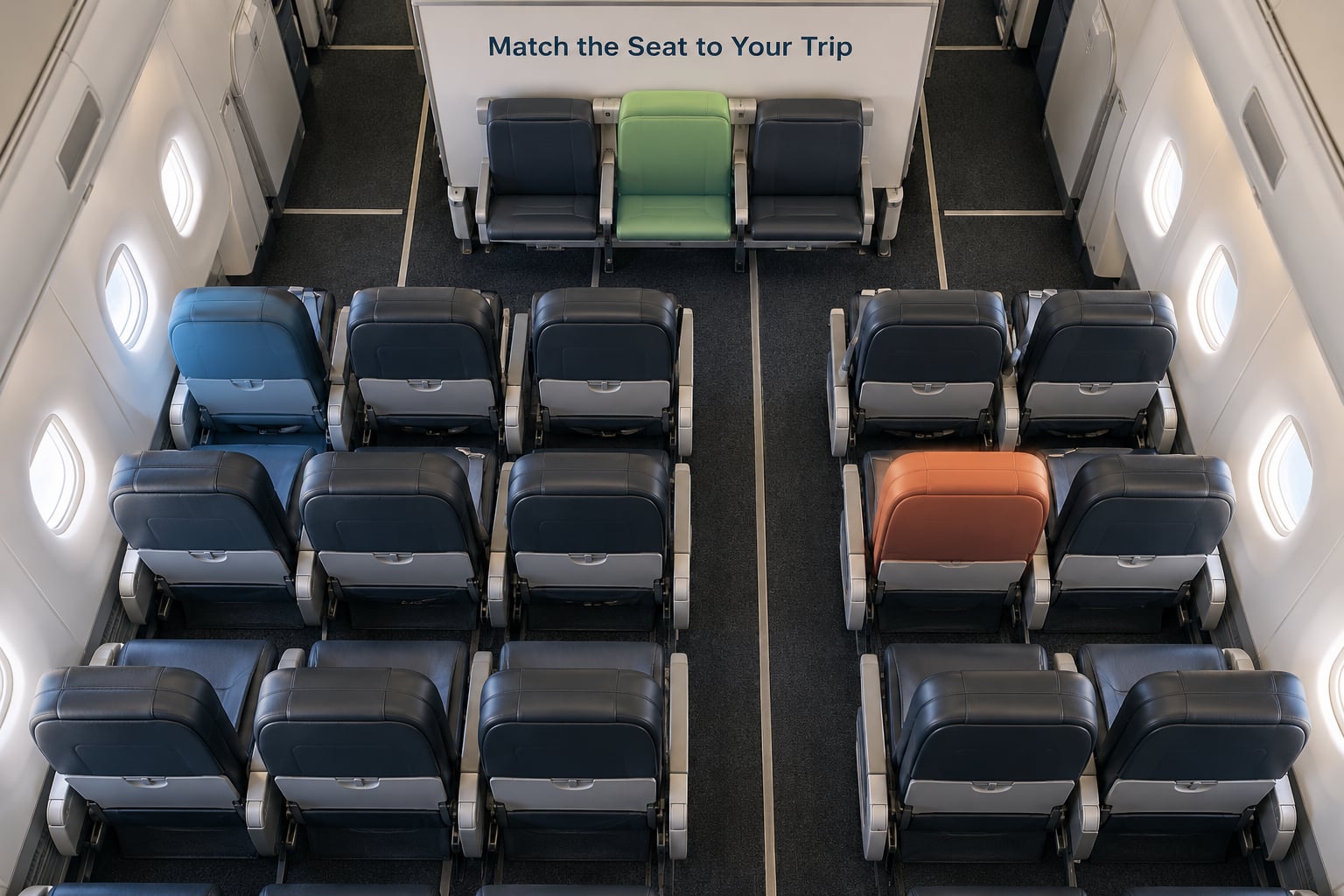
Start by naming your priority out loud, because one seat cannot win on every axis. Sleeping, legroom, quiet, bathroom access, fast deplaning and price pull in different directions, and every one of them trades against the others.
Some quick mappings that hold up most of the time. Window for sleep, shade control and not being bumped in the aisle. Aisle for getting up without apologising to strangers. Over the wings for the smoothest ride in turbulence. Exit row or the row behind it for the most legroom in economy. Front of the cabin for quietness, first meal service and the fastest walk off. Rear of the cabin for personal space and cheaper seats, at the cost of more movement.
You know the choice worked when you can finish the sentence “I picked this seat because…” without hedging. If you need two reasons and one of them is “the map showed it as recommended”, keep looking.
2. Check the Aircraft and Seat Layout
The seat number is meaningless without the aircraft. Most booking flows hide the aircraft type behind the flight number, so I click through to the flight details to confirm what I’m getting. A regional jet on your ticket can be swapped for a narrow-body, and a narrow-body can be swapped for a wide-body on a long route.
Then read the configuration notation, which is written as numbers showing how many seats sit abreast. 3-3 is a standard narrow-body with three seats on each side of the aisle. 3-3-3 is nine abreast, the tight wide-body economy layout where the middle seat is genuinely miserable. 3-4-3 is the densest common economy layout, and it’s why first-time wide-body flyers feel the pinch so hard. 2-2 is the small regional-jet layout where every seat is an aisle seat.
You’ll know the layout is right when the seat letters on the map make sense to you. In a 3-3 layout the letters usually run A B C, D E F. In a 3-4-3 the middle block is wider, and picking the middle of that block is a trap rather than a choice.
3. Compare Legroom and Seat Comfort
Seat pitch is the distance from the back of your seat to the back of the one in front, and it’s the number that decides whether you can sleep. Main-cabin pitch typically runs around 30 to 32 inches, which sounds generous until you’re sitting in it for eleven hours.
Pitch alone doesn’t tell the whole story. Seat width matters, and in a 3-3-3 or 3-4-3 layout the width is the first thing to suffer. Then check whether the row in front of you reclines, because rows directly ahead of a galley or a non-reclining row often cannot, and that removes your own ability to lean back. Bulkhead rows gain space from the missing seat in front but lose the recline entirely.
Tell it worked by checking your knees. Sit with your back against the seat and your feet flat on the floor. If you can slide your hands under your thighs without pressing hard, you have workable legroom for a night flight. If you can’t, move one row back or forward and check again.
4. Consider Noise, Movement, and Service
Noise comes from three places, and they are not in the same spot. Engines sit under the wings, so the wing itself is loud but the ride is smooth. The rear of the aircraft is quietest on engine noise and loudest on airflow. Galleys and lavatories create intermittent noise that lasts the whole flight, so the rows immediately in front of and behind them get used constantly.
Front rows sit further forward of the engines, which is why so many travelers pick them for sleep, and you also get meal service first. The trade-off is that a nervous flyer feels every bump harder near the nose, and the front rows are also where babies get bassineted, which means more noise.
A note on the over-wing advice that circulates constantly: the ride is smoother there because it’s the aircraft’s centre of gravity, not because the seat is magic. Directly over the wing, especially on a narrow-body, you’ll hear the engines more than anywhere else in the cabin. I take one or two rows forward or back of the wing, which keeps the smoothness with less of the roar.
5. Evaluate the Practical Trade-offs
Plenty of good seats come with conditions attached, and the conditions are what surprise people at boarding. Exit rows usually come with a fixed armrest in the middle that does not move, no under-seat storage because there is no seat in front, and a requirement to stow your belongings during takeoff and landing. You may also be asked to help with the evacuation, and airlines commonly set a minimum age around 15 or 16, sometimes with a language requirement.
Bulkhead rows are the other conditional seat. You get the legroom and often a bassinet option for an infant, but the row in front cannot recline into your space, and the noise from the galley or lavatory behind you carries into an open row with no seat back to absorb it.
Other practical checks: middle seats only make sense if you want both armrests and don’t mind a stranger in your space. A blocked window, which happens on some narrow-bodies where a passenger sits slightly forward, ruins the main reason to pick a window. And if you use a wheelchair or need assistance, tell the airline when you book rather than at the gate, since accessible seating and assistance requirements are arranged in advance.
6. Check Availability and Price
Seat selection works in three ways: it’s included with your ticket, it’s a paid add-on you choose during booking, or it’s free later through check-in or your loyalty status. The best fare is the one where it’s included, so check your fare rules before paying anything extra.
Compare the seat fee against what the seat actually saves you. A paid extra-legroom row is a good trade on a ten-hour flight and a waste of money on a ninety-minute hop. Middle-of-cabin and rear rows are usually the cheapest seats to pick, and for a budget trip that avoids paying to escape a middle seat entirely, which is a real saving on a full flight.
There’s also the cost of moving later. If you skip seat selection now and try to fix it at check-in, you may find the good rows gone and the alternative costs the same as the seat you avoided. Decide whether paying now beats gambling on availability.
7. Verify Before You Pay
Before you confirm, run a short checklist. The seat number is the one you picked, and the aircraft matches the seat map you looked at. Your fare rules say whether changes and cancellations are allowed, because a non-changeable fare makes a wrong seat a much bigger problem. Your assistance needs are on the booking if you have any. And you know that the layout itself can change, so the seat you read about today is a strong expectation, not a promise.
Two specific things to double-check. First, that the seat in front of yours reclines, which the map sometimes flags and sometimes doesn’t. Second, that you’re not picking a row where a bassinet is fitted by default, since those rows are blocked off for families with infants on many aircraft.
If your booking flow shows the seat as “extra legroom” or “preferred”, that’s a commercial label rather than a measurement. Confirm it against the layout before treating it as fact.
8. Recheck Close to Departure
Look again the night before you fly and once you’ve checked in. Aircraft swaps happen, and when the aircraft changes, the row numbers can shift with it. Checking in is also the moment the seat you paid for is actually confirmed in the system, and the moment you’ll see an unexpected reassignment if one has happened.
Be clear with yourself about what a paid seat assignment is. It buys a strong preference, and on most flights you get the seat you chose. It is not a guarantee against an equipment change or a crew reassignment, so if you have a genuine accessibility need, say so at booking and again at check-in rather than relying on the paid seat alone.
If you do get moved, an aisle seat near the galley or a middle seat in a 3-3-3 is the least bad outcome, and crews generally try to avoid it. Ask politely at the gate desk before boarding rather than on the ramp.
Common Mistakes
Choosing by row number alone. Row 14 means nothing until you know the aircraft. Fix: confirm the aircraft type, then the configuration, then the position within it.
Assuming every window seat is quiet. A window seat beside a lavatory or galley can be the loudest seat in the cabin. Fix: check the map for lavatory and galley positions before you commit.
Ignoring that the same seat number feels different on a different plane. A 3-3-3 middle seat and a 3-3 aisle seat are completely different experiences. Fix: treat the aircraft, not the seat letter, as the unit of comparison.
Taking an exit row without reading the conditions. Fixed armrest, no under-seat storage, stow your bag on the ground for takeoff, possible evacuation duty, and an age or language requirement. Fix: read the eligibility rules on the airline’s page first.
Waiting too long to select a seat. The good rows go first, and check-in may leave you the leftovers. Fix: choose within the first day of booking, and revisit before check-in.
Skipping the fare rules. People assume a cheap fare includes free seat selection. Fix: read what your fare covers before deciding a paid seat is the only option.
A few things worth remembering. Name your priority before you look at the map. Check the configuration, not just the row. Treat colour coding as a hint rather than a verdict, since green typically marks better legroom and red marks seats worth avoiding, but the reason always comes back to the layout. And if two seats are equally good on the map, take the one with more space behind it, because an empty row in front is the most reliable comfort upgrade there is.
Frequently Asked Questions
Is a window or aisle seat better?
It depends on the trip. A window seat gives you a wall to lean on, control of the shade, and fewer people getting past you, which makes it the better sleep choice. An aisle seat makes standing up easy, so it wins if you use the restroom often, travel with a child, or find the middle of the night cramped. Most regular flyers land on aisle seats once they get older, and window seats before that.
Are the first rows quieter and more comfortable?
Usually quieter, yes, because the front of the cabin sits further forward of the engines. You also get meal service first and deplane fastest, which matters on a tight connection. The catch is comfort during turbulence: the nose moves more than the middle of the aircraft, so if you are anxious about bumps, the front rows are the wrong choice despite the quieter engines.
How do I find the best seat on a specific flight?
Find the flight in the airline’s booking flow, open the seat map, then note the aircraft type, the configuration, and where the galley, lavatories and exits sit. Cross-check against a free seat map tool for the detail airlines leave out, then pick the row that matches your priority. Recheck after check-in, because equipment changes can shift row numbering.
Is an exit-row seat suitable for every passenger?
No. Airlines commonly set a minimum age around 15 or 16, some require a working language for safety announcements, and you may be responsible for assisting in an evacuation. The armrest is fixed, there is no under-seat storage, and you must stow your belongings during takeoff and landing. Exit rows suit confident adult travellers, not nervous flyers, families with young children, or anyone who needs frequent access.
Can I change my airplane seat after paying for it?
Usually yes, and often for nothing, through the airline’s app or website up until check-in or even after it, depending on the fare. Availability is the real constraint, not permission, so the better seat may already be taken. If you booked a non-changeable fare, the ticket rules still apply to the seat, so check both the fare conditions and what the airline allows on seat changes.
Conclusion
Start with the aircraft, not the row number. Open the real seat map for your flight, check the configuration and where the galley, lavatories and exits sit, then choose the location that matches your legroom, noise, access and budget priorities in that order of what matters to you. Everything else on the map is detail. Updated for 2026.