There is no universal winner on bus vs train for airport transfers, because the deciding factor is total door-to-door time, not the vehicle. Take the train when the airport has a rail link into the city centre and the roads are busy. Take the bus when the route runs direct to your neighbourhood, when the airport is small, or when the budget is tight.
Plenty of comparison pages treat this as a coin flip and land on a sales pitch. This one is built on the four inputs that actually move the answer: how far you are going, what time your flight lands or leaves, how many bags you are carrying, and how far the drop-off point is from your door.
Last updated October 2026.
Table of Contents
- Bus vs Train for Airport Transfers at a Glance
- Bus vs train for airport transfers by the numbers
- Which Is Usually Faster?
- Which Is Cheaper?
- Which Is More Reliable?
- Which Is Better for Luggage and Accessibility?
- Which Has Better Route and Schedule Flexibility?
- Which Is Better for Airport-to-Hotel and City Transfers?
- Which Should You Choose?
- Frequently Asked Questions
- Can I take a bus or train with oversized luggage?
- Is an airport bus faster than a train during rush hour?
- Which airport transfer is safer for a late-night arrival?
- Do children need separate tickets on airport buses and trains?
- What should I do if my flight is delayed and public transit has stopped?
- Bottom Line
Bus vs Train for Airport Transfers at a Glance
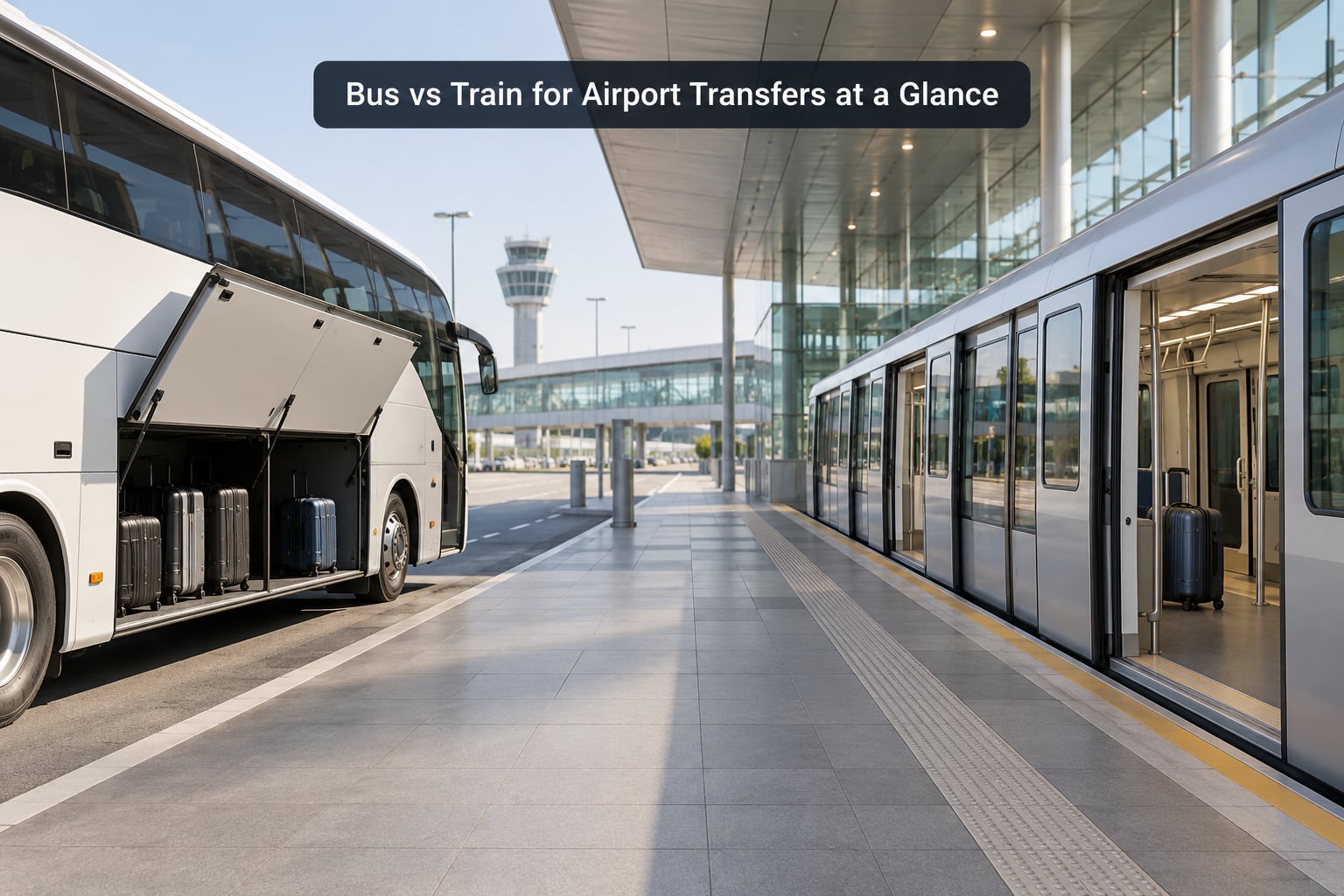
The table below is the whole comparison in one place. Read the two rows that matter most for your trip first: total door-to-door time, and the service that runs last in the evening.
| Factor | Airport coach or bus | Airport train |
|---|---|---|
| Typical fare | Local transit fare, often covered by a day pass or travel card | Local fare to express premium, priced by time saved |
| Total door-to-door time | Varies widely with traffic, especially near peak hours | Stable; immune to road congestion |
| Frequency | Every 10 to 30 minutes on main routes, thinner overnight | Every 5 to 15 minutes on airport links at big cities |
| Luggage | Dedicated compartment or under-seat space, usually no steps to climb | Overhead racks and vestibules, but stairs and platform gaps at many stations |
| Traffic exposure | Full: congestion, roadworks, accidents | None |
| Last-mile convenience | Often drops near your neighbourhood | Usually ends at a central station, then walk, metro or local bus |
| Comfort | Wide seats, reclining on express coaches, views through windows | Smooth ride, room to move, space to work, but crowded at rush hour |
| Best for | Budget travel, small or rail-less airports, families with lots of bags | Early flights, business travel, dense cities with long congested approaches |
Bus vs train for airport transfers by the numbers
Every figure in that table is an average, and averages are where bad decisions come from. The number that matters is the sum of the parts, and it always looks like this: walk to the stop, wait, ride, transfer, wait again, walk to your door.
A fast express train can lose to a slow local bus if the express station is deep underground, if the platform is a long walk from the ticket hall, and if you then need two more legs to reach your hotel. A coach that sets you down at the end of your street wins the same route. This is why comparing the two modes by how fast they move is the single most common mistake in bus vs train for airport transfers advice.
Which Is Usually Faster?
Train, on most urban airport routes, and by more than people expect. The reason is structural rather than mechanical: a train does not share road space with the same half-million commuters who are also heading into the city at eight in the morning.
Speed depends on four things, in this order. First, distance and the number of intermediate stops. An express that runs non-stop from the terminal to the main station wins easily against a bus that stops twenty times. Second, road conditions on the bus side, which swing wildly by hour and season. Third, transfer frequency, since a service every twelve minutes barely adds to your total time while one every hour might add half an hour of waiting. Fourth, siting, which is the sneaky one: the station may be a long way from the airport and the bus stop right outside the terminal.
Bus wins in a specific and common situation. In car-centric cities with few rail links and good arterial roads, a direct bus can beat the rail option on total time. This is where you see shuttle services carrying airport traffic to a downtown hub in around twenty minutes on a clear run, with no interchange and no underground platform to navigate.
Bus also wins wherever there is no rail link at all. Many regional airports are connected to the city by coach only, and in that case the comparison is not bus versus train, it is bus versus an expensive pre-booked car.
Which Is Cheaper?
Bus, nearly always. The fare gap is widest at the airports where the marketing is loudest, because a rail link lets the operator sell a premium on speed. The local commuter service is usually a fraction of the airport express fare for a saving of ten to fifteen minutes.
Compare total cost, not the ticket. Add up the transfer fare, any local transport you need at the far end, and the fallback you will need if the service has already stopped for the night. A late landing that forces a taxi home costs more than the express train would have. Several airports also hand out a city transport ticket or run a dedicated service at no extra cost, including the Boston Logan airport buses and the LaGuardia Q70, so check before assuming you have to pay.
Two cost items catch travellers out. Children may need their own ticket on either mode depending on the city and their age. And oversized luggage can attract a separate charge on an express coach, or simply be refused on a crowded commuter train at peak time.
Groups change the arithmetic fast. Once three or four people are travelling together with full-size bags, a pre-booked shared car often costs less per person than per-person fares plus the taxi you would otherwise need for the last mile. Before you fly, work out whether the free shuttle from your hotel covers the airport you are actually using.
Which Is More Reliable?
Train is structurally more reliable because it cannot be held up by a lorry across four lanes. A bus shares every road closure, every roundabout queue and every burst of rain on the motorway.
That said, reliability is a property of the corridor, not the mode. A bus on a segregated right-of-way or a dedicated airport corridor holds time very well. Rail has its own failure modes, and they are not rare: weekend engineering works, timetable gaps overnight, signal faults, and strike action are all common enough to be planned around.
The practical takeaway is to build in the buffer your mode deserves. Allow more slack for a bus, more slack for engineering works and strike dates on rail, and check the live departure board before you commit, because both modes publish real-time information.
Which Is Better for Luggage and Accessibility?
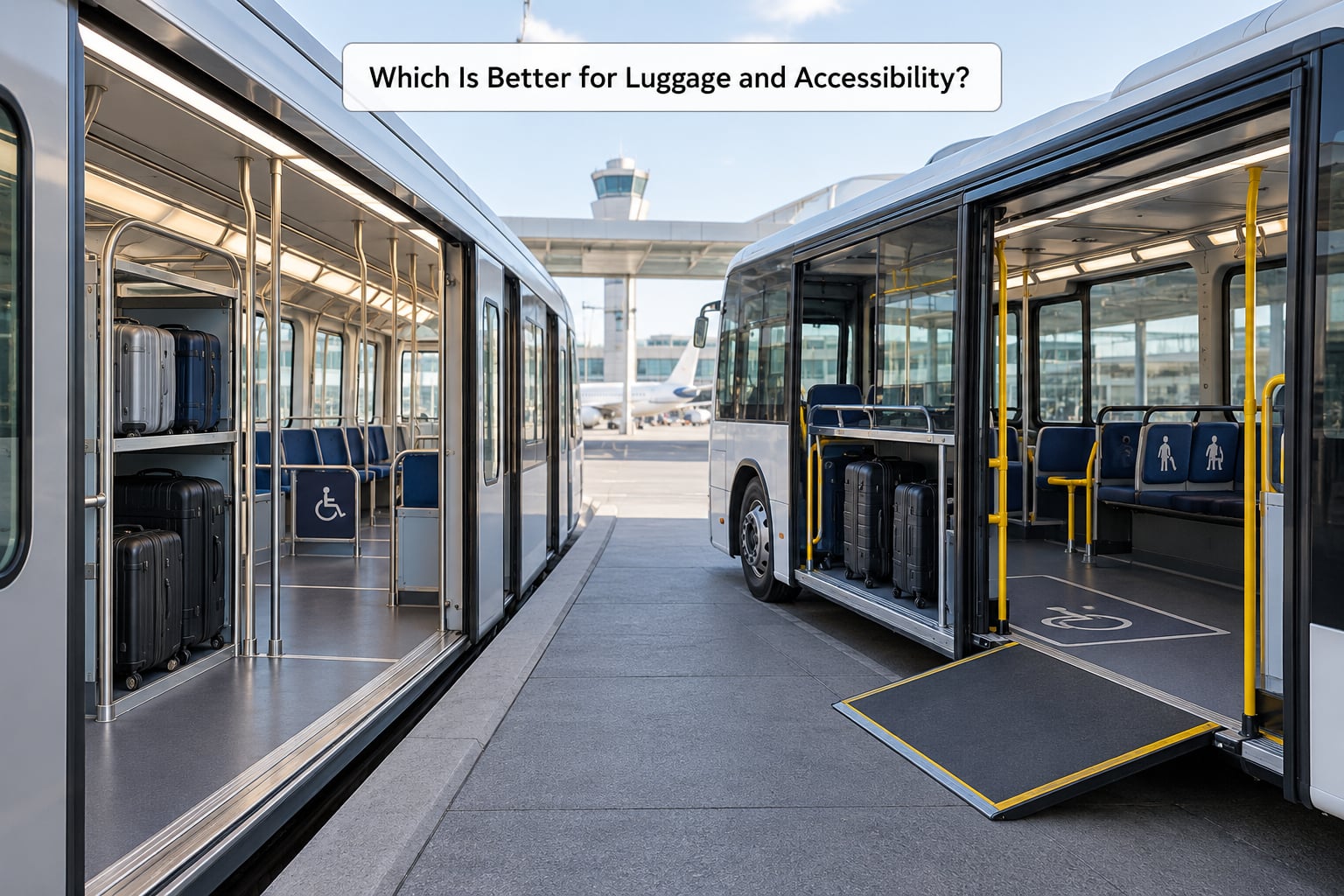
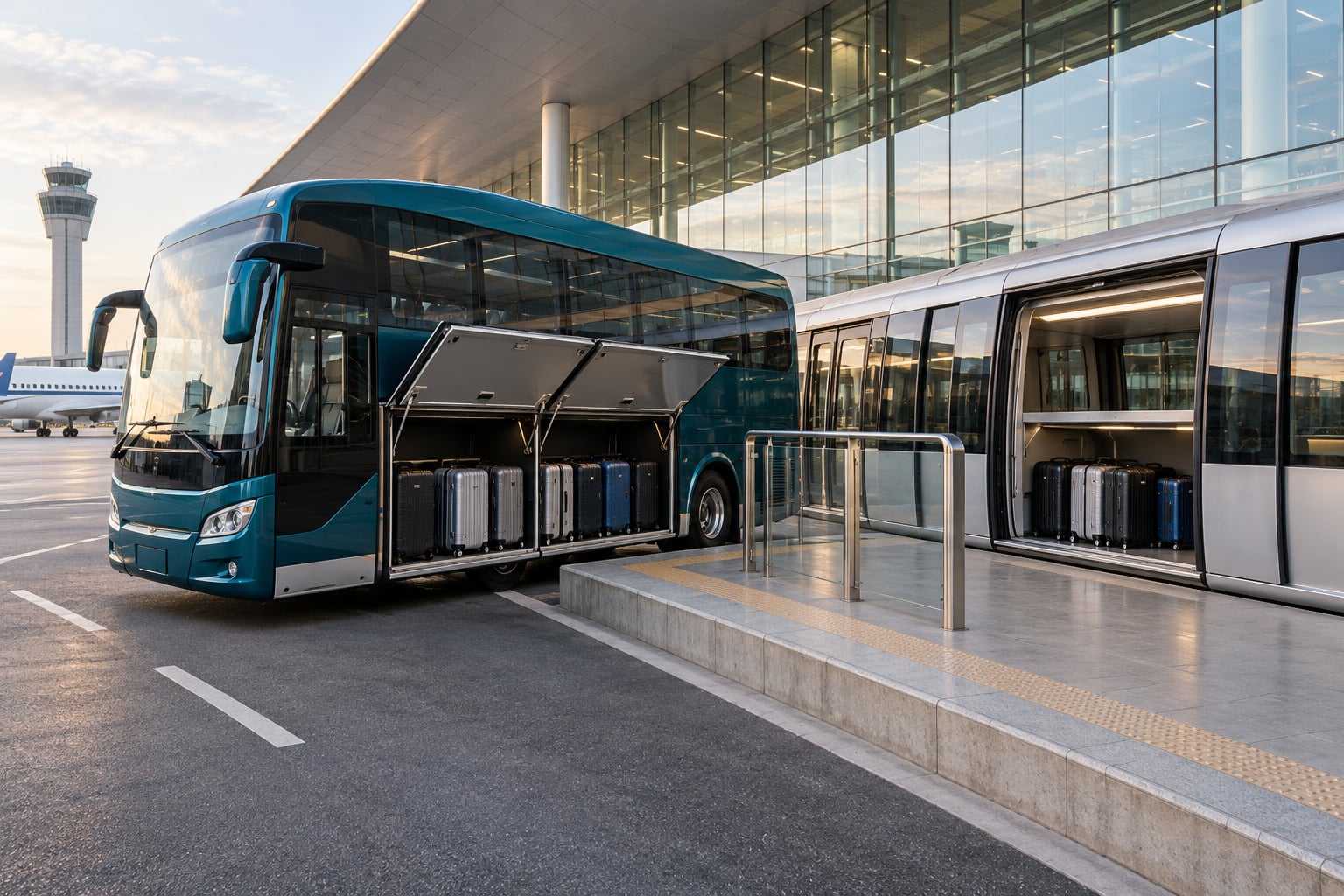
Bus, most of the time. A modern airport coach has a dedicated luggage compartment, low-floor boarding or a lift, wide doors, and no staircases between you and the kerb. That is a real advantage for a family with three suitcases and a pushchair.
Rail wins on ride quality and on space to stand or work, but it loses on the physical journey through the station. Airport stations are deep. Platform gaps, escalators and lifts add minutes to every trip, and lifts fail often enough that a traveller with a wheelchair or heavy bags should build extra time or check step-free access for every station on the route, not just the airport end.
One thing travellers consistently misread: a vehicle can be accessible while its stops are not. A low-floor bus is no help at a stop with a narrow pavement and no raised kerb. Check the accessibility of the airport infrastructure, the stop and the station, because they are separate things.
Which Has Better Route and Schedule Flexibility?
Rail wins on frequency, bus wins on reach. On busy corridors you will find an airport train or shuttle every ten minutes, which effectively removes waiting as a factor. Buses cover far more ground, drop into districts no train serves, and are the only option at many smaller airports.
The fixed timetable is the bus’s weakness and its strength. It means you can plan precisely, and it means a missed departure is a real problem. The number of intermediate stops also decides whether the service feels direct or like a tour of the suburbs.
The single most common piece of traveller anxiety is missing the last service of the night. Look up the final departure time in the airport direction before you fly, and know the first departure in the morning as well, because that gap between them is where hotel rooms get booked by mistake.
Which Is Better for Airport-to-Hotel and City Transfers?
Rail is the right answer in large cities with a central station, because the station sits on the main network and your hotel is usually a metro or tram ride away. It is also the better choice when you are catching an onward long-distance train, since you arrive at the station rather than a car park.
Bus is the better answer for neighbourhoods, small airports and any destination not on the rail spine. It is frequently the only public option, and it often drops you closer to your door than a station does.
Neither suits an airport far from the city with a thin service, a short working day and no night coverage. There, a pre-booked car is the honest recommendation rather than a sales tactic.
One asymmetry worth knowing: the same route feels harder coming in than going out. Arriving tired after a flight, you are less willing to read a map, buy a ticket and find a platform. Departing, you slept near the airport and you planned it. Choose the more complicated option for the departure leg if you can.
Which Should You Choose?
Match the mode to the trip you actually have. These are the calls I make most often.
- Fastest option: the airport express train, when it runs non-stop into a central station and you are not far from that station.
- Lowest-cost option: the local commuter train or bus, priced at the standard transit fare, especially with a day pass or travel card.
- Heavy luggage or a large group: the coach, for luggage space and level boarding, on a direct route.
- Wheelchair or reduced mobility: whichever route has step-free access end to end, verified in advance, including lifts at every station and a kerbside bus stop.
- Travelling with children: the coach if the bags are heavy, the train if the route is short and frequent and you have a pushchair that folds.
- Late-night arrival: neither, if there is no service running. Check the last departure before booking a flight that lands at that hour.
- Early morning flight: the train, because its first departure usually comes earlier and the approach road is empty at that hour anyway.
- Long-distance airport corridor, 30 km or more: the train, where one exists, since road time scales badly with distance.
- Small regional airport with no rail link: the scheduled coach, booked in advance where possible.
Frequently Asked Questions
Can I take a bus or train with oversized luggage?
Usually yes on an airport coach, which has a dedicated compartment built for large bags. On trains, expect overhead racks and vestibule space only, and at peak times they fill quickly. If you are carrying skis, a bicycle, a pushchair or more than one large case, plan for the coach or a pre-booked car instead, and check the operator’s size rules before you fly.
Is an airport bus faster than a train during rush hour?
Rarely in a dense city, because congestion hits the bus and skips the train. The exception is a car-centric city with good arterial roads and few rail links, where a direct bus can beat a two-leg train trip. At a small airport with no rail service, the bus is not competing with a train at all. Check live traffic and departure boards before you commit to either.
Which airport transfer is safer for a late-night arrival?
A train is usually safer than an empty coach at one in the morning, because other passengers are aboard and the driver is stationary. The real risk on either mode is the gap between the stop and your hotel. Mitigate it by checking the last service time before you fly, booking a pre-booked transfer if the night gap is long, sharing your live location, and sitting near the driver.
Do children need separate tickets on airport buses and trains?
It depends on the city, the operator and your child’s age. Many systems charge a reduced child fare, some charge nothing for under-fives, and a few treat a folded pushchair as a separate item. Family tickets and day passes sometimes cover several riders at once. Check the specific operator’s rules before you fly so you are not queuing at the machine with the wrong change.
What should I do if my flight is delayed and public transit has stopped?
Check the operator’s live departures before you leave the terminal, because many night services still run on a reduced timetable. If nothing is running, use the taxi rank or pre-booked car inside the terminal rather than accepting an unofficial ride outside. If the delay means you cannot make the flight, talk to the airline desk immediately, since the last check-in and security cut-off are hard deadlines.
Bottom Line
Run four checks and the answer usually makes itself. Add up the total door-to-door time for both options, including waits and transfers, not just the ride. Add up the total cost, including the local transport you will need at the far end and a taxi fallback if the service has stopped. Look up the last departure of the night in both directions. And check that the route handles your luggage and your mobility.
The mode that wins those four checks is the right one. In dense cities that is usually the train, at smaller and outlying airports usually the coach, and for a late arrival with heavy bags usually a pre-booked car. Whichever you pick, the whole bus vs train for airport transfers question shrinks to two things: know when the last service leaves, and build in enough slack that a delay does not cost you the flight.