How to transfer between buses without paying twice comes down to three things: use the exact same card or phone for every tap, complete the connection inside the transfer window, and make sure the second service is part of the same trip. Most double charges happen because someone switches from a physical card to a phone, or boards outside the time limit.
That sounds simple, but the rules are not identical across cities. New York’s two-hour window is famous, and riders elsewhere assume it applies to them too. It usually does not. What follows covers the general method that works in most bus systems, plus the places where a transfer stops being free.
You can do this in about five minutes of planning before the first bus arrives.
Table of Contents
- What You Need Before You Transfer Between Buses
- Step-by-Step: How to Transfer Between Buses Without Paying Twice
- Step 1: Check Whether Your Fare Includes a Transfer
- Step 2: Verify the Transfer Rules for Both Bus Services
- Step 3: Choose the Right Ticket or Pass to Avoid Paying Twice
- Step 4: Make the Connection Within the Allowed Window
- Step 5: Keep Evidence That the First Fare Was Accepted
- Step 6: Ask the Driver or Staff Before You Pay
- Common Mistakes That Cause a Second Charge
- Frequently Asked Questions
- Can I transfer between any two bus services without paying a second fare?
- How long does a bus transfer usually remain valid?
- Do separate bus operators honour each other’s transfer tickets?
- What should I do if I miss the connecting bus after paying a fare?
- Can a day pass cover multiple bus transfers?
- What proof do I need when boarding the second bus?
- What to Do First
What You Need Before You Transfer Between Buses
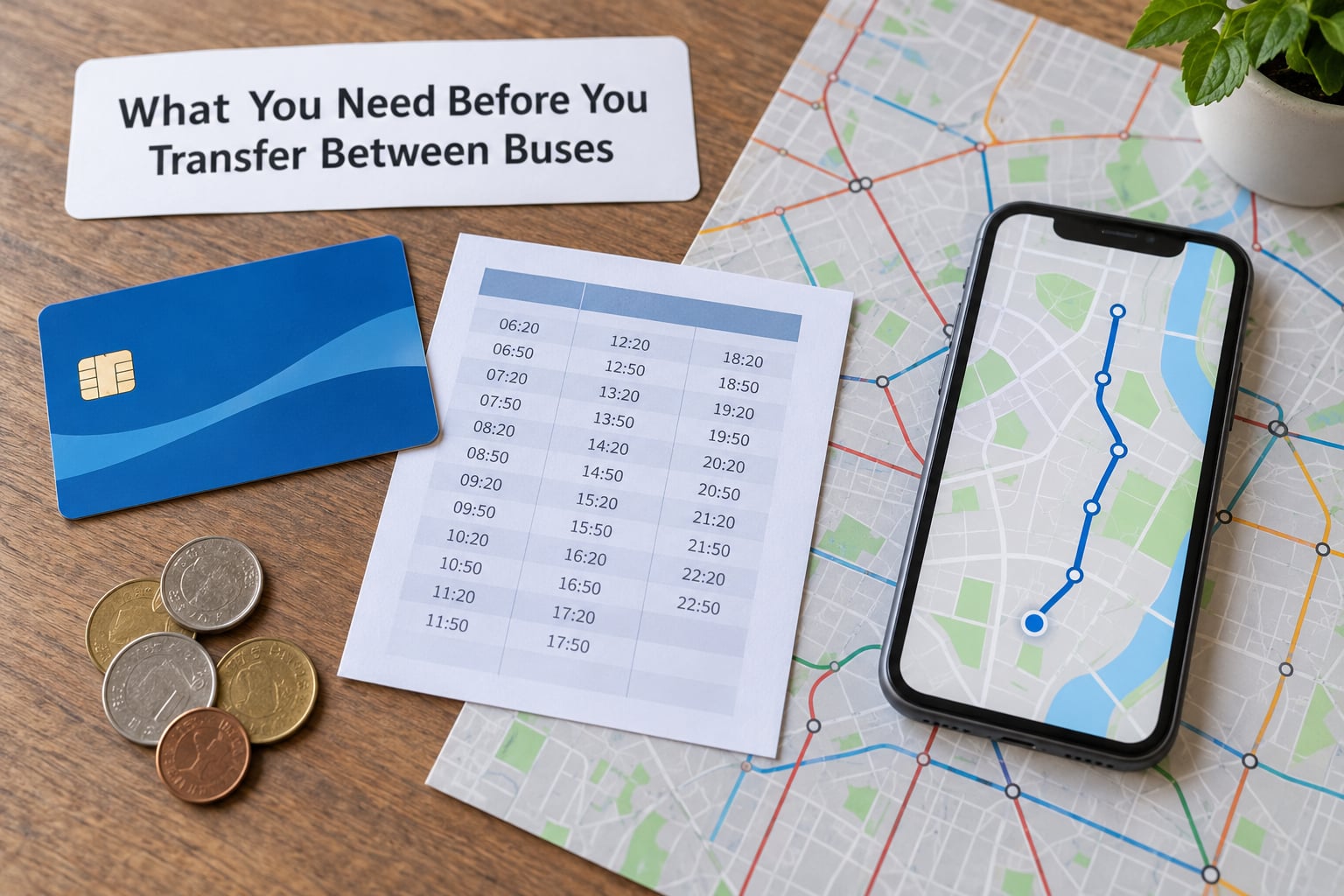
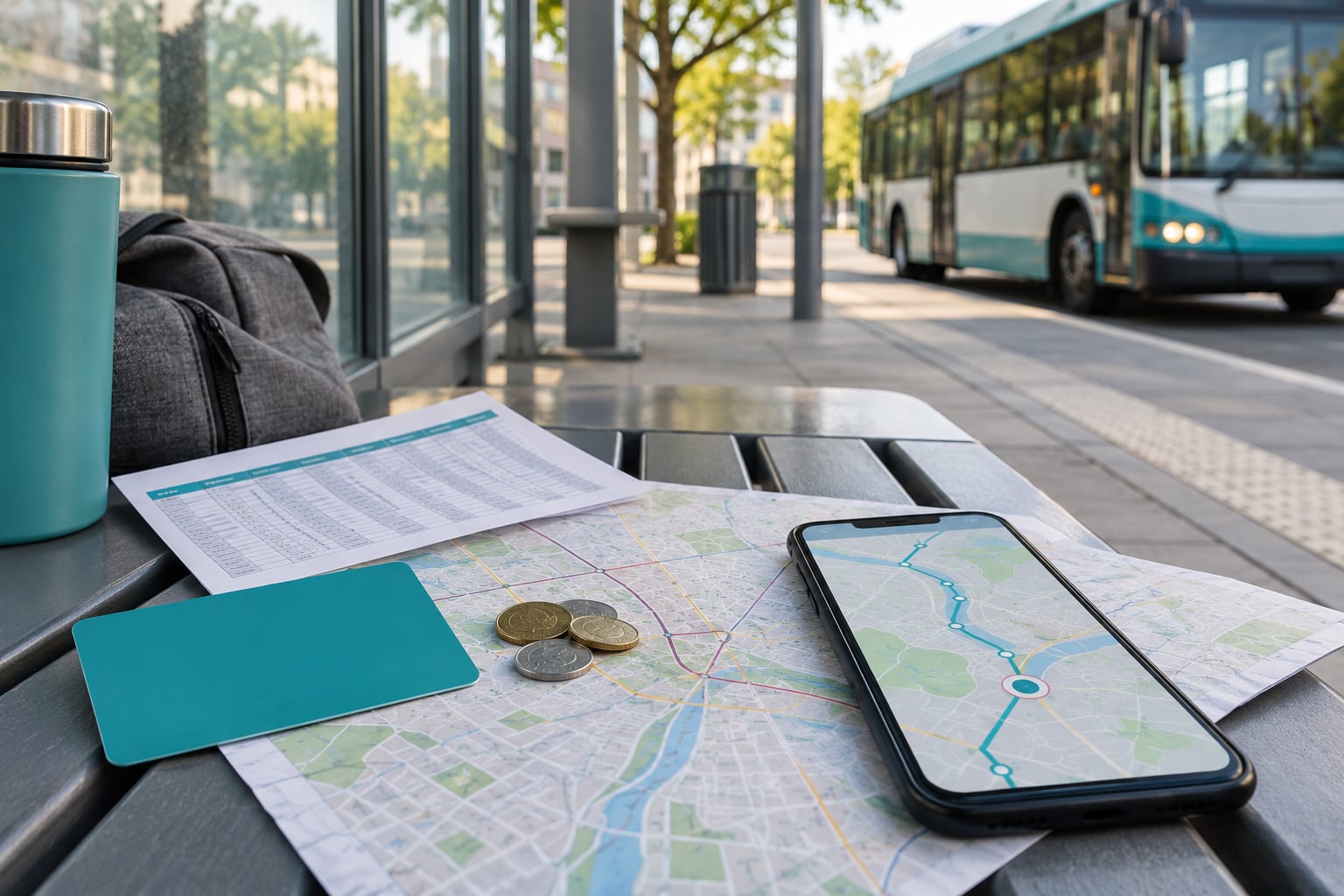
Most of the work happens before you board, not at the interchange.
First, identify the fare product you are already paying for. A single ticket, a day pass, and a weekly cap each treat transfers differently, and a pass often removes the question entirely. Second, find out whether both services belong to the same agency. Transfers are almost always in-system. Cross-operator transfers exist but are the exception, not the rule.
Third, know how your payment method is recorded. Contactless bank cards, transit smartcards, and phone wallets are each logged against a device ID, and the system matches taps on that ID. A printed ticket is handled completely differently, because there is no device to match against.
Finally, look up the connection rather than assuming it. You want the scheduled arrival time of the second bus, the expected walking time between stops or platforms, and whether the second route runs in the direction you actually need.
Step-by-Step: How to Transfer Between Buses Without Paying Twice
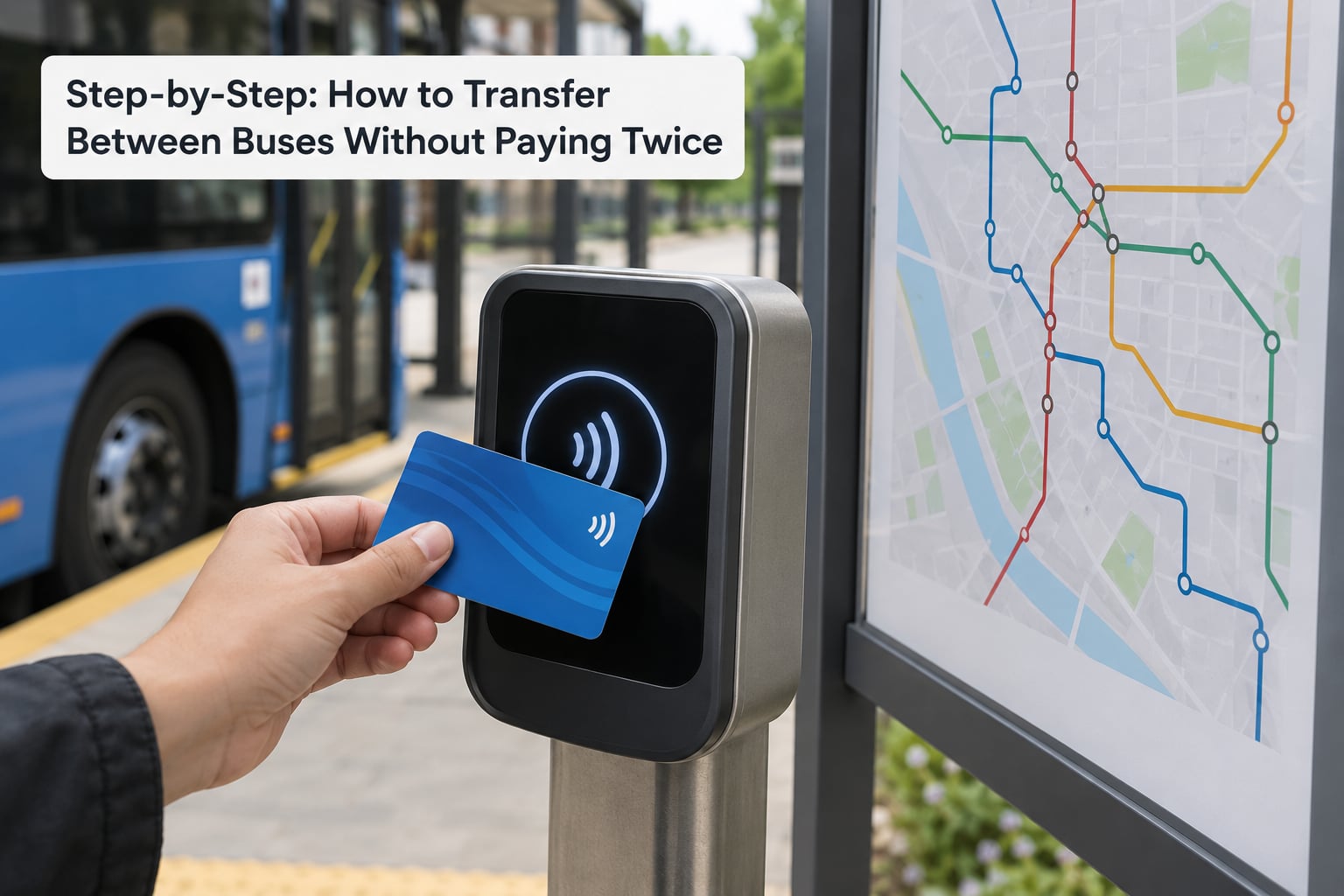
Step 1: Check Whether Your Fare Includes a Transfer
Not every fare includes a second ride. An ordinary single ticket on a city bus usually covers one boarding, and any further ride can be treated as a new fare. Transfer tickets, day passes, and multi-leg tickets are the products built to cover more than one leg.
Check the fare product name on the agency’s own site, not a third-party summary. If it says single, assume a second boarding is charged unless a transfer applies.
Step 2: Verify the Transfer Rules for Both Bus Services
Compare the two operators’ rules before you travel. You need to know whether the connecting routes participate, how long the transfer stays valid, whether the clock starts at your first tap or your first boarding, and whether the transfer has to be in the opposite direction from the leg you paid for.
That last rule catches people constantly. In New York, the agency’s own paper transfer rules state that a transfer is not valid for a return trip on the route you first paid for. A round trip on one route is two fares even if you change buses.
Cross-operator transfers deserve a separate check. Intercity rail tickets are sometimes honoured free on a connecting local bus, but only at listed stations and only with listed agencies, and some programmes exclude specific routes.
Step 3: Choose the Right Ticket or Pass to Avoid Paying Twice
If you expect two or more boardings in a day, a day pass usually costs less than paying the base fare twice and takes the transfer question off the table. A weekly or monthly pass works the same way for regular riders.
Single ticket. One boarding. A second leg is usually charged unless a transfer rule applies.
Transfer ticket. Two legs on participating routes, time-limited, with direction and window conditions.
Day pass. Unlimited boardings in a calendar day, so every transfer is just another ride on the same pass.
Weekly or monthly cap. All boardings inside the period, with transfers absorbed into the cap.
Intercity ticket, one carrier. Both legs of the journey, with reissue or refund handled under that carrier’s policy.
Separate tickets, two carriers. One leg each, with no shared fare. You buy twice by design.
For intercity travel, the deciding question is simple. If both legs are on the same carrier and booked as one itinerary, they normally arrive on a single ticket. If you booked two different carriers, you are buying two tickets and there is no transfer to honour.
Step 4: Make the Connection Within the Allowed Window
Plan against the timetable with a buffer, not against it. A connection that works on paper fails when the first bus runs three minutes late, the stop is a block away, and the connecting service leaves on the minute.
Know the transfer window before you go. Two hours is the figure most people know, and some systems add a small buffer on top, so a limit described elsewhere as two hours and a bit is not a contradiction. Others use a much shorter window, sometimes under an hour, and some have no time limit at all when a pass is involved.
At the stop, confirm direction before you board. Boarding the wrong way costs a full new fare when you turn around, because that is not a transfer.
Step 5: Keep Evidence That the First Fare Was Accepted
With a card or phone, the fare system already holds the record, so evidence is the device itself. Do not remove it from your wallet and do not hand it to a companion, because the next tap has to come from the same device.
With cash or a paper ticket, keep the ticket until you reach your destination or the end of the validity period. Riders on r/mbta describe passback as the way to carry several unpaid fares on one card at once, up to four at a time, which is how a bus-to-subway-to-bus trip works on a single payment.
On mobile, open the ticket before you reach the stop. Screenshots are not accepted as proof on most systems, and a phone with no battery is the most common reason riders end up buying a second fare.
Step 6: Ask the Driver or Staff Before You Pay
A five-second question saves a second fare. Say where you started, which route you paid for, and that you are continuing to a connecting service. Drivers and station staff deal with this constantly and can tell you whether a transfer applies before you hand over anything.
Ask for the specific rule, not for a judgement. “Does my card cover this connection” gets a clear answer. “Am I paying twice” gets a shrug if they cannot see your first tap.
Common Mistakes That Cause a Second Charge
Switching between your card and your phone. The system tracks a device, not a person. Tapping a bank card on the first bus and a phone on the second is two separate payments in its eyes, and this is the most common complaint on transit forums. Fix: pick one device for the whole trip and stick to it.
Assuming every city uses a two-hour window. Riders on enthusiast forums are quick to point out that free transfers are an agency-by-agency policy, not a national standard. Fix: read the local agency’s fare page, not a general travel blog.
Buying a new ticket before checking. Paying first and asking later is a refund conversation instead of a free transfer. Fix: ask at the reader or the driver before you tap.
Overrunning the window. A long lunch stop, a missed connection, or a detour through a construction zone can push the second tap past the limit. Fix: check the clock when you board, not when you arrive.
Taking the same route back. A return leg on the route you first paid for is not a free transfer in several systems. Fix: change routes for the trip back, or buy a return fare and stop expecting coverage.
Trying to pay for a group on one device with a gap. Passback has a short limit on how long you have between taps for the extra riders. Spread out too far and each person becomes a separate fare. Fix: tap back-to-back, not over several minutes.
Assuming an elevator or walkway outage keeps your transfer in-system. When a connection is broken, the walking transfer may no longer qualify. Fix: check service alerts before you commit to the route.
Relying on an expired or wrongly-dated paper ticket. Paper transfers and day passes have their own validity rules and are not always honoured on every bus. Fix: check the date on the ticket before boarding.
Frequently Asked Questions
Can I transfer between any two bus services without paying a second fare?
No. Transfers are almost always limited to routes in the same system, sometimes to a defined set of routes, and they expire after a set window. If the two services belong to separate operators or the second one is outside the participating list, you pay a full new fare. The exception is a formal cross-agency programme, where a rail or coach ticket is honoured free on a listed local bus at listed stations.
How long does a bus transfer usually remain valid?
Most systems give you around two hours from the first tap, and some add a short buffer, so a limit quoted as two hours and a bit is not unusual. A few cities run much shorter windows, and a day or weekly pass removes the time limit entirely because every boarding is already covered. The reliable move is to check the transferring agency’s own fare page, since these windows are set locally and change.
Do separate bus operators honour each other’s transfer tickets?
Only when there is a written agreement between them. A few regional programmes let you present a same-day train or coach ticket to a connecting local bus operator free of charge, and those programmes list participating stations and participating agencies precisely because coverage is narrow. In every other case the two operators share nothing, and a transfer ticket from one is meaningless to the other. Ask the second operator before you rely on it.
What should I do if I miss the connecting bus after paying a fare?
Tell staff or the driver straight away rather than waiting quietly for the next one. On a single intercity ticket, a missed connection is usually handled by the carrier, which may reissue you on the following service or offer a partial refund under its conditions, so contact them the same day and keep your receipt. On a city system, your transfer window may still be running, so keep tapping with the same device until it expires.
Can a day pass cover multiple bus transfers?
Yes, and this is the simplest way to avoid the problem. A day pass covers unlimited boardings in a calendar day on participating services, so every transfer is just another ride on the same pass with no separate fare to negotiate. A weekly or monthly pass works the same way and usually replaces a fare cap entirely. Check which operators and routes the pass covers, because passes are rarely valid on regional or express services.
What proof do I need when boarding the second bus?
With a contactless card or phone, the device is the proof. Tap the exact same one you used on the first bus, because the system matches taps on the device ID and cannot link a card to a phone. With cash or paper, keep the issued ticket until you reach your destination. A screenshot of a mobile ticket is usually not accepted, so open it before you board and keep your phone charged.
What to Do First
Before you board the first bus, pick one payment device and use it for the whole journey.
Then check the transferring agency’s own fare page for the window length and the participating routes, and make sure your connection is in the direction you need. If you expect two or more boardings in a day, a day pass removes the arithmetic entirely. Updated for 2026, since these rules change with every fare restructure and it takes one wrong tap to undo the whole thing.