Hawaii rental car cost runs roughly $60 to $130 a day for an economy or midsize car, or $400 to $900 for a week, before taxes and airport fees land on the bill. The advertised daily rate is rarely what you end up paying. On most islands the tax and fee stack adds 25 to 35 percent on top, and picking up at an airport adds more again.
That gap between the quoted rate and the charged total is where most people lose money, and it is also where the savings are. Rates move weekly in Hawaii, sometimes by 50 percent in a single week, so the booking you make today is a starting point rather than a final answer.
Prices last checked 3 October 2026. Hawaii rental rates move weekly and change with season, island and booking date, so treat every number here as a realistic range rather than a quote.
Table of Contents
- Hawaii Rental Car Cost and How to Save at a Glance
- What Does a Hawaii Rental Car Cost Once Everything Is Added?
- How Much Do Hawaii Rental Cars Cost by Island?
- What Affects the Price?
- Ways to Save on a Hawaii Rental Car
- How to Save Money on Your Hawaii Rental Car: The Booking Checklist
- Frequently Asked Questions
- Do you need a rental car on every Hawaiian island?
- Is it cheaper to rent a car at the airport or in town in Hawaii?
- What taxes and fees get added to a Hawaii rental car?
- Do I need rental car insurance in Hawaii?
- Is a week-long rental cheaper than two shorter ones in Hawaii?
- Why are Hawaii rental car prices so high right now?
Hawaii Rental Car Cost and How to Save at a Glance
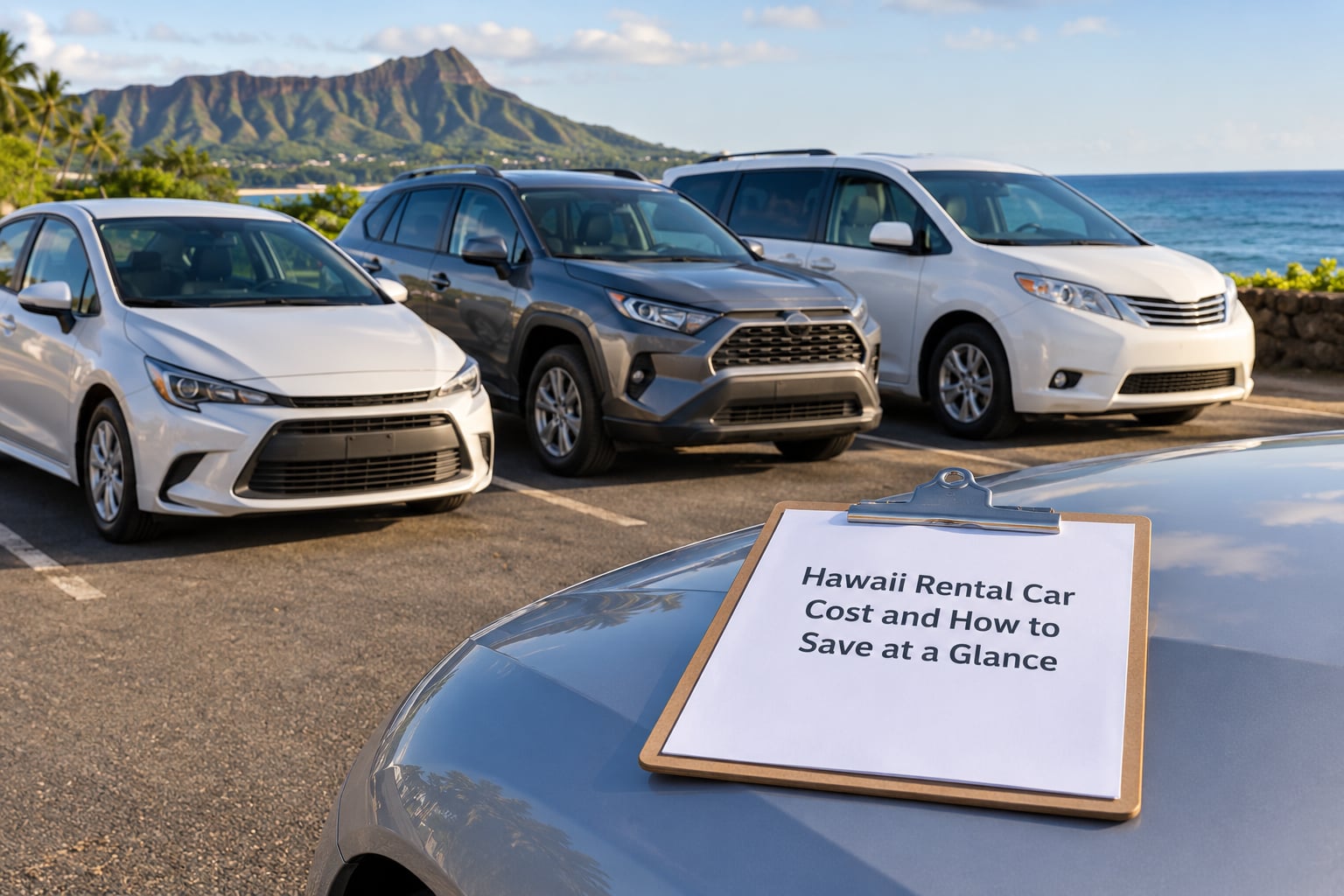
These are typical US ranges for a Hawaii rental car. The economy and compact classes are plentiful and price well; SUVs and convertibles carry a premium that widens in peak season.
| Vehicle class | Typical daily rate | Typical weekly rate | Who actually needs it |
|---|---|---|---|
| Economy or compact | $55 to $95 | $350 to $600 | Solo or couple staying in one town, mostly short trips |
| Midsize sedan | $75 to $130 | $470 to $850 | Comfortable default for a full-island loop |
| Compact SUV | $90 to $160 | $560 to $1,050 | Extra luggage space, longer circuits, uneven resort roads |
| Full-size SUV | $130 to $230 | $850 to $1,450 | Three or four adults with real luggage volume |
| Minivan (7 seat) | $140 to $250 | $900 to $1,600 | Families and groups splitting one vehicle |
| Convertible or Jeep | $150 to $300 | $1,000 to $1,900 | Leisure trips where the drive is the point |
For scale, tracked week-long pricing at Kahului in March 2026 put the cheapest economy rental around $905 all-in and a seven-seat SUV near $1,951, while the cheapest Honolulu week for the same period was about $268. That spread is the single most useful thing to understand about Hawaii rental car cost.
What Does a Hawaii Rental Car Cost Once Everything Is Added?
The final bill is a stack of separate lines, and each one is charged on the base rate. Here is what sits underneath the number you see in a search result.
- Base rental rate. The per-day or per-week figure, sometimes discounted heavily for a long booking.
- Hawaii sales tax. 4.712 percent, applied to the rental.
- General excise tax on car rentals. A separate state tax applied specifically to vehicle rentals, and one of the largest single additions to your total.
- Airport concession recovery and facility charge. Only if you pick up at an airport. The customer facility charge pays for the consolidated rental car facility and shuttles at Honolulu, Kahului, Lihue and the Kona airports.
- Damage waiver. Optional, and priced per day. It is the biggest discretionary line at the counter.
- Fuel. Either you refill and pay market rate, or you accept the refuelling service at a marked-up price.
- Additional driver. Often $10 to $15 per day, though several major programs include a free second driver.
- Parking. Not on the rental invoice, but a real trip cost in Waikiki, Honolulu and resort areas.
So a week advertised at $500 can bill $650 to $700 all-in, and a week advertised at $700 can land above $900. Forum readers report exactly this: one two-week rental quoted around $490 turned into $808 after taxes and fees, and another saw a plan pushed toward $2,000 for the car alone before a single day of parking.
How Much Do Hawaii Rental Cars Cost by Island?
Oahu and Honolulu are usually the cheapest per day, partly because Honolulu is the largest fleet base in the state and partly because there is far more off-airport supply. A cheap rate on the airport side can be around $30 a day for a base model, which is roughly a third of what a nearby resort counter asks for the same car.
Maui and the Big Island usually run highest. Maui sits behind the consolidated rental car facility at Kahului, so every airport pickup passes through a single building with a smaller effective fleet and a shuttle wait. The Big Island has two separate airports with thinner inventory, and Kona in particular has been reported averaging well above $100 a day, which at times makes it the most expensive airport rental market in the country.
Kauai lands in the middle. Lihue is small, so off-airport supply exists but not a lot, and one documented case showed a 21-day Kauai compact at roughly $1,800 with airport pickup and return versus about $1,080 at a town location a short taxi ride away. Same car, same dates, same island, a difference of more than $700.
The ranking shifts by week, though, so do not plan an itinerary around a static island price order. What you can rely on: airport pickup on any island is more expensive than a town pickup, and the gap is largest where the island has a consolidated airport facility.
What Affects the Price?
Ten variables move a Hawaii quote more than the vehicle class does. Read them in this order.
- Travel dates. Spring break weeks, the Christmas and New Year stretch, and the July Fourth period carry the highest rates of the year. Weekday-to-weekday bookings are cheaper than a Friday-to-Friday one.
- Rental length. Weekly rates usually undercut daily rates, and there is a standard 28-day billing cycle. Bookings long enough to trigger per-diem billing work differently from a normal week.
- Vehicle class. An SUV can cost two to three times an economy car for the same week, and the gap is widest in spring break weeks and over the holidays.
- Transmission. Automatic is standard and effectively the only realistic option for most visitors.
- Pickup location. Airport versus town versus hotel delivery. This is often worth more than any other choice on the list.
- Insurance choices. A damage waiver added at the counter adds more per day than the base rate difference between a compact and a midsize.
- Driver age. Under-25 surcharges in Hawaii run around $25 to $35 a day, which turns a week-long booking for a family of four into a four-figure line item.
- Fuel policy. Prepaid fuel removes the risk of a high refuelling charge but usually costs more per gallon than the pump.
- Payment terms. Pay-later rates cost more per day than prepaid rates but keep the flexibility that makes rebooking work.
- Booking lead time. Peak dates close months ahead in peak season. Shoulder weeks can still be found inside two weeks.
Compare the total after fees, never the advertised daily rate. Two quotes that look identical in a search result can differ by several hundred dollars once the airport facility charge and the excise tax are on both.
Ways to Save on a Hawaii Rental Car
Each of these has a trade-off, and the honest version is below.
- Book early for peak travel, later for shoulder weeks. Locking in holiday and spring break dates months ahead is the reliable saving. For a September week, waiting two to three weeks often finds the same car cheaper.
- Pick up in town instead of at the airport. The single biggest saving available. One documented Kauai booking saved more than $700 this way. The trade-off is a $20 taxi ride and possibly an extra day of hotel parking before you collect the car.
- Reserve a cancellable rate, then rebook as prices move. Book the replacement first, then cancel the old reservation. One reader cut a Maui booking from about $100 a day to about $38 by rebooking the day before pickup.
- Check more than one booking channel. Costco Travel, AutoSlash, a discount broker and the rental company direct each win different trips, so no single source is reliably cheapest. One Kauai reader saved $486.81 on a ten-day booking by re-reserving through Costco; another saved $300 rebooking the same Maui trip six times in three days.
- Reserve the smallest car that fits. Economy and compact cars have the deepest supply and the flattest price curve. Choose a larger vehicle only when luggage volume genuinely requires it.
- Check your credit card coverage before the counter. Many cards cover damage to the rental as a secondary benefit when you pay with that card and decline the rental company’s waiver. Read the exclusions for vehicle type and rental length before you rely on it.
- Decline the counter extras you will not use. GPS units, satellite radio, toll transponders and child seats are all priced well above retail. Your phone already does navigation and mapping.
- Look for a free second driver. A second driver is usually $10 to $15 a day, and some programs include one free. That matters if you are splitting pickup and drop-off on a two-island itinerary.
- Split a long rental into two short bookings. One reader picking up after the New Year holiday instead of a couple of days before it cut a two-week rate by about 40 percent. The trade-off is two counter queues and the risk of the exact car not being available the second time.
- Refill it yourself. The optional refuelling service is marked up above the pump price, and Hawaii gas stations are full-service, which makes refilling a little slower but not difficult.
- Budget for parking, and pick a hotel with it. In Waikiki and Honolulu, daily parking can exceed the cost of a cheap rental on its own. A resort fee that includes parking quietly beats renting a car you mostly leave in a garage.
- Read the unpaved road clause. Rental agreements in Hawaii are void on unpaved roads. Taking a standard sedan down an unpaved stretch to a waterfall or a beach can void the agreement entirely, so no amount of careful driving protects you.
- Photograph the vehicle at pickup and at return. Damage and cleaning charges are assessed after you leave the lot. Timestamp photos are the fastest way to dispute one.
- Watch the 90-day rule for foreign licences. Visitors on a non-US licence are generally permitted to drive for up to 90 days. An international driving permit is a translation document, not a licence, and long-stay visitors should confirm requirements before arrival.
How to Save Money on Your Hawaii Rental Car: The Booking Checklist
Run through this before you confirm anything, and you will catch most of the avoidable cost.
- Compare the final total after taxes and fees, not the daily rate.
- Check whether the rate is prepaid or pay-later, and how free cancellation works.
- Compare airport pickup against a town location for your exact dates.
- Confirm the mileage allowance, and whether it is unlimited.
- Read the fuel policy and the price you pay for a refill.
- Check whether your credit card or personal auto policy covers damage, and what it excludes.
- Add up the daily driver age surcharge and additional driver fees before you book.
- Measure your luggage against the vehicle’s cargo space, not its passenger rating.
- Confirm the car will actually be available at your pickup location and time.
- Check the airport facility and concession fees separately if you are picking up at HNL, OGG, LIH or KOA.
- Check cancellation deadlines and no-show penalties.
Frequently Asked Questions
Do you need a rental car on every Hawaiian island?
No. Honolulu and Waikiki are well served by TheBus, hotel shuttles and rideshare, and a compact rental often costs less than parking alone in those areas. A car earns its keep when your itinerary reaches places transit does not, such as the Road to Hana, Haleakala sunrise, Waimea Canyon, Volcanoes National Park, or any island loop with more than two stops. Rent for the days you drive, not automatically for the whole stay.
Is it cheaper to rent a car at the airport or in town in Hawaii?
Town is usually cheaper. Airport pickup adds a concession recovery fee and a customer facility charge that pay for the consolidated rental buildings and shuttles, and one documented Kauai booking came to roughly $1,800 at the airport versus $1,080 at a nearby town location for the same car and dates. The trade-off is a taxi or shuttle ride out to town, and occasionally thinner availability during peak weeks.
What taxes and fees get added to a Hawaii rental car?
Expect Hawaii sales tax of 4.712 percent, a separate general excise tax applied specifically to car rentals, and, if you pick up at the airport, a concession recovery fee and a customer facility charge. On top of that sit your optional choices: the damage waiver, additional drivers, refuelling service and toll transponders. Together the tax and fee stack commonly adds 25 to 35 percent to the advertised daily rate.
Do I need rental car insurance in Hawaii?
It depends on what you already have. Many US credit cards cover damage to a rental car as a secondary benefit when you pay with that card and decline the rental company’s waiver, though exclusions for vehicle type and rental length are common. A personal auto policy may extend to rentals as well. Check both before you reach the counter, because the counter damage waiver is priced per day and is the largest discretionary line on the bill.
Is a week-long rental cheaper than two shorter ones in Hawaii?
A single week-long booking is normally cheaper than splitting the same dates into two reservations, because weekly rates undercut daily rates. The exception is holiday pricing, where starting a couple of days after the New Year cut one reader’s two-week rate by roughly 40 percent. That trick works because of how demand spikes, not because shorter is structurally cheaper, so it only pays off around a demand peak.
Why are Hawaii rental car prices so high right now?
Supply is the main reason. Hawaii runs a small fleet relative to demand, and every airport rental at Honolulu, Kahului, Lihue and Kona passes through a consolidated facility with a shuttle wait. Smaller effective fleets mean fewer cars available on any given day, which pushes prices up quickly when a holiday or spring break week fills. Island and airport demand also shifts week to week, so prices can move sharply between two searches a week apart.
If you do one thing, price the same dates at a town location instead of the airport before you book anything. It is the largest saving available, it takes five minutes to check, and it costs you a taxi ride rather than a mistake. After that, reserve a cancellable rate and rebook once more as the date gets close. Hawaii rental car cost is negotiable in the same way any last-minute travel price is, as long as you keep the flexibility to move.