To find a vacation rental with a kitchen, stop searching for the word “kitchen” and start filtering with it. Most listings use that label for a two-burner cooktop and a microwave, so the real work is setting the appliance filter, then reading the amenity list literally and asking the host what is actually in the cupboards before you pay.
That approach takes about twenty minutes of filtering plus one message to the host, and it is the difference between a rental you can cook a week of meals in and one that only heats up soup. Below is the process I use, in the order I use it.
Table of Contents
- What You Need
- How to Find a Vacation Rental with a Kitchen: Step-by-Step
- Set the Search Criteria
- Use Kitchen and Appliance Filters
- Verify the Kitchen Before Booking
- Compare Cost, Location, and Convenience
- Make the Booking Decision
- Common Mistakes
- Frequently Asked Questions
- What is the difference between a full kitchen and a kitchenette?
- How can I confirm that a vacation rental really has a kitchen?
- Are vacation rentals with kitchens cheaper than hotels?
- What kitchen appliances should I look for when booking a rental?
- How do I find a vacation rental with a kitchen near groceries in Hawaii?
- Can I cook meals in a vacation rental with a kitchenette?
- Conclusion
What You Need
Five inputs decide which listings are worth your time. Gather them before you open any booking site, because they determine which filters you set and which listings you can rule out in seconds.
Dates and length of stay. A kitchenette survives one or two nights. A full-size refrigerator and a dishwasher only start paying for themselves around five nights, so the length of your trip sets the bar for what counts as adequate.
Party size and who actually cooks. Six adults sharing a rental need a different kitchen than a couple. Tallying chairs at a table and usable burners is more useful than the property type on the listing title.
Your cooking level. Light meals, regular weeknight cooking, and baking a birthday cake are three different requirements, and only the third one needs a proper oven and a mixer-sized counter.
Real budget, fees included. Before comparing anything, note the cleaning fee, the extra-guest fee, any pet fee, parking, and linen charges. Those sit on top of the nightly rate, and they can eat the food savings you were counting on.
Grocery access. Know what is within a short drive or walk of the property. A full kitchen twenty minutes from the nearest supermarket is a different proposition from one across the street from a market.
How to Find a Vacation Rental with a Kitchen: Step-by-Step
Filtering beats searching because amenity filters are written by the platform, not by the person selling the room. Set the kitchen and appliance filters inside a booking platform, read the resulting amenity list word for word to tell a full kitchen from a kitchenette, match the kitchen to your group size, then send the host a written list of verification questions before any money changes hands.
- Set the stay length, destination and party size as fixed criteria.
- Choose your minimum acceptable kitchen based on how much you plan to cook.
- Run the same search on two or three platforms and apply the kitchen and appliance filters on each.
- Read every amenity label literally instead of trusting the title or the photos.
- Search the reviews for the word “kitchen” and read what guests say about the equipment.
- Compare the full cost, the neighborhood, and grocery access rather than the nightly rate alone.
- Message the host with your verification questions and keep the written answer as your record.
Set the Search Criteria
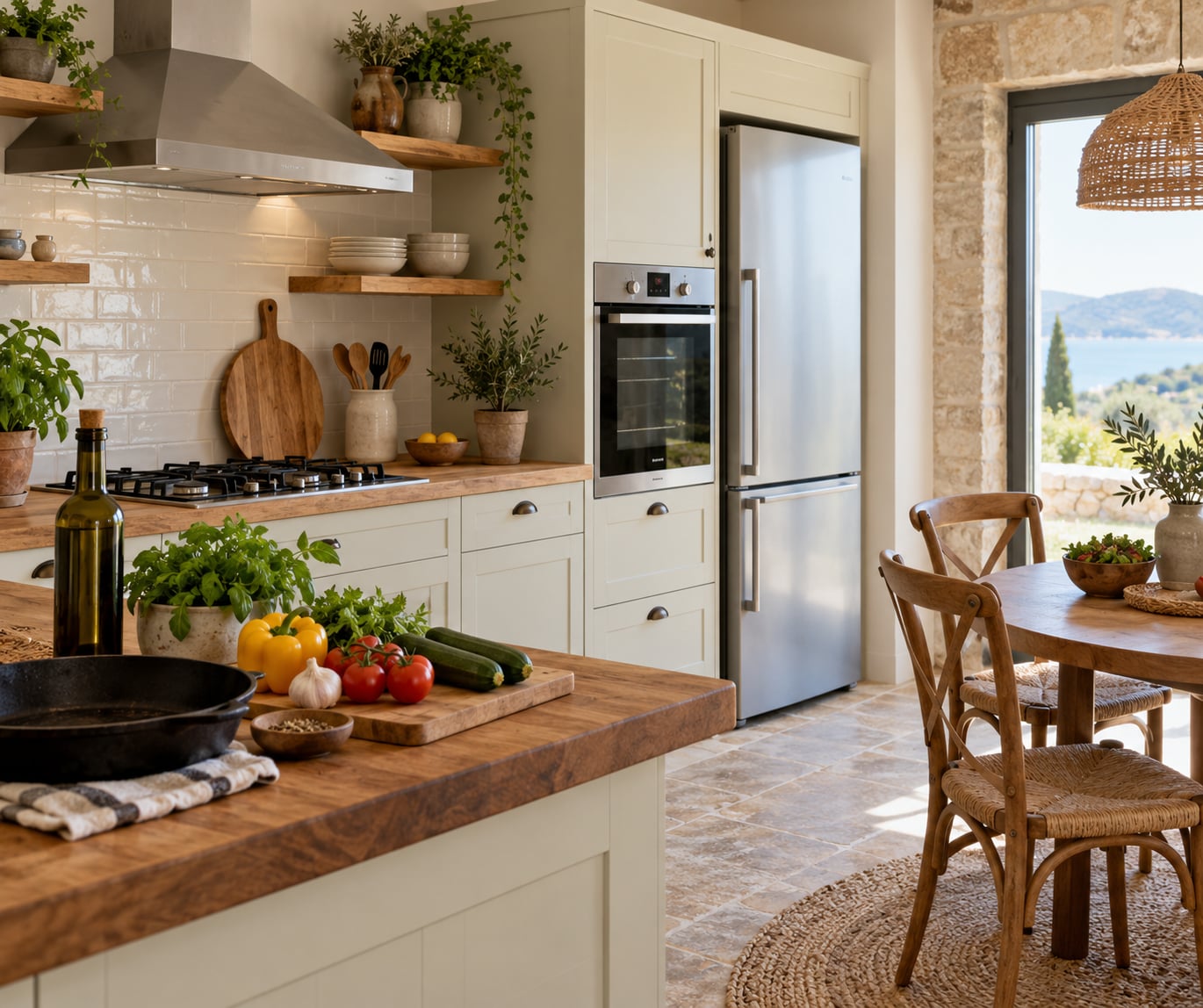
Start by writing your minimum acceptable kitchen on paper, because the words in a listing are not a specification. For most trips that means a refrigerator with real shelf space, a cooktop with more than two burners, a real oven, a sink, and counter space you can work on with the fridge door open.
Then check that the kitchen is sized to your group. The pattern I see is that home size predicts kitchen size far more reliably than the listing title does, so a studio will usually mean a kitchenette and a three-bedroom house will usually mean a proper room you can cook in with company around the island.
| Feature | Full kitchen | Kitchenette | Kitchenette-only listing |
|---|---|---|---|
| Cooktop | Four burners or more | Two burners | Two hot plates, sometimes none |
| Oven | Separate built-in or under-counter oven | Often none, sometimes a small one | None |
| Refrigerator | Full-size with a freezer | Mini or under-counter | Mini fridge for drinks |
| Dishwasher | Common in larger homes | Rare | None |
| Cookware and dishes | Pots, pans, dishes, cutlery, glassware for the group | A frying pan, a few plates | Sometimes nothing at all |
| Counter space | Enough to prep with the door open | A narrow run | A single counter |
| Dining space | Table and chairs for the group | Bar seating or a small table | Nowhere in the unit |
| Best suited to | Five nights or longer, families, groups, restricted diets | A weekend of simple breakfasts and one pan dinner | One or two nights where you eat out anyway |
Two words worth searching in addition to “kitchen”: self-catering, which is the term European and UK listings use for the same thing, and fully equipped, which usually signals that cookware and dishes are supplied. Neither word guarantees anything on its own.
Use Kitchen and Appliance Filters
The useful filters live inside each platform rather than in a search engine, and they differ by name. The general pattern is the same everywhere: open the filters panel on the search results page, open the amenities or facilities section, and tick the kitchen-related entries rather than typing keywords.
On Airbnb, the filter sits under the amenities list on the left of the results page, where “Kitchen” and “Cooking basics” appear as tickable entries. Because guests filter on the same list you are reading, it is the closest thing to an authoritative description of what is in the unit.
On Vrbo, kitchens are part of the standard property-type filters, so narrowing to houses, condos and apartments rather than hotel rooms gets you most of the way there. The dedicated kitchen landing page on the site is a browsing shortcut, not a filter, which is worth knowing before you rely on it.
On Booking.com, look under the facilities section for kitchen and cooking equipment, and tick the hob and oven entries if the site offers them separately. Booking.com also mixes privately owned rentals with hotel inventory, so a kitchenette labelled “kitchenette” is common there.
Google Vacation Rentals and Vacation Rentals by Owner are worth a pass mainly because the same property sometimes appears at a different total cost on a second channel, which travelers have reported repeatedly. Run your search in two places before you commit.
A few search phrases surface better listings than the word kitchen on its own: full kitchen, self-catering, chef’s kitchen, house with kitchen, and, for larger homes, penthouse or houseboat. A listing that calls itself a penthouse with a chef’s kitchen is telling you what it wants to be booked as.
Verify the Kitchen Before Booking
This is the step that saves the trip. Listing photos are staged, and a single wide shot of a kitchen regularly hides a two-burner cooktop and no oven at all. Open the photo set and look specifically for the cooktop, the oven, and the interior of the refrigerator.
Next, search the reviews for “kitchen” and read the sentences around each hit. Guests are specific in a way listings are not. They will tell you the fridge was tiny, the oven took four hours to reach temperature, the coffee maker was missing, the pans were scratched, or the dishwasher worked fine, which are exactly the details you need.
Weight recent reviews more heavily, since appliances get replaced and hosts change what they stock.
Then message the host. Hosts on rental forums say plainly that guests should just ask, and the reply itself is a trust signal. A fast, specific answer means an attended property. A template reply that never mentions an appliance means you will find out on arrival.
Hosts mention the amenities list as the reference point for what a property provides, which is worth remembering: if an appliance is not in the published list, assume it is not there. The message below is the one I send, and you can paste it as-is.
Hello, we are interested in [dates] for [number] guests and we plan to cook most meals in. Could you confirm a few things?
1. Is there a full-size refrigerator with a freezer, or a mini fridge?
2. How many burners does the cooktop have?
3. Is there a separate oven, and is it a wall oven or under-counter?
4. Is there a dishwasher?
5. What cookware is provided: frying pans, saucepans, a baking dish?
6. Are dishes, cutlery and glassware provided for six people?
7. Are knives, cutting boards, a peeler or a can opener provided?
8. Is there a coffee maker, a kettle, a toaster or a blender?
9. Is there dish soap, sponge, paper towels and trash bags?
10. Is there a table and enough chairs for everyone to eat at once?
11. How far is the nearest grocery store, and is there a market closer than that?
12. Is there a grill or outdoor cooking area?
For anyone with a food allergy, add two questions: whether the previous guests cooked there regularly, and whether the pans and utensils are shared across a cooktop with no separate preparation area. Hosts answer these honestly, and the answer tells you whether you are cooking safely there or not.
Then pack the gaps. Guests report arriving to missing knives, cutting boards, decent frying pans, spices, oil, coffee, dish soap, paper towels, ice bags and trash bags. A short list of your own removes the argument entirely.
Compare Cost, Location, and Convenience
A kitchen has a running cost that a nightly rate does not show: the groceries you buy, the cleaning fee, the extra-guest fee if the host caps occupancy below your group, parking, and the linen charge. Add those before deciding, because a rental with a kitchen can cost more than a hotel room with breakfast once the fees land.
Cooking in does replace some restaurant meals, but not all of them. A realistic week for a family of four saves most on breakfasts, lunches, and the one or two dinners you actually cook, and saves nothing on the evening you walk to a dock and eat what the day produced. Judge the kitchen on the meals you will genuinely make.
Location matters more with a kitchen than without one. Check what is within walking distance: a supermarket, a market, a late-opening store, a pharmacy. Check parking, because a full refrigerator and a car full of shopping bags are not a good combination. Check transit if you plan to cook on weekdays, since evening buses get sparse outside city centres.
On neighborhood safety, read recent reviews rather than the listing copy, and look for comments about the walk to the car and the street after dark. That is usually more informative than anything in the description.
One practical comparison I do before booking is the same listing on a second channel. The property, the kitchen, and the photos are identical, and the total can differ because of how each platform handles fees and long-stay discounts. For stays of a week or more, ask about a weekly rate directly; many hosts will not advertise one.
Make the Booking Decision
You are ready when three things line up: the amenity list literally names the appliances you need, the reviews describe that kitchen without a complaint you cannot live with, and the host has answered your questions in writing.
Keep the host’s reply. If the property later shows a missing oven or a broken dishwasher, you have a record of what was promised, and both platforms have a resolution process for listing accuracy that you cannot start without it.
One more habit: re-run the search the week you book. Hosts add and remove appliances between seasons, and platform filter menus get renamed often, so the label you learned this year may sit somewhere else next year.
Some trips are not worth filtering at all. One or two nights in a city centre, an all-inclusive resort where food is already included, a remote cabin with no shop within an hour, or a stay where you genuinely want to eat out every evening. In those cases a serviced apartment, an aparthotel, an extended stay hotel or a residence inn gives you a kitchenette without the cleaning fee and the long minimum stay.
Common Mistakes
Treating the word “kitchen” as a specification. It is a marketing label, not an inventory. Fix: read the amenity list item by item and look for appliance names, not adjectives.
Assuming a kitchenette is a full kitchen. A two-burner top, a microwave and a mini fridge will not feed four people for a week. Fix: match the kitchen to your stay length, and call anything without an oven a kitchenette.
Booking a week-long stay on a mini fridge. You will do a grocery run every second day. Fix: require a full-size refrigerator with a freezer for five nights or more.
Trusting one staged wide photo. A single wide shot of a kitchen hides a lot. Fix: look for a separate close-up of the cooktop and the open oven door.
Not counting seats. A kitchen can be excellent and still have one bar stool for six adults. Fix: ask how many chairs there are, and include a table in your must-have list.
Comparing nightly rates and ignoring fees. Cleaning, extra-guest, pet, parking and linen charges can cancel out the food savings entirely. Fix: compare the total for your exact dates and guest count, on two channels.
Assuming the cookware is good. Scratched pans, one mismatched pot, no lids, no colander. Fix: ask the direct question, and bring a small kit if the answer is vague.
Booking before checking grocery access. A full kitchen with no shop nearby is a worse outcome than a modest kitchen two minutes from a market. Fix: ask the host for the nearest grocery store and the nearest market, and check the map yourself.
Frequently Asked Questions
What is the difference between a full kitchen and a kitchenette?
A full kitchen has a refrigerator with a freezer, a cooktop with more than two burners, a separate oven, a sink, real counter space, and cookware and dishes for the number of guests. A kitchenette is a compact run with a two-burner cooktop, a microwave and often a mini fridge, with no oven and little counter space. A kitchenette suits a weekend of simple meals; a full kitchen suits a week of normal cooking.
How can I confirm that a vacation rental really has a kitchen?
Read the amenity list literally and look for named appliances rather than the word kitchen. Then check the photos for a close-up of the cooktop and the open oven door, search the reviews for the word kitchen, and message the host with a written list of questions. Keep the reply, because it is your record of what the property claimed before you paid.
Are vacation rentals with kitchens cheaper than hotels?
Sometimes, but only for stays of about five nights or more, and only after you add every fee. Grocery spending replaces some restaurant meals rather than all of them, and the cleaning fee, extra-guest fee, parking and linen charges add up fast. Compare the total for your exact dates on two booking channels, then judge the kitchen on the meals you will genuinely cook.
What kitchen appliances should I look for when booking a rental?
Prioritise in this order: a full-size refrigerator with a freezer, a cooktop with more than two burners, a separate oven, a sink with counter space around it, and a dishwasher for long stays. Then check for a coffee maker, a kettle, a toaster and a blender if you need them. Cookware, dishes, cutlery and glassware matter as much as appliances for a week-long stay.
How do I find a vacation rental with a kitchen near groceries in Hawaii?
Filter for a full kitchen first, then check grocery access in the map view and in the reviews, since island addresses can look close and drive for an hour. Ask the host for the nearest supermarket and the nearest market, and ask about weekly versus daily shopping. Longer stays make the difference enormous, because shipping and repeat trips cost far more than the rent of a stocked kitchen.
Can I cook meals in a vacation rental with a kitchenette?
Yes, with limits. A two-burner cooktop handles omelettes, pasta, one pan dinners and reheating, and a microwave covers the rest. Plan one cooked meal a day rather than three, expect no baking without an oven, and bring a small kit of your own. A kitchenette is a reasonable choice for two or three nights and a poor one for a week.
Conclusion
Write down the kitchen features you cannot do without, set the appliance filters on two or three booking platforms, read the amenity lists literally, and get the host’s answers in writing before you pay. Filtering finds the candidates, and only the written confirmation tells you which one actually has an oven, a real refrigerator, and somewhere to sit down and eat.