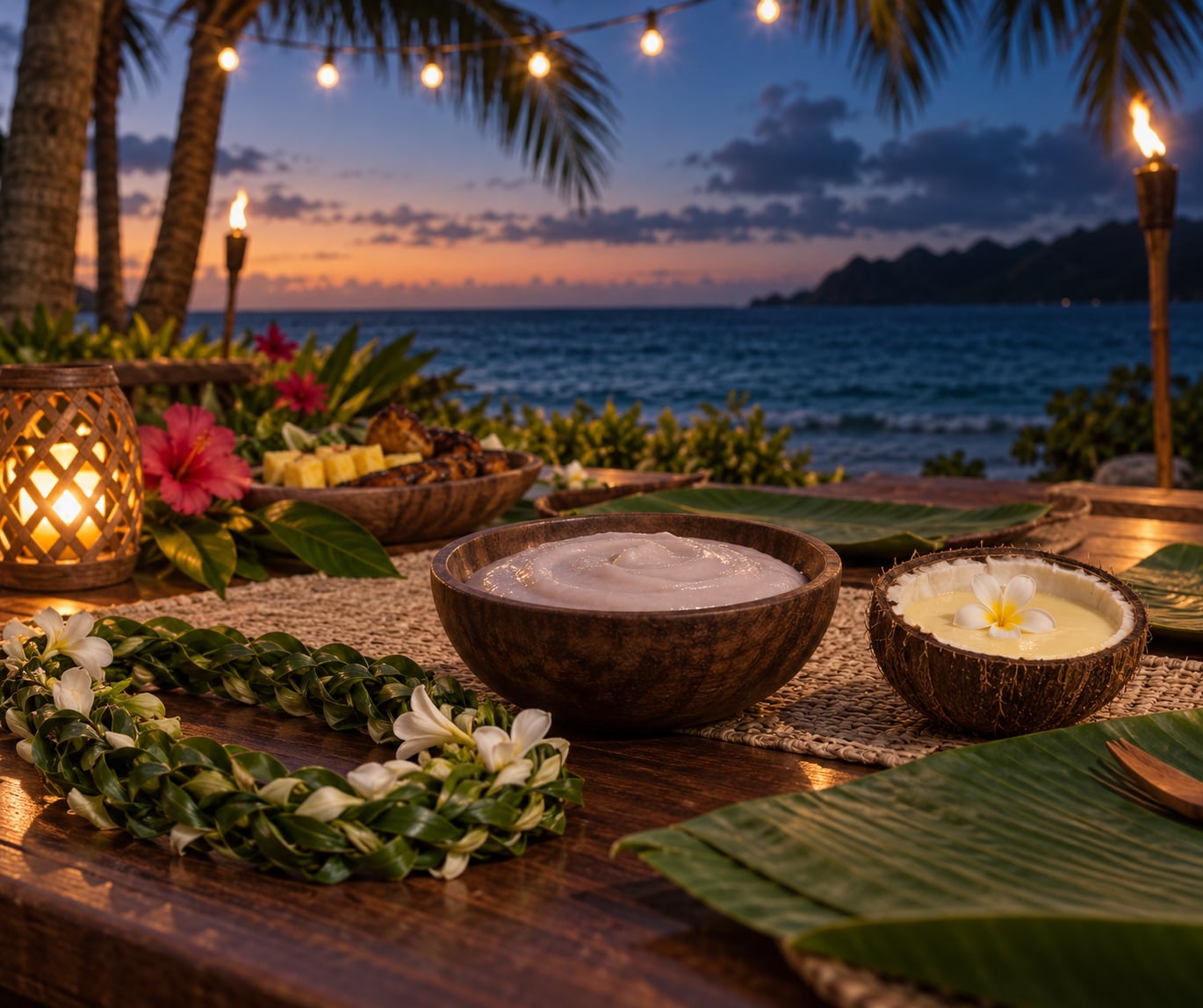
A Hawaii luau is an evening feast and cultural show that usually runs three to four hours from arrival to the end of the performance. You are greeted with a lei, spend the first part of the evening at hands-on activity tables, eat a buffet dinner while an underground oven is opened, then watch a 45- to 60-minute stage show of hula, chant and fire knife dancing.
Most first-timers who say they had a good time did one thing right: they arrived early. The hour before the show — lei making, weaving, ukulele, a hula lesson — is consistently the part people remember, and it is easy to miss. Show details, menus and schedules change, so treat the operator’s own booking confirmation as the source of truth rather than any blog, including this one. Details here were checked in October 2026.
Table of Contents
- What Is a Hawaii Luau?
- Hawaii Luau: What to Expect for First Timers
- How to Choose the Right Luau for Your Family
- How Long Does a Luau Last?
- What Should You Wear and Bring?
- What Food Is Usually Served?
- Is Alcohol Included?
- What Happens During the Show?
- Can Children Attend and Participate?
- What Is the Etiquette for Attending a Luau?
- Hawaii Luau Problems First Timers Can Avoid
- Frequently Asked Questions
- Can I attend a Hawaii luau alone?
- Is a luau suitable for young children?
- What happens if it rains during a luau?
- How far in advance should I request dietary or accessibility accommodations?
- Is a resort luau the same as a local community event?
- Plan Your First Luau with Confidence
What Is a Hawaii Luau?
A luau is a Polynesian-inspired social gathering built around food, music, dance and storytelling. Most luaus a visitor can book are commercial experiences: a host company feeds you, seats you, and puts on a performance representing several Pacific cultures including Hawaiian, Samoan, Tahitian and Maori traditions.
It helps to keep two different things apart. A commercial luau is hospitality and entertainment built for visitors, and it is a perfectly good way to spend an evening. A community cultural event is something else entirely: an ʻahaʻina-style gathering hosted by a specific family or group, tied to a particular occasion, and not a product you can reserve a seat at.
One more piece of vocabulary trips people up. The word luaʻau with an okina over the first “l” refers to a specific historical feast, traditionally boys cooked in an imu while the men ate separately, with kapu restrictions on who could eat with whom. Modern luaus dropped most of that. When someone uses the old word loosely, it is usually marketing language, not a claim that what you are watching is unchanged.
Hawaii Luau: What to Expect for First Timers
Here is the flow of a typical evening, in order. Treat the timings as a shape rather than a schedule — every operator runs its own clock, and the version you booked is the one that counts.
- Check-in and lei greeting. You give your name at a desk or to a host, often receive a fresh orchid lei, and are pointed toward tables and check-in photo spots.
- Welcome and orientation. A host explains the flow of the evening, the seating plan, and any participation opportunities. This is also where the host usually talks about the cultures represented in the show.
- Activity stations. The 60- to 90-minute window before the show: lei making, lauhala or ti-leaf weaving, ukulele, a hula lesson, sometimes tattoo stamping or a craft table. Most are optional and most are included.
- The imu ceremony. The underground oven is uncovered. Food that cooked underground for hours is lifted out, and the smell of kālua pork arrives before the buffet does.
- Buffet dinner. You move through the food tables yourself, or in some venues a set meal is served at your seat. Kids are usually called up first.
- Stage show. Roughly 45 to 60 minutes of music, hula, storytelling and knife handling, often closing with a fire performance.
- Wrap-up. Sometimes a post-show market, craft tables or a photo package; sometimes you are simply shown out. Expect to be done around 9:30 or 10pm for an evening showing.
If you want the cultural stations, plan to be in the car 90 minutes before the listed showtime. Travellers on forum threads describe arriving at showtime and finding the interesting part already over, which is the most common first-timer regret.
How to Choose the Right Luau for Your Family
Choose by the shape of the evening you want, not by the word “traditional” on the ticket. Families tend to do best with venues that have shorter transfer times, seating away from the loudest rows, and a clear menu they can read before they travel. Here is how the main types compare.
| Experience type | Setting | Atmosphere | Good for children | Transport | Usually included |
|---|---|---|---|---|---|
| Resort luau | On-site at a hotel | Large, polished, easy | Yes, often with a kids menu | Walk or short shuttle | Dinner, show, sometimes lei and activities |
| Excursion luau | Off-site venue | Roomier, less polished | Yes, with activity stations | Round-trip hotel shuttle | Dinner, show, lei, pre-show activities |
| Premium seating | Same venue, better seat | Closer to the stage | Yes | Same as base ticket | Better sightline, priority entry, sometimes dedicated service |
| Adult-oriented evening | Smaller venue | Quieter, more intimate | Check age rules first | Often shuttle or self-arranged | Dinner, show, usually an open drink option |
| Family-focused | Varies | Activity-heavy, informal | Yes, built around them | Usually shuttle | Activities, hula lesson, kids meal, show |
| Culturally focused | Smaller or non-resort | Quieter, more specific | Usually, with planning | Self-arranged often | Fewer extras, more depth in the show and hosts |
One thing worth knowing from people who have done both: the difference between a basic seat and a front-row seat is often smaller than the ticket screen implies. One r/VisitingHawaii poster put it plainly — they had the premium seating and didn’t feel it was a significant quality improvement. Pay up for the upgrade only when the extra is something you’ll actually use, like closer seating for a child who needs a clear view or a quieter table.
Ask three questions before you book: how long is the round-trip transfer, what is the actual dinner service, and what happens to the schedule if the weather turns. An answer to any one of those will tell you more than the adjectives.
How Long Does a Luau Last?
Plan for three to four hours door to door, and roughly two of those hours are yours once you are seated. The performance itself is only 45 to 60 minutes — most of the evening is arrival, activities and dinner, and that is normal, not a sign something is wrong.
| Segment | When it happens | How long it usually runs |
|---|---|---|
| Arrival and check-in | 60-90 min before showtime | 15-20 min |
| Activity stations | From check-in to dinner | 45-75 min |
| Imu opening | At the start of dinner | 10-15 min |
| Buffet dinner | Before the show | 45-60 min |
| Stage show | Main event | 45-60 min |
| Departure | After the finale | 15-30 min plus shuttle time |
Departure is not the same as the end of the show. Vendors wrap up after the finale, and if you are on a shuttle the return leg can add another half hour. Some operators run a 5pm family showing and a 7:30pm adult showing from the same venue on the same night, so confirm which time your ticket covers. Always read the current schedule in your confirmation email rather than a general page, because start times change by season.
What Should You Wear and Bring?
Wear something warm, loose and comfortable. A luau is an outdoor evening in the tropics — humid, breezy after dark, and often right beside the ocean — and you will be sitting still for two hours while a fire is lit a few metres away.
- Clothes: an aloha shirt, a sundress, a skirt and top, or anything else you would wear to a casual island dinner. All of these are fine. Nobody is turned away at the door for what they are wearing.
- Footwear: sandals are fine for dinner. Bring closed shoes if you are on a grass or sand surface and want them for the shuttle queue.
- Insect repellent: worth having in your bag, especially for activities on a lawn near water.
- A light layer: a thin overshirt or fleece for the show, which often runs on an open stage after sunset.
- Sunscreen: you arrive in late afternoon, usually in full sun, and there is a long wait before dinner.
- Your reservation details and photo ID, plus any medication you take.
On the specific question of what a woman should wear: a sundress, a maxi skirt with a blouse, or trousers and a nice top are all completely standard. The short answer to “what not to wear” is nothing that will not survive two hours of outdoor seating and a buffet line. Many venues lend or sell leis on arrival, and some include one in the ticket, so check before you buy your own.
What Food Is Usually Served?
Expect slow-cooked meat, starches, fresh salads and something sweet made with coconut. Menus change often and differ by operator and island, so treat the list below as a reliable expectation rather than a guarantee.
- Kālua pork, pulled from an imu after hours of underground cooking, plus roast chicken or shoyu beef.
- Lomi lomi salmon, raw fish tossed in tomato and onion.
- Poi, pounded taro (kalo) served sticky and bland on purpose, often with fish.
- Rice, sweet rolls, macaroni salad and island-style potato salad as the familiar buffet anchors.
- Haupia, a coconut milk custard, often with candied macadamia nuts.
- Fresh fruit, water and iced tea at the drinks station.
Two things first-timers tend to be surprised by. Poi is meant to be mildly bland and sticky, not a sauce — the flavour is meant to be the fish or the kālua next to it. And much of the food is rich and sweet, so if that is not your thing, the salads, fruit and grilled items are where you will do better.
| Request | What to do | How far ahead |
|---|---|---|
| Food allergy | Tell the operator in writing, name the specific allergen, and re-ask on the night | As early as you can; days, not hours |
| Vegetarian or vegan | Most luaus have a plant-based line, but ask what is actually cooked separately | Several days |
| Children’s portion | Most venues serve a kid menu; ask about age cutoffs | At booking |
| Wheelchair or mobility access | Many sites are grass or sand, and operators commonly ask for 72 hours’ notice | 72 hours minimum |
Nobody will refuse you a seat over a dietary request, but the kitchen is cooking for a few hundred people at fixed times. Late notice simply means fewer options at the table.
Is Alcohol Included?
Sometimes, and it depends entirely on the ticket. Plenty of packages include a welcome drink, a pour with dinner, or a full open bar for the evening; plenty of others include nothing and offer an upgrade at the door. The ticket description tells you which, and it is worth reading line by line rather than assuming from the word “luau.”
Nonalcoholic options are usually present — mai tai, fruit punch, water, iced tea — and at larger venues there is usually a free drinks station. Ask at check-in rather than assuming the bar is complimentary. If you do drink, plan the ride home before you go: shuttles are common and some are included, and booking a rideshare for two or three people costs less than the drink package did. Check the age rules too, because some venues will not serve alcohol to anyone under 21 and will not let minors into an adults-only section.
What Happens During the Show?
You will hear narration, live music, singing and a lot of hula, and you will probably be invited up. The order is fairly standard: a host opens and explains the cultures represented, instrumental and vocal pieces follow, storytelling segments explain the significance of what you are seeing, and the evening builds toward a knife-handling act. Some shows close with fire.
No two shows are the same. A large resort production may feature several Pacific cultures and a full fire finale; a smaller community-affiliated venue may do 40 minutes of Hawaiian music and hula with no fire at all. Neither is a fake version of the other. What matters is whether the host names what they are presenting and why.
Audience participation is optional everywhere. Being pulled up for a hula lesson is friendly, not a test, and passing genuinely does not matter.
Can Children Attend and Participate?
Yes, usually, and most families rate it as the easiest evening of the trip — the activity stations and the buffet are built for children. Participation is always optional, so nobody’s child has to get up and perform.
Check three things. Some acts carry age limits, and a few venues run adults-only sections in the evening. Kids are often seated closer to the stage in family sections, which is great for them and louder for them. And the last act of the night tends to be the loud one, so if your child is a light sleeper, plan the timing or the seating accordingly rather than hoping.
Ticket pricing for children varies by operator and by age, so check the specific brackets rather than assuming a free or half-price rule.
What Is the Etiquette for Attending a Luau?
There is no dress code to memorise and no formal ritual you can get wrong. Good manners at a luau are mostly about respecting the people performing and the host’s schedule.
- Listen during the introductions. The host’s opening explains what the show is and where the music and dance come from. It is short and it is the most educational part of the evening.
- Join activities when you want to. Stations are open invitations. Watching someone else weave is completely fine.
- Follow staff directions during the imu ceremony. The oven is opened in a specific order for a reason, and guests are usually asked to stay back or hold a torch.
- Do not treat performers as photo props. Ask before photographing a performer, especially a child in the hula group, and do not climb onto the stage for a shot mid-show.
- Learn which culture you are watching. A show that names its traditions is doing something different from a generic tropical spectacle, and you will enjoy the difference.
- Stay for the finale. Leaving during the knife or fire act is the one thing reviewers consistently flag.
On tipping, which comes up more than almost anything else: service charge practices vary widely. Many luaus add a service charge, some include gratuity, and others simply have servers working on commission. If the bill does not mention it, tipping is welcome but optional. A per-person amount given to the server at the end of the night is the common practice, and you can hand it to them directly rather than leaving it somewhere. Nobody will chase you down.
Hawaii Luau Problems First Timers Can Avoid
- Arriving at showtime. You skip the pre-show activities, which are the best-value part of the ticket. Fix: aim to be at the venue 60-90 minutes before the listed start.
- Underestimating the transfer. Off-site venues can be 30-45 minutes from Waikiki or Kihei each way. Fix: subtract that from your evening before you commit to a 7pm showing.
- Treating “traditional” as a specification. Marketing copy uses the word loosely. Fix: read the current show description and the menu, and ask what is actually included.
- Assuming drinks are included. Fix: read your ticket’s inclusions list. If it is vague, budget for it.
- Leaving dietary requests to the night of. Fix: contact the operator in advance and again on arrival.
- Forgetting transport home. A shuttle may be included, may cost extra, or may not run late. Fix: settle it before the first drink.
- Judging it by the first twenty minutes. The opening is slow while everyone is checked in. Fix: give the evening until the imu is opened before deciding.
If your budget is tight, a free public hula performance in Waikiki is a reasonable way to see the dancing without the dinner, and some visitors combine a free show on one night with a food-focused luau on another.
Frequently Asked Questions
Can I attend a Hawaii luau alone?
Yes, plenty of people do, and it is a common way to spend an evening when you are travelling solo. Activity stations make it easy to meet people, the buffet requires no partner, and the show is the same whether you are alone or not. Book a shuttle-based package if you plan to drink, since you will not want to drive back.
Is a luau suitable for young children?
Usually yes, and most families find it easier than expected. The activity stations, the buffet and the fire finale hold most kids’ attention for a couple of hours. Check for age limits on certain performances, ask about family seating away from the loudest rows, and be aware the closing act is the loudest part of the night.
What happens if it rains during a luau?
Most luaus run in the rain. They are set up for tropical weather, and a light shower rarely changes the schedule because the dinner area and seating are usually covered or under a marquee. Heavy weather is the exception, so before you book, ask the operator what their rain and rebooking policy is rather than guessing what happens if a show is called off.
How far in advance should I request dietary or accessibility accommodations?
Contact the operator as early as you can, and treat 72 hours as the minimum rather than the target. Kitchens cook for several hundred people at fixed times, so a request made on arrival often means fewer options. For allergies, give the specific allergen in writing and re-ask when you check in. Mobility access also needs lead time because many sites are on grass or sand.
Is a resort luau the same as a local community event?
No, and the difference matters if you care about the cultural content. A resort luau is a commercial hospitality and entertainment experience, often featuring several Pacific cultures in one evening. A community event is hosted by a specific family or group, tied to a particular occasion, and normally not something you can book a seat at. Both can be enjoyable, but they are not interchangeable.
Plan Your First Luau with Confidence
Confirm four things before you pay: the actual showtime, how far the venue is from your hotel, what the ticket includes, and what the rain policy is. Those four answers remove nearly all of the uncertainty that makes first-timers anxious.
Then arrive early, dress like you are going to an outdoor dinner, and leave the schedule loose. Arrive ninety minutes before the show, eat the food you recognise first and then explore, and stay for the finale — that is the evening people describe a year later as the night they got it.