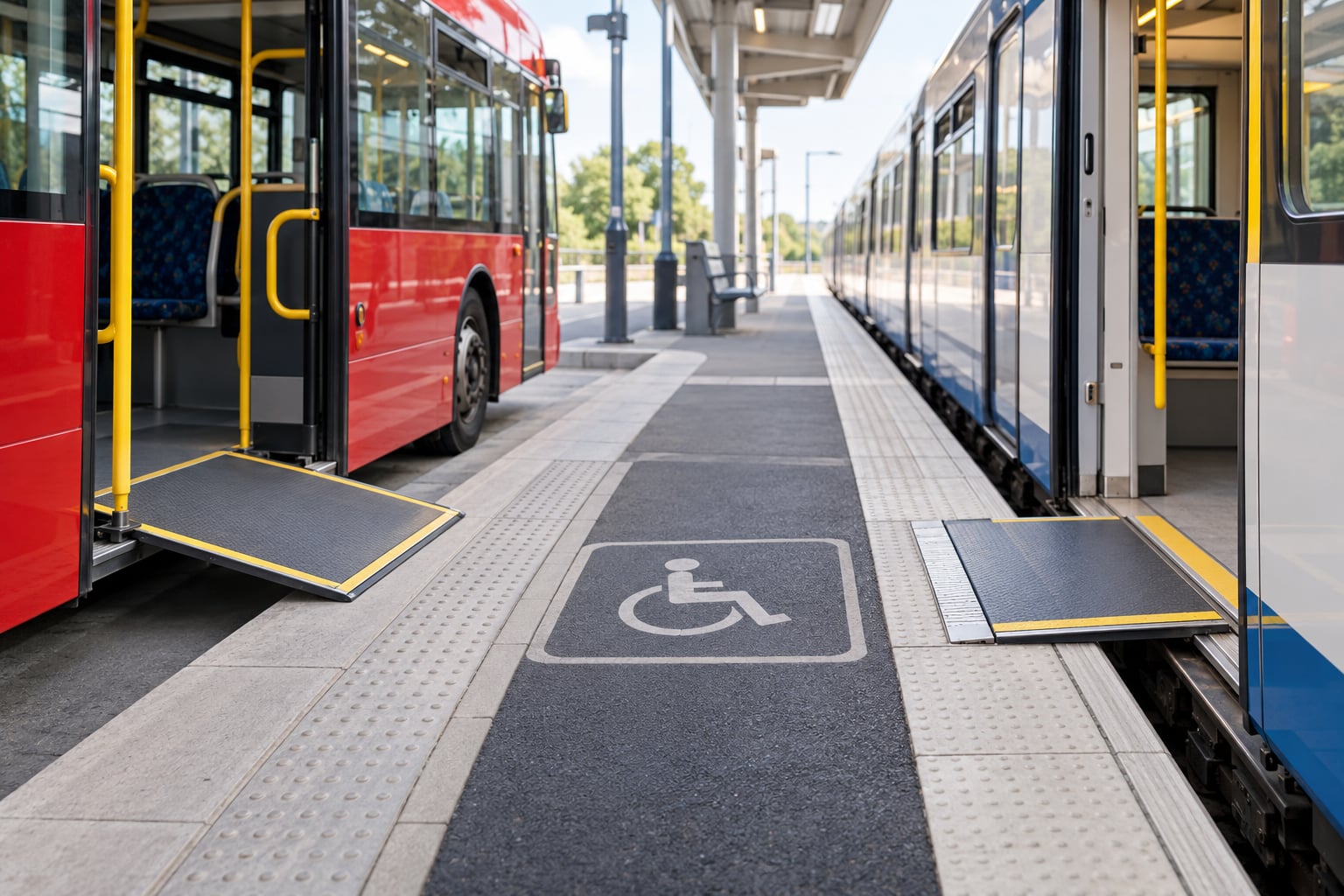
Step-free transit access works when the whole trip lines up: a level or ramped path from the pavement, a boarding point you can reach, a vehicle floor that matches that boarding point closely enough to cross safely, and space inside for a wheelchair. Knowing how step-free transit access works comes down to that chain, and it breaks at its weakest link. Most trouble riders hit comes from one gap in it, not from a missing feature at the entrance.
The confusing part is that “step-free” does not mean the same thing on every map. On one network it describes the platform-to-train boarding, on another the whole street-to-train trip. Once you can tell those apart, planning gets a lot easier.
Table of Contents
- What Step-Free Transit Access Means
- How Step-Free Transit Access Works From the Street to the Seat
- The Main Parts of an Accessible Transit Route
- Level Boarding and the Role of Gap Fillers
- What each system can and cannot fix
- Why Some Step-Free Routes Still Cause Problems
- How to Check Step-Free Access Before You Travel
- How step-free access differs by mode
- Frequently Asked Questions
- Is a low-floor bus automatically wheelchair accessible?
- What is the difference between step-free access and full wheelchair accessibility?
- Do transit operators have to provide a ramp or lift at every stop?
- How can I find out whether a station has an accessible route?
- What should I do if a lift or ramp is not working?
- Can a step-free route still be difficult for a wheelchair user?
What Step-Free Transit Access Means
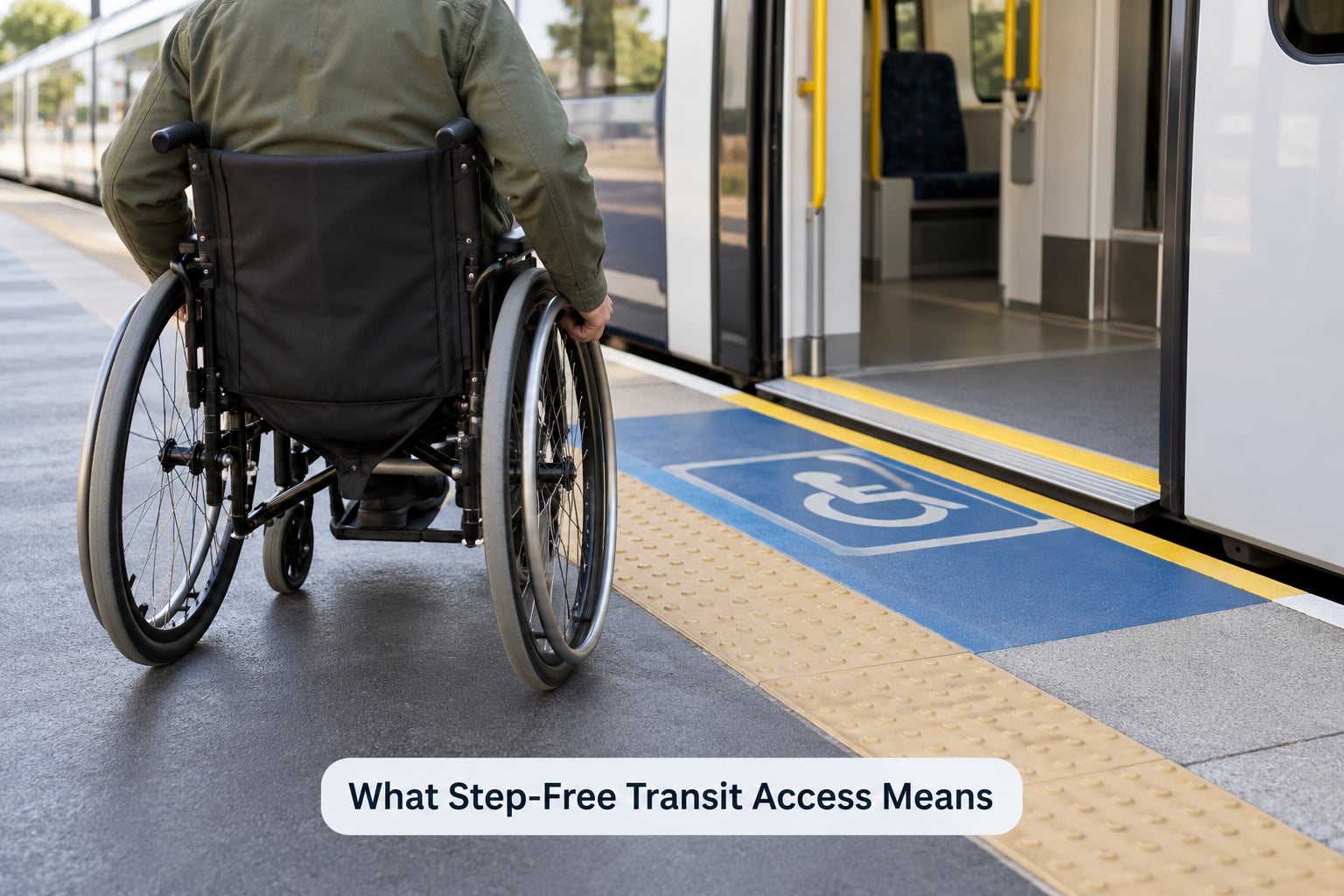
Step-free access means you can complete a trip without using stairs or escalators. Lifts, ramps and level surfaces replace them, and the gap and vertical step between the platform and the vehicle are small enough to cross without help, or covered by a ramp or bridge plate.
It is not the same as wheelchair accessible. A route can be step-free yet still have a 1 in 20 gradient for its full length, a 900mm passage narrowed by a bike rack, or a lift that is out on the morning you travel. Accessibility is the usable outcome; step-free is the condition that makes it possible.
Riders use this term loosely for two different things. One is street-to-platform: getting from the pavement to where the vehicle stops. The other is platform-to-train: crossing the gap onto the vehicle. A station can deliver the first and not the second, which is exactly why the label alone is not much use.
How Step-Free Transit Access Works From the Street to the Seat
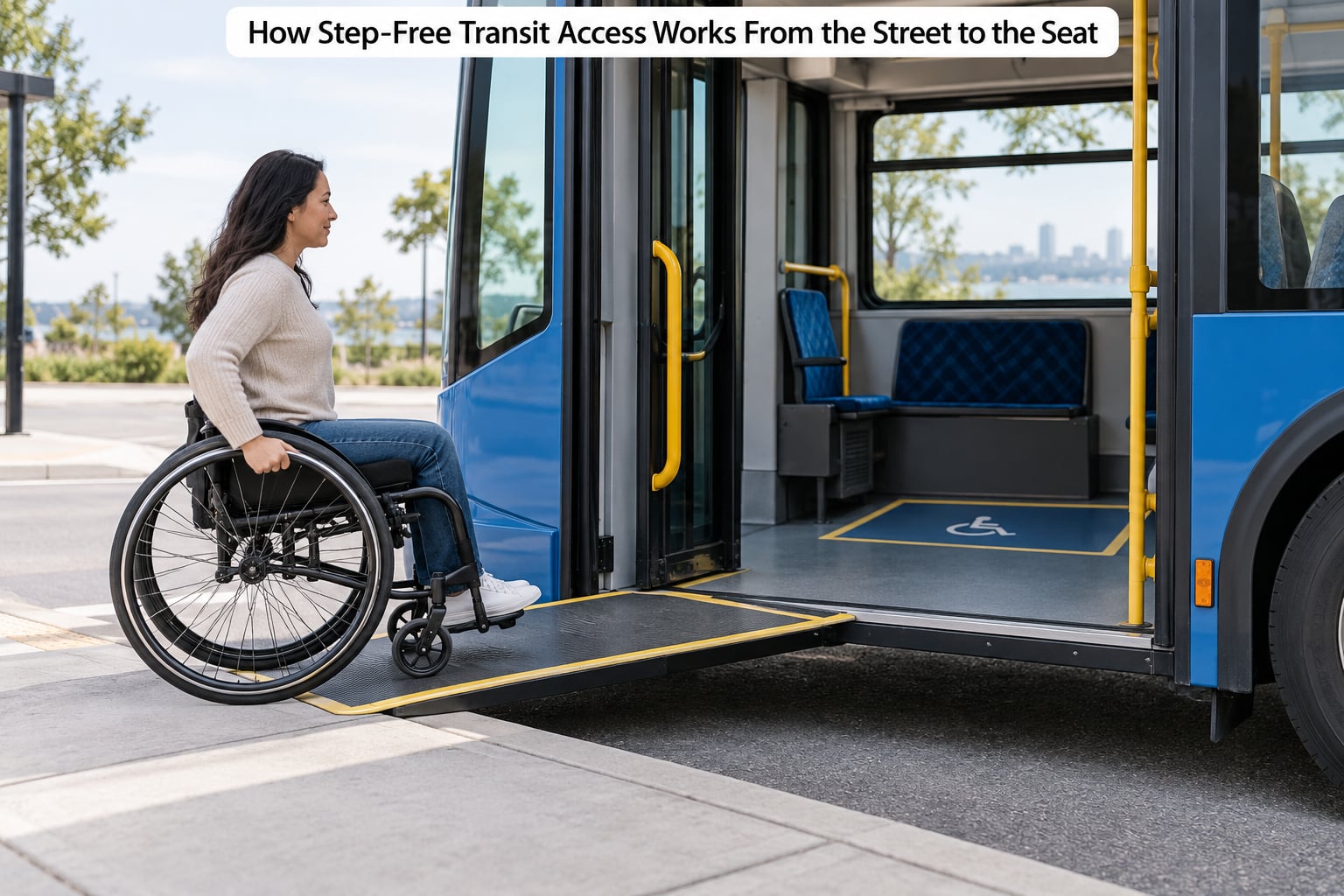
A step-free trip is a chain, and every link has to hold. If one fails, the trip fails, even when everything else is perfect.
The Main Parts of an Accessible Transit Route
- Accessible footway: a firm, even, uncluttered path wide enough to turn a wheelchair. Parked bikes and overhanging signs are the usual culprits.
- Kerb ramp or kerb upstand: a dropped kerb at the crossing point. A lowered kerb elsewhere does nothing if the crossing is 40m away with a dropped kerb you cannot cross from.
- Boarding pad or pad marking: the raised kerb or island where the vehicle door meets the waiting area.
- Level boarding: a vehicle floor and platform edge at matching heights, so you roll straight on.
- Gap filler, bridge plate or ramp: equipment that closes the horizontal gap and the step, usually deployed by the driver.
- Accessible doorway and interior space: a wide door, a wheelchair bay or securement area with restraint straps, and turning room.
- Information and help: tactile paving, audio and visual announcements, an accessible fare gate, a help point, and a call button the driver can reach from the seat.
Getting onto the vehicle is only the middle. Transfers matter as much: a platform-to-train station that connects to a staircase-only interchange undoes the trip. The last 200m from the exit to your destination is the part most operators publish least about, and it is where a lot of plans quietly fail.
Level Boarding and the Role of Gap Fillers
Level boarding is a system of four things agreeing with each other: platform height, vehicle floor height, the horizontal gap between them, and the procedure for closing what is left. Change one and the rest have to compensate.
On metro systems built for it, platforms are set to match a low floor and the residual gap is small enough to roll across. On older mainline platforms, the gap and step are larger, so a ramp or bridge plate bridges the difference and a member of staff or the driver deploys it. Low-floor buses work the same way, with a ramp or a kneeling suspension that brings the entrance floor down to the kerb.
What each system can and cannot fix
A bridge plate is passive. It sits there and covers the gap permanently, which makes it reliable, and it also occupies space beside the vehicle that can pinch the boarding area. A deployable ramp adapts to different platform heights but depends on someone operating it, and the vehicle keeps moving either way.
Gap fillers, the rubber or metal extensions along a platform edge, only solve the horizontal gap. They do nothing about a vertical step, so a station can have excellent fillers and still be unusable from a high platform.
Driver procedure is the soft link. On many bus networks the driver stays seated and deploys the ramp from the cab, which works well but is busiest exactly when everyone is rushing. If the driver does not spot you, you may need to ask, and on some systems asking is still treated as unusual.
One more factor decides how a gap feels in practice: whether you can reverse out of it. A small gap you can back away from is safer than a large one in a confined bay with a crowd at the door.
Why Some Step-Free Routes Still Cause Problems
Even a route built to standard can be awkward. The usual reasons are well known to regular riders.
- Gradients. A long shallow slope is harder than a short steep one for anyone pushing, propelling or braking. Check the gradient along the whole path, not the ramp on its own.
- Narrow passages. Gate widths, platform narrowing at lifts, and furniture placed after the station was built.
- Lift outages. A lift is a single point of failure with no accessible alternative route. Regular riders check the live status page the night before and again that morning rather than trusting the station map.
- Poor information. A map that says step-free without saying which kind, and no lift list beneath it to check.
- Construction. Temporary ramps and diverted footways are often steeper and narrower than the permanent route.
- Crowding at peak. A wheelchair space on a full train can be blocked by luggage and standing passengers, and you may have to wait for the next service.
- Weather. Ice on a ramp, water pooling at a dropped kerb, and slippery platform surfaces.
- The last mile. The stretch from station exit to door, where no operator has responsibility and where dropped kerbs often disappear.
The pattern across these is continuity. Riders on accessibility forums talk about it constantly: a route only counts as accessible if every part of it works at the time you travel.
How to Check Step-Free Access Before You Travel
Run this list the night before, then again on the morning. It takes about ten minutes.
- Plan in the operator’s own journey planner, not a generic one. It knows which exits are in use and which platforms are step-free from the street.
- Turn on step-free routing. In Google Maps, open route options and enable wheelchair accessible; the filter removes routes with stairs, though it cannot see a lift that is broken that day.
- Check the tier for every stop. Confirm street-to-platform at your origin and destination, not just platform-to-train in the middle.
- Check the exit end. Look at the map and the street view for the destination station’s exit. Step-free on the arrival platform tells you nothing about the exit.
- Read the lift status page. Look for planned engineering work and check again before leaving.
- Work out the boarding method. Level boarding, a bridge plate or a staff-operated ramp changes how early you need to arrive and whether you need to book.
- Book assistance if the network asks for it. Allow more notice than you think: many systems want bookings well ahead for a guaranteed meet, though some stations will still help on a turn-up-and-go basis.
- Name a backup station. If your interchange is step-free only via one lift, know which station covers you when it fails.
- Build in slack. Extra minutes absorb a lift detour and a longer board at the kerb.
- Check the demand-responsive fallback. Know whether your city runs a booked door-to-door service and how far ahead it needs booking.
How step-free access differs by mode
| Mode | How step-free access is delivered | Typical failure point |
|---|---|---|
| Bus | Low floor, kneeling suspension, ramp or step deployed by the driver | Driver time and traffic at the kerb during busy periods |
| Metro or underground | Level platforms matched to train floor, minimal gap | Stations built before accessibility standards, reached by lifts only |
| Mainline rail | Ramps, bridge plates and on-board staff meet on the platform | Platform gap and staff availability at unstaffed stations |
| Ferry and river bus | Gangway, level deck, crew assistance | Water movement and tidal steps at open decks |
| Demand-responsive service | Vehicle and ramp come to the kerb | Booking lead times and service boundaries |
Frequently Asked Questions
Is a low-floor bus automatically wheelchair accessible?
No. A low floor removes the step from the doorway, which is only one part of the trip. The bus still needs a working ramp or kneeling function, enough clear space inside, and space in the wheelchair bay. A high-capacity low-floor bus can also be so crowded that the bay is unusable at peak. Treat low floor as the entry solution, not the whole answer.
What is the difference between step-free access and full wheelchair accessibility?
Step-free describes infrastructure: no stairs or escalators, and a small enough gap to board. Wheelchair accessibility describes the outcome: you can actually complete the trip. A route can be step-free and still fail on gradient, width, a broken lift or a crowded wheelchair bay. Accessibility depends on the infrastructure working at the moment you travel.
Do transit operators have to provide a ramp or lift at every stop?
Usually not, and this is the part riders misunderstand most. Requirements usually apply to stations and to a share of the vehicle fleet rather than to every stop on every route. Buses carry their own ramps instead, and rail stations are assessed individually. That is why a journey planner, rather than a general rule, is the only reliable way to check a specific trip.
How can I find out whether a station has an accessible route?
Use the operator’s own journey planner and accessibility map, then look for the station’s lift list rather than the step-free label alone. The lift list tells you which lifts exist and whether there is an alternative if one is out. Check the destination exit as well as the arrival platform, and look at street view for the final part of the walk.
What should I do if a lift or ramp is not working?
Contact station staff if they are present, or use the help point, and ask what the accessible alternative is rather than where the lift is. Many operators publish a disruption line and a status page that names the fallback route. If there is no alternative accessible route, treat it as a disruption: switch to your backup station, change the time, or use the booked door-to-door service.
Can a step-free route still be difficult for a wheelchair user?
Yes, and often. Long gradients, narrow passages, a platform gap that requires a sharp reverse, a lift that is out of service, or a full carriage where the wheelchair space is blocked all sit inside a route that is officially step-free. Regular riders plan around these by travelling off-peak, checking status the morning of the trip and keeping a backup station in mind.
Step-free access is reliability, not a feature list. Check the live lift status, confirm the exit end as well as the platform, know your boarding method, and keep a backup station in your pocket before you travel.