Travelling with a slow walker or senior parent works when you plan each day around one honest walking-distance number, request assistance before you need it, and check accessibility claims yourself instead of trusting the photos. Most of the work happens the week before departure, not on the day itself. Budget roughly two hours of preparation for a single trip day, and expect the first hour after arrival to feel slower than anything at home.
I say this because the trips that go wrong almost never fail at the airport gate. They fail because someone booked a museum with a mile of indoor walking, moved a transfer at 6:40 in the morning, and then wondered why their parent was exhausted by dinner.
Table of Contents
- What You Need Before Traveling With a Slow Walker
- Documents and health records to gather
- Mobility aids and their backups
- Comfort items that prevent a bad day
- Step-by-Step Plan for Traveling With a Senior Parent
- 1. Run a reality check on mobility, energy, health and memory
- 2. Match the trip length to how the day goes
- 3. Book transportation that reduces transfers
- 4. Verify hotel accessibility with specific questions
- 5. Build each day on a one-on-two-off rhythm
- 6. Plan meals, hydration and medication timing
- 7. Get through screening with mobility aids
- 8. Agree on the backup plan before you leave
- Common Mistakes and How to Fix Them
- Overpacking the itinerary
- Booking transfers at the last minute
- Ignoring bathroom locations
- Assuming a wheelchair is a step down
- Skipping the accessibility verification call
- Leaving medication timing vague
- No plan for delays
- Treating rest as a failure of the trip
- Frequently Asked Questions
- How do I get through an airport with a slow walker or senior parent?
- What is the best way to choose accessible transportation?
- How do I plan a travel day without making it exhausting?
- Should I bring a wheelchair even if my parent can walk some distances?
- How should I store and carry medication while travelling?
- What should I do if my parent becomes tired or needs a rest sooner than planned?
What You Need Before Traveling With a Slow Walker
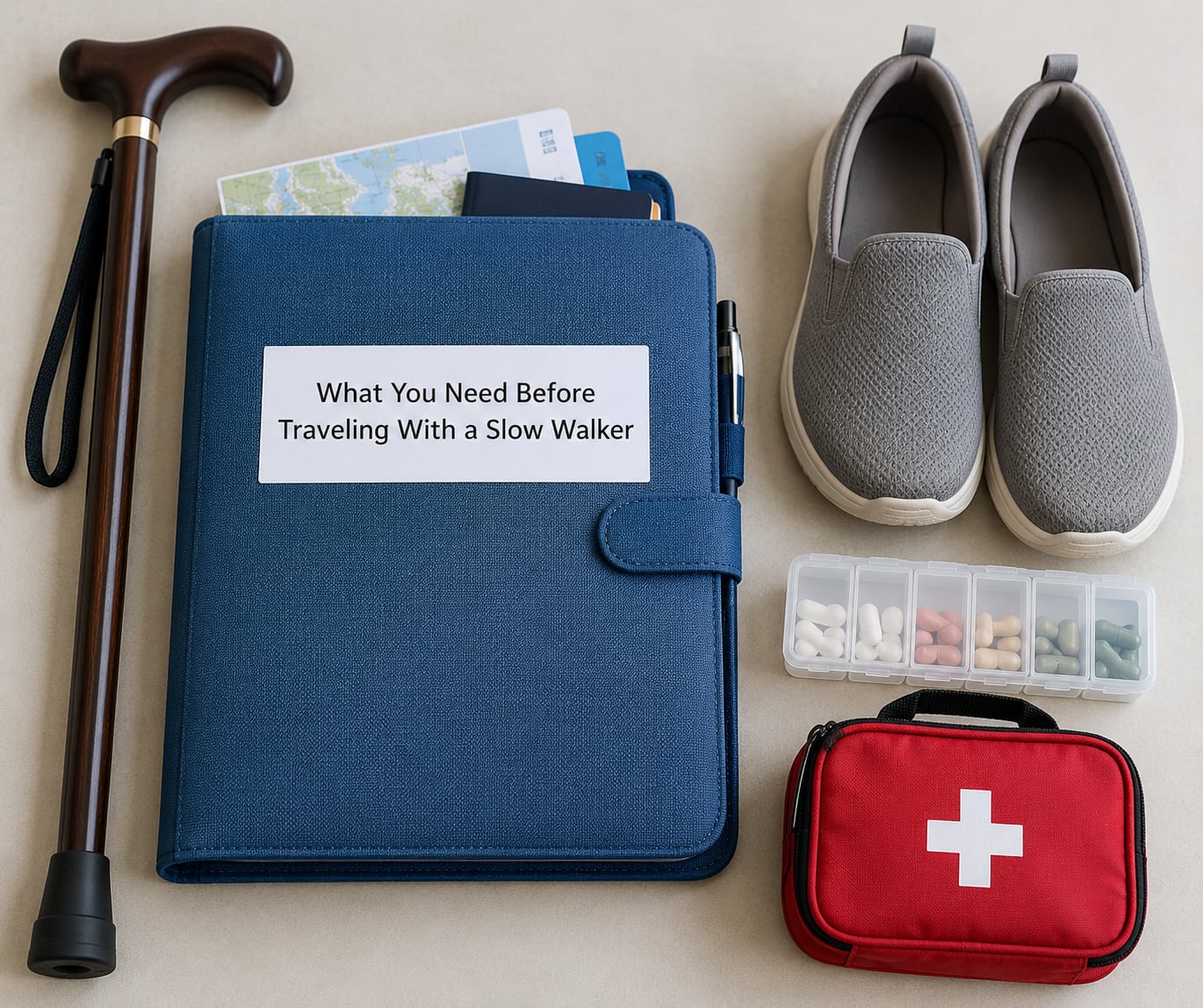
Gather everything before you book anything. The order matters: what you learn about your parent’s actual limits this week determines which hotel you reserve, which flight you take and which excursions you drop.
Documents and health records to gather
Carry identification, insurance details, and a one-page health summary in the hand luggage, not in a checked bag. The summary lists diagnoses, allergies, current medications with doses, the prescribing clinician’s contact, and an emergency contact who is not travelling with you.
Two copies are better than one. One stays with the traveller, one travels in a different bag or stays with a person at home, so a lost suitcase does not become a lost medical history.
Mobility aids and their backups
Bring the cane, walker or wheelchair already in use rather than buying one on arrival. Add a cheap foldable backup, because folding canes and lightweight rollators fit in a taxi trunk where a rigid walker does not.
- A folding cane or collapsible rollator as a backup
- A gel seat cushion for long transfers and tour seating
- A portable ramp if the destination has known steps at the entrance
- Non-slip slip-on shoes as a spare pair in the hand luggage
Comfort items that prevent a bad day
Compression socks reduce swollen feet after a long flight or drive. A lightweight cooling scarf helps in hot climates and costs nothing. A folding cane-chair turns any bench into a seat, which matters more than people expect.
Pack incontinence supplies discreetly even if the problem is occasional. Airport screening and long transfers are the two situations where an accident turns into a public event, and having the right supplies in the bag turns that outcome from humiliating into boring.
Step-by-Step Plan for Traveling With a Senior Parent
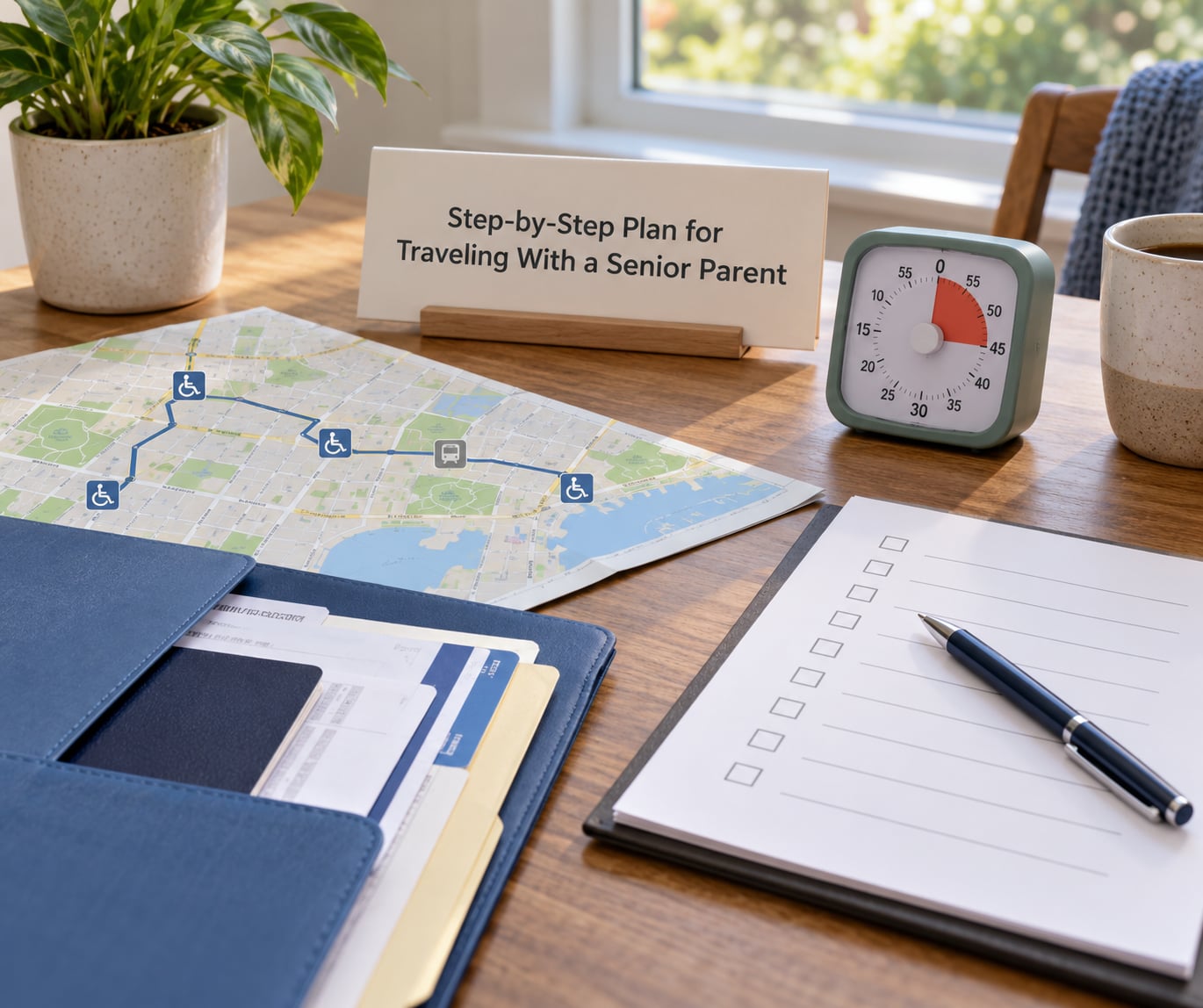
Eight steps, in this order. Skipping ahead usually means a conversation on the pavement with a stranger and a suitcase.
1. Run a reality check on mobility, energy, health and memory
Watch how a normal Tuesday goes, not the best day of the past month. Write down three numbers: the longest comfortable walk without a stop, the longest stretch of standing in one place, and how many times a rest is needed in a full day. The step-by-step planning for traveling with a senior parent starts with those three numbers, and everything else gets built around them.
Note the cognitive picture too. Confusion that appears only in unfamiliar places, trouble finding the bathroom at night, or getting lost in a familiar building all change how you plan. You worked it out if a normal morning has no surprises in it.
2. Match the trip length to how the day goes
A trip with one anchor activity a day suits almost everyone. Add a second activity only if the first one is short, seated and close to where you sleep.
Three to five days is usually the sweet spot for a first trip with a slow walker: long enough to feel like a holiday, short enough that nobody counts the days until the flight home. Longer trips work when you know exactly which hotel you are sleeping in every night.
3. Book transportation that reduces transfers
Every change of vehicle is a chance to get lost, stand too long or sit on the wrong side of an aisle. Fewer transfers always beats cheaper transfers.
- Air: book nonstop. Layovers are the most common breaking point on senior trips, and a three-hour connection with a slow walker is an endurance event, not a pause.
- Rail: request an aisle seat near the toilet, check lift availability at both ends, and avoid the last train of the day when possible.
- Bus and coach: confirm that the operator carries a folding wheelchair and that the restroom is on board rather than at a rest stop.
- Car: plan a genuine stop every ninety minutes, not every two hours, and use a rental with hand controls if transfers are hard.
4. Verify hotel accessibility with specific questions
Accessible rooms with grab bars are the exception at many budget hotels, and marketing photographs rarely show the shower lip or the doorway. Email or call the property before booking and ask for the room number you are being assigned, the actual bathroom photographs, and confirmation of the lift to the guest floor.
Ask about the turning space beside the bed, whether the shower has a low threshold, and how far the room sits from the lift. If your parent uses a walker, a room on the ground floor near a ramp beats a room with better dimensions on the fourth floor.
5. Build each day on a one-on-two-off rhythm
The one-on-two-off method means one planned activity, then two rest blocks around it. The rest blocks are not optional padding: they are the reason the activity works at all. A museum in the morning, a long hotel break, an early evening stroll, then sleep.
Caregivers on forums credit this rhythm more than any other single change, because it replaces the pattern where the good hour gets spent on transit and the good energy gets spent waiting.
6. Plan meals, hydration and medication timing
Write the medication schedule on one page with times in home time, then shift it to destination time on arrival and note the change. Ask the pharmacist or prescriber how to adjust doses across time zones rather than guessing, and carry medication in your hand luggage in the original labelled containers.
Keep a refill bottle in the checked bag, along with a written generic list of what is in each bottle. Hotel breakfasts are fine, but plan one simple seated meal a day and keep water within reach at all times. Dehydration does not announce itself in older adults; it shows up as confusion, dizziness and tiredness that get misread as a bad day.
7. Get through screening with mobility aids
Request assistance through the airline at least 48 hours before departure for any passenger who cannot walk the distance to the gate, and confirm it in writing a day before. Gate agents often cannot help with a manual transfer, so ask whether a boarding chair and an aisle chair are available at the aircraft door.
At security, tell the officer what the traveller can and cannot do before the process begins, not halfway through. Travellers with TSA PreCheck or a screening card usually keep their shoes on and their cane or walker with them, though officers decide on the day and a polite request helps. Removal of a mobility device requires a private screening if the traveller asks for one.
Battery-powered mobility aids carry airline and federal rules about the battery type, and airlines may need the device checked ahead rather than at the gate. Find the specific wording on the airline’s accessibility page and read it before you pack, not at the counter.
8. Agree on the backup plan before you leave
Decide together, calmly, what happens if the day falls apart. Which museum gets dropped, which taxi gets called, and what the signal is for “I need to stop now”. A short agreed phrase saves both of you an awkward public negotiation when someone is tired and out of dignity.
If memory is a concern, write the hotel address, your room number and the local emergency number on a card that stays in a pocket. For a parent with dementia, plan one indoor anchor per day and keep the itinerary to two locations, because familiarity is what makes new surroundings survivable.
Common Mistakes and How to Fix Them
Almost every mistake here is a planning error rather than a behaviour problem, which means you can fix it before departure instead of explaining it afterwards.
Overpacking the itinerary
Three landmarks in a day is a normal holiday for someone with a bad knee. Fix: one anchor, two optional stops, and a rule that anything optional can be cut without discussion.
Booking transfers at the last minute
Unbooked assistance means standing in a queue at a gate with a tired parent while the rest of the cabin leaves. Fix: request assistance when you book, then confirm by phone or email 48 hours ahead.
Ignoring bathroom locations
A map of a city with no bathroom on the route is a route your parent will refuse. Fix: check accessible restrooms at the airport, station, venue and hotel before the day starts, and note them the way you note restaurants.
Assuming a wheelchair is a step down
Rentals get delivered to hotels and let a slower walker cover more ground than most families expect, and older travellers are frequently told by their own legs that today is not a walking day. Fix: book a folding chair in advance as a backup even when walking seems possible. Families report the rented chair covering ground their parent managed on foot at home, so try it.
Skipping the accessibility verification call
The photo on the booking site shows a wide bathroom, and the actual room has a 6-inch shower lip. Fix: ask for the real room number and current bathroom photos before you pay, and keep the confirmation email.
Leaving medication timing vague
Improvised doses across time zones cause missed doses and doubled doses. Fix: one written page in home time and destination time, doses in hand luggage, and a question to the pharmacist before you fly.
No plan for delays
Every trip has at least one cancelled connection, delayed train or locked attraction. Fix: keep the day’s main activity early in the day and one flexible item late, so a delay eats the flexible part.
Treating rest as a failure of the trip
A slow walker who sits in a hotel café for two hours while the group walks is not ruining anything. Fix: schedule the rest as if it were an event, because it is the part that makes the evening possible.
Frequently Asked Questions
How do I get through an airport with a slow walker or senior parent?
Request wheelchair assistance when you book, at least 48 hours before departure, and confirm it in writing the day before. Choose a nonstop flight and an aisle seat near the toilet. At security, describe what your parent can and cannot do before screening starts, and ask for a private screening if removal of a cane or walker becomes uncomfortable.
What is the best way to choose accessible transportation?
Fewer transfers beat cheaper ones every time, so pick nonstop flights, direct rail routes and short taxi legs over itineraries that save a change. Ask each operator whether it carries folding wheelchairs, whether lifts work at both ends of the journey and whether a restroom is on board. For cars, a rental with hand controls removes the hardest transfer of the day.
How do I plan a travel day without making it exhausting?
Use the one-on-two-off rhythm: one planned activity, then two rest blocks around it. Keep the day’s main event early so a delay does not ruin it, cluster everything within a short walk of the hotel, and plan one seated meal. Write the schedule on paper and hand it over, so nobody spends energy arguing about what comes next.
Should I bring a wheelchair even if my parent can walk some distances?
Yes, book a folding wheelchair or rollator as a backup even when walking seems possible. Hotel bathrooms, long museum halls and uneven paving defeat a good day more often than people expect, and a rental chair often gets delivered to the hotel to save luggage space. Frame it as backup equipment rather than a verdict on ability, because pride is usually the real obstacle.
How should I store and carry medication while travelling?
Keep everything in hand luggage in the original labelled containers, plus a written schedule that shows doses in both home time and destination time. Ask the pharmacist or prescriber how to shift doses across time zones instead of improvising. Pack a refill bottle and a generic list of what is in each bottle in a checked bag, and keep a copy of the health summary separate from the bags.
What should I do if my parent becomes tired or needs a rest sooner than planned?
Stop where you are rather than pushing to the planned stop, and use the phrase you agreed on beforehand so the decision belongs to both of you. Sit somewhere with shade and water, and cut the rest of the day to the flexible item. Tiredness in older adults is often dehydration, low sugar or pain rather than simple tiredness, so offer food, fluids and a painkiller before booking anything else.
The real answer is simple: measure an honest walking distance, book one activity a day, request assistance early, and decide in advance what gets cut. Start with a single afternoon trip, use what you learn to fix the rhythm, and the rest of the holiday takes care of itself.