Most fog trouble is not caused by the fog. It is caused by a driver travelling too fast for the distance they can see, then reacting late and abruptly to something they never had warning of. Learning how to drive through fog without panicking is therefore mostly about three things: your speed, your lights and the size of the gap you keep.
The technique is simple enough to learn before you need it, which is why preparation matters more than nerve. Here is the calm version, step by step.
Table of Contents
- What You Need to Drive Through Fog Without Panicking
- Step-by-Step
- Before You Enter the Fog: How to Drive Through Fog Without Panicking
- Match Your Speed to What You Can See
- Use Low Beams and Fog Lights Correctly
- Leave Space and Drive Smoothly
- Pull Over Safely When Visibility Drops
- Common Mistakes
- Frequently Asked Questions
- How do I know when fog is too dangerous to keep driving?
- Are front and rear fog lights legal in heavy fog?
- What should I do if the car ahead suddenly disappears from view?
- How do I stop my windscreen from fogging up while driving?
- What should I do after a near miss in fog?
- Conclusion
What You Need to Drive Through Fog Without Panicking
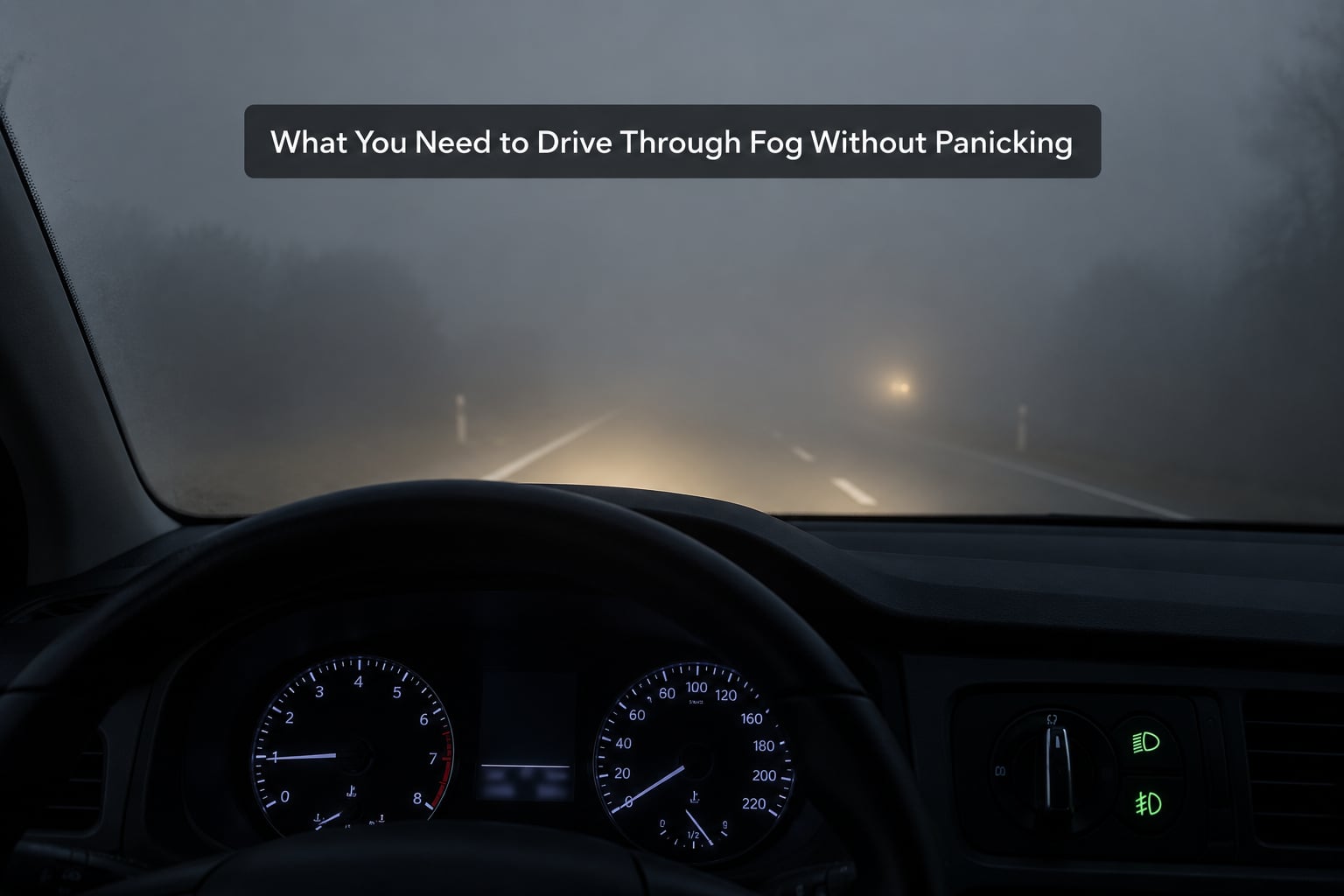
Fear in fog is worst when it arrives unprepared. Before you drive anywhere near a fog-prone stretch, take ten minutes and set things up so your hands are never the reason you cannot cope.
- A phone that is mounted and charging. Hands-free means your hands stay on the wheel when you need them. A phone you have to hold is a phone you will fumble with at the worst moment.
- Your route already loaded. Knowing the next turn removes one very common source of panic: the sudden swerve to reach an exit you did not see.
- Enough fuel for a long detour. Fog often means a slow crawl in traffic, and low-speed driving burns more fuel than people expect.
- Working lights, and familiarity with the controls. If you cannot find the front fog light switch without looking down, practise now. Do it in a parked car on a bright afternoon.
- A defroster and windscreen wiper that work properly. Interior condensation is a bigger cause of poor visibility in fog than people expect.
- Layers you can keep moving in. Cold and stiff shoulders feed tension into your arms, and tension feeds a tight grip and over-steer.
One quick check while you are out there: watch the air temperature and the road surface together. Fog that forms in freezing air often comes with rime ice, which looks like frost on the roadside posts and turns bridges and shaded bends into the slickest surfaces on the route. If that is what you are driving into, the sensible answer may simply be to wait.
Step-by-Step
Before You Enter the Fog: How to Drive Through Fog Without Panicking
How to drive through fog without panicking begins before the fog is visible, not once it is already in your headlights. Slow down while you can still see the road clearly, because a car that is already doing 80 km/h needs a much longer stretch of clear air to shed that speed than one doing 50.
Then run through the same short routine every time: mirrors, indicators, low beams on, front fog lights on if visibility drops below roughly 100 metres. Most cars have a rear fog light switch as well. Some have an auto-fog function that switches them on and off for you; others do not. Check your owner’s manual once and you will never have to think about it again.
Match Your Speed to What You Can See
Speed has to be low enough that you can stop within the distance you can actually see. That is the whole rule. In clear conditions you see far enough to make the posted limit sensible; in fog the number shrinks fast, and the posted limit becomes a ceiling you are very unlikely to reach safely.
A useful mental test: pretend something is stopped in your lane with its hazards on, and ask how long it would take you to reach it. If the answer depends on being able to see the hazard lights first, you are too fast.
| How far ahead you can see clearly | Maximum sensible speed | What to do |
|---|---|---|
| Over 200 metres (about 650 ft) | Posted limit, but stay alert | Keep your normal following distance and watch for patches |
| 100 to 200 metres | 80 km/h / 50 mph | Low beams, front fog lights, double your normal gap |
| 50 to 100 metres | 50 km/h / 30 mph | Drop back well behind the vehicle in front |
| Under 50 metres | Walking pace, or stop | Find a safe place to pull over and wait it out |
These are working numbers, not legal ones. Weather slows everyone down; your local rules set what counts as unsafe visibility.
Use Low Beams and Fog Lights Correctly
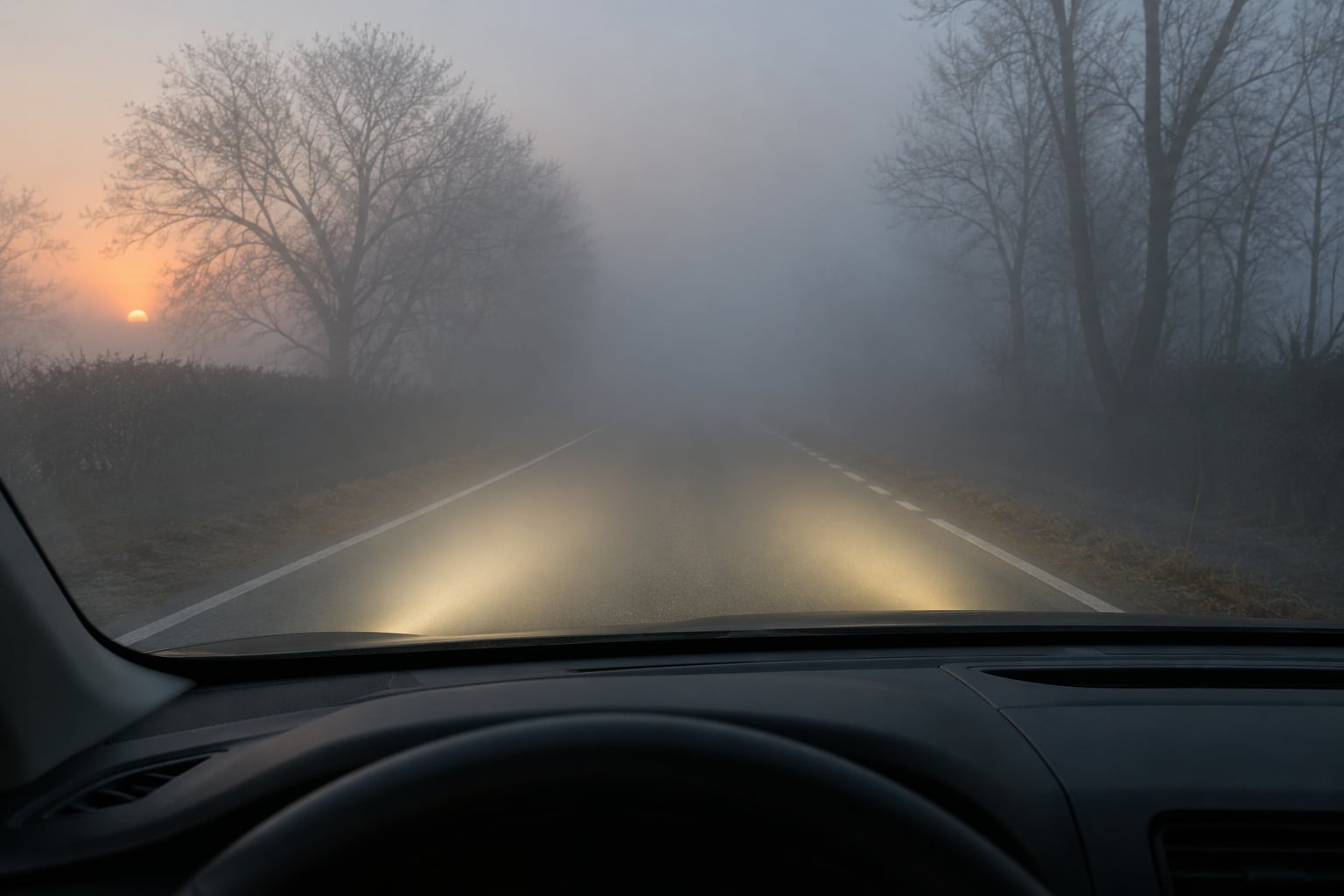
Low beams point down, which keeps your light on the road rather than in the air, where fog droplets send it straight back at you. Switch them on before you need them. Front fog lights help by lighting the near edge of the road where there is no rival beam to compete with them.
High beams are the opposite. The light hits the fog, scatters back, and you get a white wall where the road used to be. Backscatter makes a driver see less than they would with their lights off, so high beams in fog are actively dangerous.
Rear fog lights are for genuinely poor visibility. Other drivers can see them, which is useful, but they are dazzling to anyone behind you, so switch them off the moment visibility improves. Hazard lights are different again: they are for a stationary or crawling vehicle showing a stopped vehicle ahead, not for general driving. Local rules vary, so check yours. If you are unsure about which switch does what, one calm minute in a parked car removes all doubt.
Leave Space and Drive Smoothly
Double your normal following distance in moderate fog and triple it in dense fog. The reason is reaction time, and fog eats it: you are not just seeing the obstacle later, you are recognising what it is later still. If the vehicle ahead defines the pace, you can never outrun your own visibility.
Small inputs only. Brake gently and early, steer smoothly, and stay out of the cruise control — it holds a speed you chose before the fog, which is exactly the wrong speed now.
For orientation, use whatever is still there: lane markings, the solid edge line, reflective road studs, roadside delineator posts, and the shapes of trees and shadows. Where lane markings disappear, do not drift. Hold your line and let the studs or posts count the distance for you. Cracking the driver’s window a couple of centimetres gives you an early warning of vehicles you cannot yet see.
Pull Over Safely When Visibility Drops
Giving up a few minutes is the correct decision, not the wrong one. Nobody behind you has ever criticised a driver who pulled off to wait for a fog bank to thin.
Use the nearest safe place: a lay-by, a refuge area, a rest stop, or the far verge where there is solid ground well clear of through lanes. Avoid bridges, bends, hill crests, junctions and entrances, where a stationary vehicle is hardest to avoid.
Come in gradually, signal, and stop as far from the traffic side as you can. Turn on your hazards. Stay in the vehicle with your seatbelt on unless leaving it is genuinely safer, and never walk back along a motorway or fast road to investigate a marker you cannot see. Call emergency services from the car if you need to, and follow local guidance about where you are allowed to wait.
Common Mistakes
Every one of these makes fog more dangerous, and every one is easy to fix once you know it is happening.
- Driving at the posted limit. Fix: pick a speed from your visibility, not from the sign.
- Following two seconds behind. Fix: double it in moderate fog, triple it in dense fog. Count the studs if counting seconds is hard.
- Switching on high beams to see more. Fix: low beams only. Backscatter makes it worse, not better.
- Leaving rear fog lights on after it clears. Fix: switch them off the moment you can see the road edge clearly again.
- Staring hard into the fog. Fix: look at the near road surface and the left edge line, not at the grey wall. Fixed staring tightens your neck and your grip.
- Making a sudden lane change to find a clearer view. Fix: hold your lane. What you cannot see is in that lane.
- Checking the phone manually. Fix: hands-free only, and only when stopped.
- Forcing the drive through. Fix: fog thins. Arriving late beats not arriving.
And if the fear shows up after the drive, that is normal after a low-visibility scare. Most drivers feel steady again after a day or two, and driving again in daylight or light fog rebuilds confidence quickly. The regular advice from people who deal with driving anxiety is to go back to it in easier conditions rather than avoid it, because avoidance tends to make the fear grow. If the anxiety is persistent, shows up in clear weather too, or affects daily life, that is worth raising with a GP or a driving anxiety course.
Frequently Asked Questions
How do I know when fog is too dangerous to keep driving?
The clearest sign is that you can no longer see the road edge, the lane markings or the vehicle ahead without straining. A second sign is that you have slowed down instinctively, which means your body has already judged the visibility unsafe. As a working rule, if you cannot make out a person standing 100 metres ahead, treat the drive as unsafe and pull into the nearest lay-by to wait.
Are front and rear fog lights legal in heavy fog?
Generally yes, and in heavy fog they are exactly what they were designed for. Front fog lights light the near edge of the road where there is no beam of your own to compete with. Rear fog lights warn traffic behind you that visibility is poor, but they dazzle drivers who are following closely, so they should be switched off as soon as the fog thins. Rules vary by country, so check what applies where you drive.
What should I do if the car ahead suddenly disappears from view?
Ease off the accelerator and leave the accelerator alone rather than stamping on the brake. Close your eyes briefly or lift your gaze for a moment to let your eyes refocus, then look for the tail lights, the glow of the dashboard reflecting off the fog, or the road markings reappearing. Keep both hands on the wheel, hold your lane and stay patient until the outline returns. Never make a sudden move to find it.
How do I stop my windscreen from fogging up while driving?
Run the windscreen demister on high and point the footwell vents at the glass as well, because a lot of interior condensation forms low down. Crack a window open to let moist air out, keep the air conditioning on cold if you have it, and use the fresh-air setting rather than recirculate, which locks damp air into the cabin. Clearing the glass from the outside with a scraper before you set off prevents most of it.
What should I do after a near miss in fog?
Pull over somewhere safe and switch the engine off. Being shaken after a near miss is a normal response, and most of the anxiety fades within a few hours. Talk it through with someone, and before driving again in similar conditions, check what actually went wrong: usually it was speed, gap or a late reaction rather than the fog itself. Persistent anxiety after a scare is worth discussing with a GP.
Conclusion
Knowing how to drive through fog without panicking comes down to one habit: slow down before the visibility drops, not after. Put your low beams on, add the front fog lights when you need them, leave a gap far bigger than feels normal, and make small inputs only.
If the road ahead is no longer clear, pull over and let it thin. Fog passes, and being late is a small price for getting there in one piece. Drive calmly and give the visibility, not the schedule, the final say.