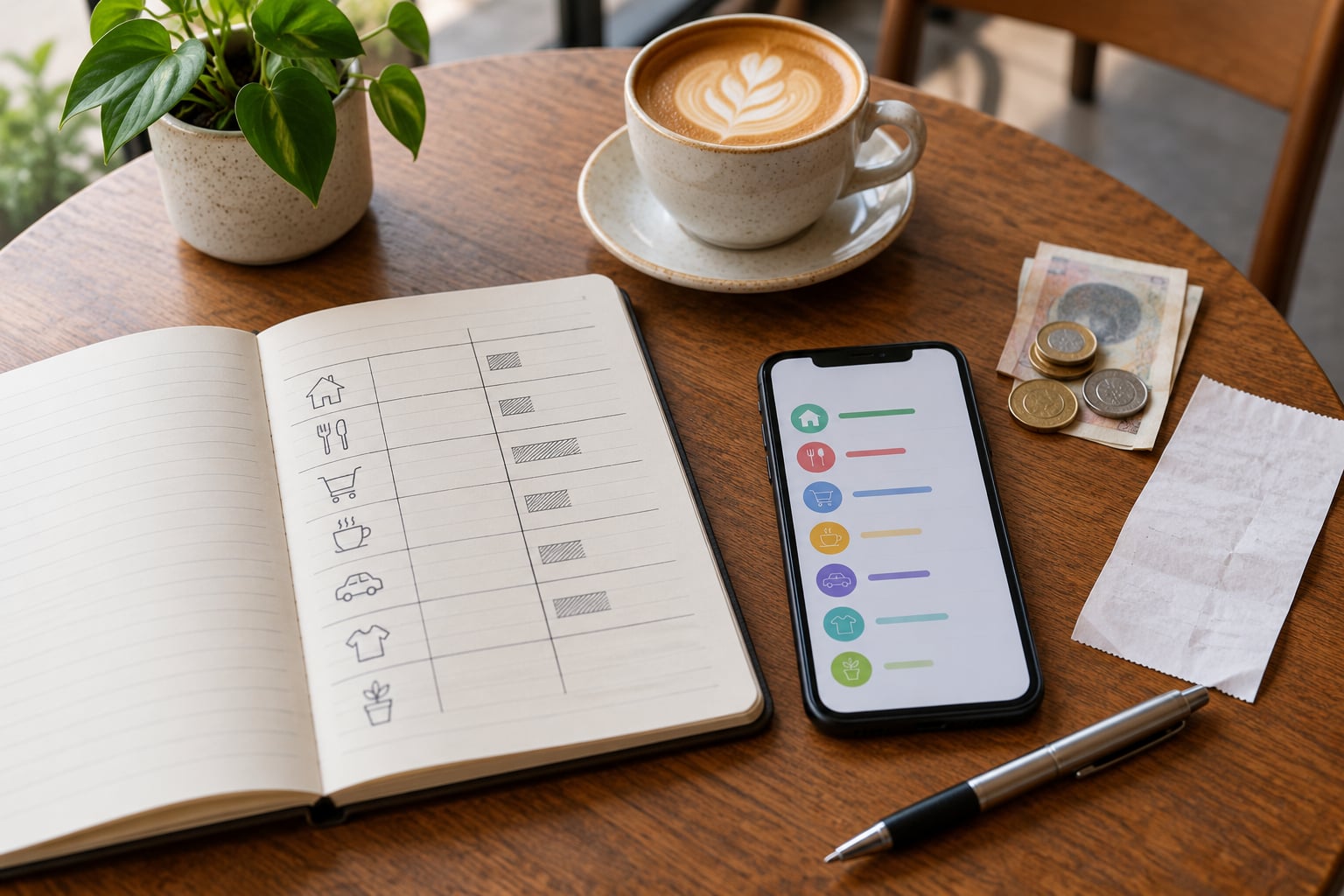
To track vacation spending without stress, you set one total and one daily figure before you leave, record what you actually spend once in the evening, and compare the running total against that figure. Most of the work happens in about ten minutes before departure and two minutes a day after that.
That last part matters more than it sounds. The trackers that fall apart are the ones that demand a record for every coffee, and the trackers that lie to you are the ones you update on the flight home when memory has already gone soft. One record, updated once a day, is the whole idea.
Here is the short version before the detail.
- Decide the total before you book, and split it into categories that mean something to you.
- Set daily spending limits only for the categories you actually control day to day.
- Keep one record. One. Not a spreadsheet plus an app plus a shoebox of receipts.
- Log in the evening, not at the moment of purchase, so a queue never slows you down.
- Reset once in the middle of the trip and adjust the days ahead, never the days behind.
Five habits, none of which take more than a coffee break. Here is where each one comes from.
Table of Contents
- What You Need
- Step-by-Step: How to Track Vacation Spending Without Stress
- Set Your Total Budget and Non-Negotiable Limits
- Use a Simple How to Track Vacation Spending Without Stress Worksheet
- Check the Tracker Once at the End of Each Day
- Use a Weekly or Midtrip Reset
- Reconcile Payments and Protect the Final Budget
- Common Mistakes
- Frequently Asked Questions
- What is the easiest way to track vacation spending while traveling?
- How should couples or families track shared vacation expenses?
- Should I track every small cash purchase during a trip?
- How do I record expenses paid in a foreign currency?
- What if I am already over budget partway through the vacation?
- When should I finalize my vacation spending record after returning home?
- Conclusion: Start With Today’s Spending
What You Need
Four things, and you almost certainly already own all of them.
A total trip budget. A single number you actually have access to, not a hopeful figure. Splitting it into categories comes in the first step.
Your payment methods, listed. Which card, how much cash you are carrying, and anything you will book on the way. You want to know this now, not when a card is declined at a station ticket counter.
A phone or a paper notebook. One device that comes with you. Your phone works fine for this, provided you accept that some entries happen without a signal.
A single place to record transactions. That is the entire tool list. You do not need accounting software, and you do not need a special travel app, though one can work if it is already installed and you like it.
One extra note for trips abroad: convert foreign amounts using the rate you get on the transaction date, not a rate you look up later. Currency conversion is roughly the only thing that makes a tracker feel dishonest, and it is entirely avoidable.
Step-by-Step: How to Track Vacation Spending Without Stress

Set Your Total Budget and Non-Negotiable Limits
Break your total into six buckets: accommodation, transport, food, activities, shopping, and a contingency buffer. The buffer is the one people skip and the one that saves the trip. A common recommendation is to hold back 15 to 20 percent of your total for the things you cannot plan, like a cancelled day booking or a taxi you did not order.
Accommodation and transport are largely decided before you leave, so treat them as fixed and subtract them from the total. What remains is your daily spending pool for everything else.
Now set a daily spending limit on the categories you genuinely control in real time: food, activities, shopping. No daily limit on accommodation. Splitting the remaining pool across your actual number of days gives you a figure that is useful rather than comforting.
Two things worth remembering. These limits are planning tools, not financial advice, and every threshold has a different cost of living behind it. Exchange rates, taxes, tips and local prices vary a lot by destination, so a daily number that works in one country is meaningless in another.
You will know it worked if you can say what you may spend on food tomorrow without checking anything.
Use a Simple How to Track Vacation Spending Without Stress Worksheet
One record, seven columns, and you are done. Each column earns its place.
- Date – which day the money moved.
- Category – food, transport, activities, shopping, accommodation or other.
- Amount – the number as it was spent.
- Currency – the currency of that number, so mixed trips stay readable.
- Payment method – cash, card, or booked online. This one pays for itself at the reconciliation stage.
- Who paid – only if you are travelling with other people.
- Notes – anything you would not remember in three weeks, such as who the dinner was with.
Here is a worked entry, using an unnamed destination so the numbers stay generic. A market lunch: date Day 3, category food, amount a local amount at a spot exchange, currency that local currency, payment method cash, who paid you, notes street lunch rather than a seated restaurant.
Write it however you like, but write it the same way every time. Inconsistency is what makes people abandon a record, not the method itself. One travel planner thread put it plainly: people are not looking for a perfect system, they are looking for the thing they will still open on day six.
You will know it worked if you can total the Food column without rereading the notes.
Check the Tracker Once at the End of Each Day
Batch the day’s spending into one sitting, usually while you are back at the room before anyone else needs you. Five minutes, four moves: log the new entries, group them by category, compare each category against its limit, note anything unusual.
The unusual note is the one people skip and the one that pays. If the same number keeps appearing three days running, it is not a one-off and it is worth knowing.
Worked example. Your daily food limit is a flat amount. Day one you log breakfast, lunch and a takeaway, and finish comfortably under. Day two looks similar. On day three you realise you have been adding a second coffee every afternoon without counting it as a meal, and the food line is climbing faster than the days are.
None of that required a spreadsheet. It required noticing on day three instead of on the flight home, which is the entire return on the five minutes.
You will know it worked if each category has a running total you could read out loud in one sentence.
Use a Weekly or Midtrip Reset
Midway through, pause for twenty minutes and compare actual spending against the original plan. Look at two things: what is already booked and still ahead of you, and which categories have quietly drifted.
Then change the days ahead. Adjust tomorrow’s daily limit so the remaining pool covers what is left, and leave every past entry exactly as you wrote it. Rewriting history is how a tracker becomes fiction, and it is usually the first sign that the record has stopped being useful.
Unexpected costs get handled in a fixed order. Trim the flexible categories first: shopping, then dining out, then paid activities you were not that committed to. Reach for the contingency buffer next. Savings come last, if they come at all.
Everyone already using an envelope budget at home can treat the contingency as a vacation envelope that funds itself before departure, rather than a line item invented in week two.
You will know it worked if the rest of the trip still has a number attached to it that you are comfortable with.
Reconcile Payments and Protect the Final Budget
Reconciliation is the bit people postpone, which is exactly when the remaining money stops being obvious. Sort your entries into three piles: cash, card, and anything booked online. Cash is the pile that goes wrong first, because it leaves no trail behind it.
Check for duplicates next. An authorisation held on a card and settled a day later can look like two spending events if you logged it twice. Small differences between the amount you were charged and the amount your bank shows are usually currency conversion, not overspending.
On the final day, run this list before you leave the room.
- Money left in cash. Decide whether it counts as unspent budget or gets used, because the honest answer depends on whose money it is.
- Every shared expense, with who paid and who owes what.
- Pending card transactions that have not settled yet, so you do not count them twice.
- Receipts and records you need for reimbursement from an employer or for tax documentation.
That last item is the one worth keeping. If any of this trip is work-related, the standard advice is that an expense reconstructed from memory a month later rarely survives a request for proof.
You will know it worked if the amount in your account and the amount in your record are close enough that the difference has an explanation.
Common Mistakes
Recording only the big purchases. This is the most common one, and it is why people arrive home with no idea where a gap appeared. The three-figure items feel worth tracking and the small ones feel like noise, but the small ones are usually where the drift lives. Fix: record everything above whatever a coffee costs to you, and stop worrying about the rest.
Mixing currencies without a column for them. Add foreign and home amounts to the same row and you get a number nobody can interpret later. Fix: keep the original currency, add a converted value beside it, and use one consistent conversion date.
Tracking every single cash payment. This is the opposite error and it kills a system faster than skipping entries does. Fix: set a floor, such as ignoring small cash amounts, and record everything above it.
Sharing one total across a group without deciding who fronted what. Splitting a total at the end of the trip turns into an argument nobody enjoys. Fix: one row per person per expense, marked at the moment of payment, and a settlement conversation while receipts are still familiar.
Relying on a daily average. Averaging across the whole trip hides a bad day until there are no days left to fix it. Fix: check the running total each evening, and use the average only as a midtrip sanity check.
Changing the budget without writing down why. Moving a number with no explanation makes the whole record untrustworthy a year later. Fix: one line in the notes column. Future you will want to know that the second half was a long transfer day.
What keeps a system alive past the first three days is unglamorous. Record at the same time each day so it becomes attached to something you already do. Keep the record in the same place every time. And forgive yourself for a gap, because a day you skip is recoverable and a week you abandon is not.
Frequently Asked Questions
What is the easiest way to track vacation spending while traveling?
A note on your phone with a running total, updated once in the evening, is the lowest-effort method that still works. Set a total and a daily figure before departure, then add the day’s spending to the same record every night. Dedicated travel expense apps work well too, particularly for groups, but only if you enjoy opening them. The best tracker is the one you will still use on day six, not the most capable one.
How should couples or families track shared vacation expenses?
Keep one row per person per expense, marked with who paid, rather than one shared total you divide at the end. Shared-accommodation and shared-car costs work best as one row with a note about who shares it. Shared-cost apps handle the arithmetic, but whatever tool you use, capture who paid while people still remember.
Should I track every small cash purchase during a trip?
No, and trying is the fastest way to abandon a tracking system. Set a floor you are comfortable ignoring, such as small cash amounts below a coffee, and record everything above it. Cash is the category that most needs attention, because it is the only one that leaves no transaction trail later. Record enough to protect the daily limit rather than trying to capture everything.
How do I record expenses paid in a foreign currency?
Keep the amount in the currency you paid and add the converted value in your home currency beside it, using the rate available on the day of the transaction. Converting later at a single rate makes your running total wrong in ways you cannot explain. A small difference between the rate you saw and the rate your bank applied is normal, not overspending.
What if I am already over budget partway through the vacation?
Sort what is already booked, then adjust the daily limits for the days ahead and leave past entries alone. Trim flexible categories first, such as shopping and dining out, then draw on the contingency buffer you set at the start, and use savings last if at all. Rewriting your record to look better only removes your ability to make the next decision well.
When should I finalize my vacation spending record after returning home?
Within a week, while card transactions and receipts are still fresh in your inbox. Sort your entries into cash, card and online, check for duplicate charges from pending authorisations, and note any exchange-rate differences so they are not mistaken for overspending. Then turn the per-category totals into the basis for your next trip budget while the detail is still readable.
Conclusion: Start With Today’s Spending
Do one thing now rather than planning a perfect system. Work out your total, divide it by the number of days you will actually be there, and write down what you have already spent today.
That is the whole method. The point of tracking vacation spending without stress is not perfect records, it is knowing on day four instead of on the flight home, while there is still a day you can change.