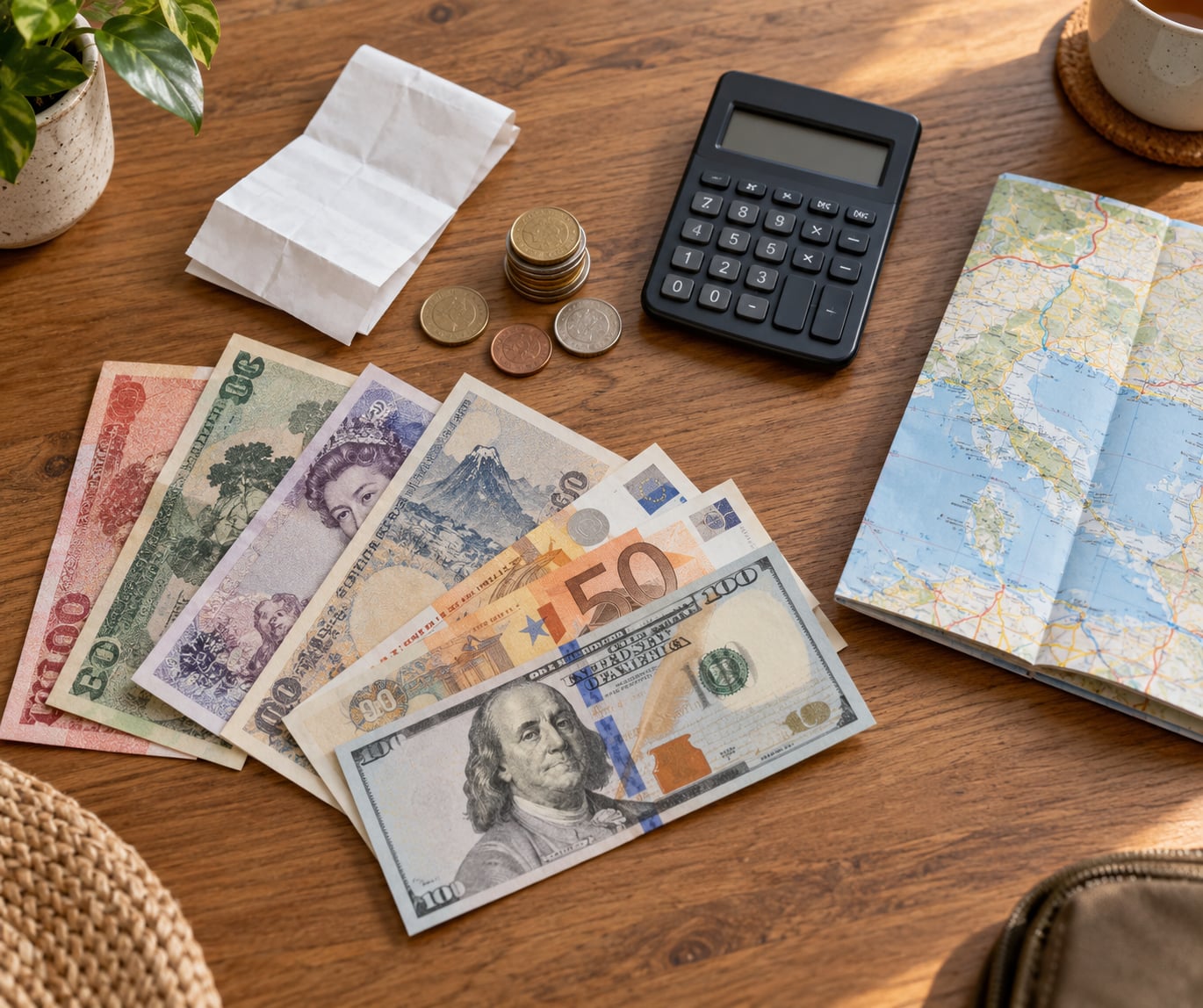
Most travelers get this wrong in one of two directions: they bring a wad they then spend nervously, or they bring nothing and freeze at the first market stall. The working answer to how much cash to carry on a trip is about 50 to 100 USD per person per day in local currency, plus a separate emergency reserve, which works out to roughly 150 to 300 USD per person for a typical week.
That figure assumes cards cover your hotel, your transport bookings and anything expensive. Cash fills the gaps: street food, taxis, tips, small shops, transit tickets, entry fees and the odd place where the terminal has no network.
Every amount below is a typical US dollar equivalent. Prices and cash needs vary by region and change over time, so treat the ranges as a starting point you adjust for where you are actually going.
Table of Contents
- How Much Cash to Carry on a Trip: Typical Amounts
- What Determines How Much Cash You Need
- How long you are away
- How card-friendly the destination is
- Local prices and the exchange rate
- ATM access and fees
- Tips, street food and small purchases
- Transport, tickets and deposits
- The backup method you carry
- How to Calculate a Safe Cash Amount
- The formula in one line
- A worked seven-day example
- How much cash to carry on a trip with kids
- Adjusting for expensive or cash-only places
- Where to Keep Cash While Traveling
- Split the total three ways
- What travels on your body
- What stays in the hotel safe
- If cash is lost or stolen
- Ways to Reduce the Cash You Carry
- Frequently Asked Questions
- What is a good amount of cash to carry on you?
- Is 100 USD a day enough for Europe?
- How much cash do I need for Japan?
- Can I fly with 3,000 USD in cash?
- Is the 10,000 USD limit per person or per family?
- What if my destination has limited ATM access?
- What to Do First
How Much Cash to Carry on a Trip: Typical Amounts
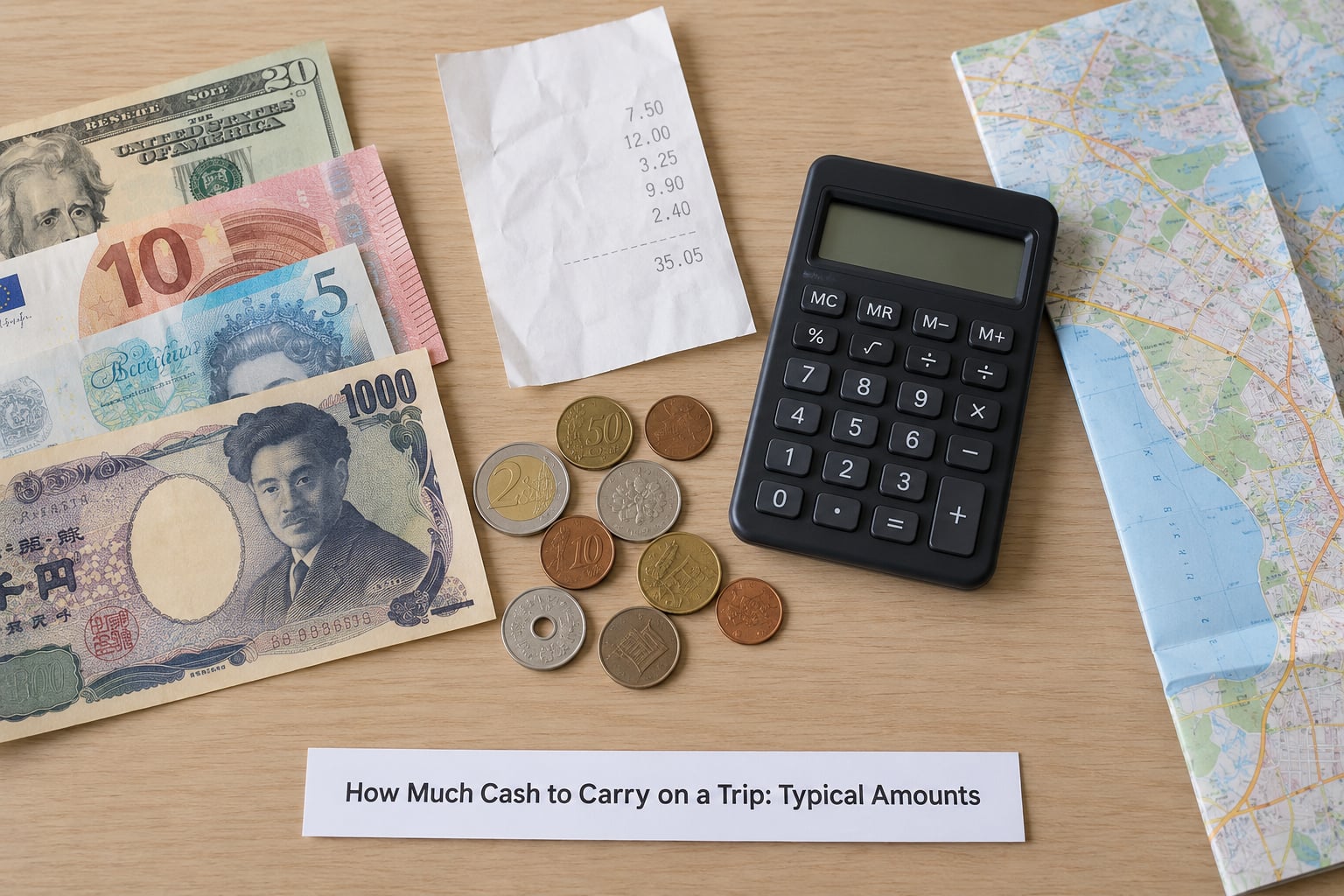
The clearest way to answer this is to split it into three pots: a daily spending allowance, an emergency reserve you do not plan to spend, and the cash you need in your pocket on the day you land.
| Trip type | Daily cash budget | Emergency reserve | Practical starting total per person |
|---|---|---|---|
| City break, 2 to 3 days | 50 to 80 USD | 100 USD | 200 to 350 USD |
| One week, card-friendly country | 50 to 100 USD | 150 USD | 500 to 700 USD equivalent, drawn as needed |
| Two weeks or longer | 50 to 100 USD | 200 USD | 700 to 1,000 USD equivalent, drawn as needed |
| Cash-only or cash-heavy destination | 100 to 200 USD | 300 USD | The full trip amount, carried |
| Rural, mountain or island trip | 70 to 120 USD | 200 USD | 500 to 900 USD equivalent |
| Cruise or all-inclusive resort | 30 to 60 USD | 100 USD | 200 to 400 USD for the whole sailing |
Notice that for most trips you are not carrying the total in your handbag. You carry two to three days of spending, plus your arrival cash, plus the reserve, and you withdraw the rest from a bank ATM when you need it.
What you actually need on arrival day is small and predictable: transport from the airport, the first meal, a tip or two, and whatever entry fee got charged online. In most destinations that is 60 to 120 USD per person. Have it in small notes, in local currency, in the front pocket.
What Determines How Much Cash You Need
Two travelers on the same itinerary can need wildly different amounts. These are the variables that move the number.
How long you are away
Cash needs scale with days, but not perfectly. A three-day trip needs enough to cover the awkward arrival moment, while a three-week trip only needs enough to get you to the first well-placed ATM. Most independent travelers land somewhere between 50 and 100 USD a day, with the first two days at the top of that range.
How card-friendly the destination is
Scandinavia, Singapore, South Korea and much of Western Europe run on cards almost everywhere. Japan and the UK are mixed: convenience shops and small restaurants are cash-only, chains and department stores take cards. Local markets, small guesthouses, taxis and tips stay cash-first almost everywhere, including destinations that advertise themselves as modern.
One regional detail worth knowing: cards may work perfectly in a capital city and fail two hours away in the countryside. Ask the property where you are staying whether the local buses, guides and restaurants take cards.
Local prices and the exchange rate
The exchange rate is doing real work in your budget. A stronger home currency stretches your cash further; a weaker one does not. Convert your daily allowance into local currency before you leave home so you are budgeting in the currency you will actually spend.
ATM access and fees
Where ATMs are common and free, you can travel light. Where you need a bank-branch ATM in daylight or cash is the default, you carry more. Forum travelers report all-ATM withdrawals costing several dollars once the home bank and the local bank both take a cut, which is the strongest argument for fewer, larger withdrawals.
Tips, street food and small purchases
This is the category that surprises people. Street food, market snacks, taxis, tips and public toilets add up to more cash than the big-ticket items, and none of it can be paid by card in many places. Budget 20 to 40 USD a day for tips and small purchases alone in a mid-cost destination.
Transport, tickets and deposits
Airport transfers, first-day train tickets, local transit cards and small damage deposits are often cash-only at the counter even when the booking was made online. Some guesthouses and rental agencies hold a cash deposit. Add 50 to 150 USD for a week of that, depending on how much transit you plan to pay for in cash.
The backup method you carry
A traveler with two cards from different networks, one with no foreign transaction fees, can safely carry less cash. A traveler with a single card and no backup should carry more, because cash becomes the fallback when that card is declined at an out-of-network ATM or blocked by a fraud alert.
How to Calculate a Safe Cash Amount
The formula in one line
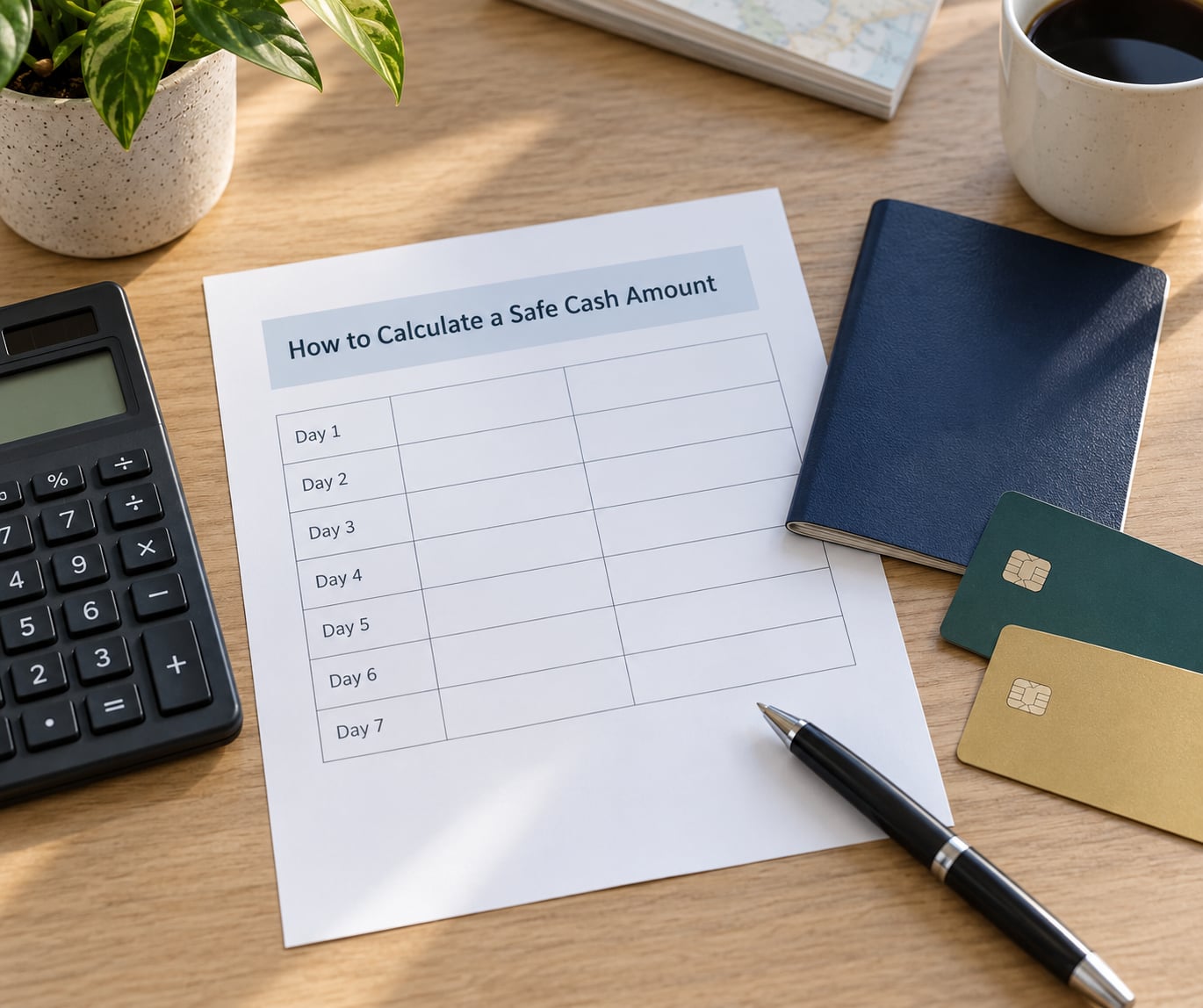
Multiply your daily cash budget by the number of days you are away, add your arrival-day cash, add 10 percent as a buffer, and keep the emergency reserve separate. The reserve is insurance, not spending money, so it never enters the multiplication.
In practice: (days × daily cash budget) + arrival cash + 10 percent buffer + emergency reserve.
A worked seven-day example
A couple spending seven days in a mixed destination where accommodation and major transport are prepaid by card would work like this. Daily cash budget of 70 USD each for food, taxis, tips and small purchases. That is 490 USD for the week, plus 100 USD of arrival cash for the airport transfer and first dinner, plus a 10 percent buffer of 59 USD, plus a 200 USD emergency reserve held securely.
The working total is about 850 USD per person. But they only physically carry the arrival cash, two days of spending and the reserve, so roughly 340 USD. The rest is withdrawn in two or three larger installments from bank-operated ATMs during the week.
How much cash to carry on a trip with kids
Budget for the family, not the adult. Each adult plus each child needs a daily cash allowance, and children need more per head than adults because they buy snacks, drinks and small souvenirs with physical money. A family of four on a seven-day trip in a cash-heavy destination should plan 100 to 150 USD per person per day rather than the 50 to 100 USD an adult would use alone.
Split the physical cash: one adult carries the day budget for the adults, the other carries the money for the children and the day’s receipts, and a third amount stays secured. Never send the whole day’s cash with one person on public transport.
Adjusting for expensive or cash-only places
Doubling your daily budget for a high-cost destination is a reasonable first move, but for genuinely cash-only destinations you do not adjust the budget, you change the structure: you carry the full amount, because you will not be topping up from an ATM. Bring small, clean notes, since worn or torn bills get refused, and keep the total in more than one place.
Where to Keep Cash While Traveling
No storage method makes cash safe in an absolute sense. Splitting it lowers the damage when something goes wrong, which is the goal.
Split the total three ways
One third stays on your body, one third goes in a locked place at your accommodation, and one third stays as a backup you would only use in an emergency. Travelers who split this way rarely lose more than one portion at a time.
What travels on your body
Carry only what you need for the day plus a little more, in a front pocket or zipped inner pocket, in small notes. A money belt worn under clothing works well for larger amounts, but only if you will actually take it off in a bathroom, because a belt you never opens is cash you never reach. In crowded markets, buses and pickpocket hot spots, move the day’s cash around your body rather than keeping it in one pocket.
What stays in the hotel safe
Use the room safe for the bulk, or a locked bag in a fixed location, and keep a written record of what is hidden where. Not every room safe is well made, so keep your most valuable cash on your person and treat the safe as a deterrent rather than a guarantee.
If cash is lost or stolen
Step one is safety: get somewhere staffed and secure before you do anything else. Then cancel and replace your cards, notify your bank so the remaining cash and cards can be frozen if needed, and report the loss to local police if the amount is significant, because insurers and banks often ask for a report number. Photograph your cards front and back before you travel so replacements are fast, and tell your insurer about the trip in advance.
Ways to Reduce the Cash You Carry
Most trips need far less cash than instinct suggests. A few habits shrink the amount you have to expose.
- Pay by card where cards are genuinely accepted. Hotels, restaurants with table service, transport bookings, museums and larger shops all take cards in most destinations.
- Use ATMs operated by established banks. Bank-branch and bank-affiliated ATMs charge less and are less likely to be tampered with than standalone machines in shop windows.
- Withdraw larger amounts less often. Each withdrawal can cost a few dollars in fees, so three withdrawals of 150 USD cost less than six of 75 USD.
- Decline dynamic currency conversion. If an ATM or terminal offers to charge you in your home currency instead of local currency, say no and let the transaction settle at the real rate. The offer usually carries a hidden spread of several percent.
- Notify your bank before you leave. A travel note on your account prevents your card from being blocked abroad, and it tells you which of your cards are usable on that trip.
- Carry a second card from a different network. One card blocked, frozen or skimmed should not end your access to money.
- Budget meals and transport in advance. Deciding where the day’s spending goes keeps the cash envelope from emptying on a taxi ride you did not plan for.
- Keep the emergency reserve intact. It is not part of the trip budget, and treating it as one is how travelers end up spending their safety net on a souvenir.
Frequently Asked Questions
What is a good amount of cash to carry on you?
Carry enough for the current day plus one extra day, in small notes, in a front or inner pocket. For most trips that is between 100 and 200 USD in local currency on your body at any time. The rest of your trip money belongs in your accommodation safe or a money belt, topped up from bank ATMs as you go.
Is 100 USD a day enough for Europe?
It is enough for a traveler whose hotel, transport and major meals are paid by card, because daily cash covers coffee, a market lunch, local transit, a taxi and tips. It is not enough if you are buying a daily train pass, eating two restaurant meals a day or staying in high-cost cities. Add 30 to 50 percent for expensive capitals or peak season.
How much cash do I need for Japan?
Plan roughly 80 to 150 USD per person per day in cash, plus about 300 to 500 USD carried as a reserve. Small restaurants, ramen shops, convenience store top-ups, taxis and temple entries are still cash, while chains, department stores and many attractions take cards. Train passes can be bought with cash at station counters even when bought online with a card.
Can I fly with 3,000 USD in cash?
Yes, in the United States you can carry and declare that amount without a problem. US Customs and Border Protection requires a cash declaration when you carry or receive more than 10,000 USD in currency or negotiable instruments, and the rule applies per person, not per family. Declare it in writing, keep the declaration receipt, and never split the amount to stay under the threshold.
Is the 10,000 USD limit per person or per family?
It is per person in the United States. Each traveler over 10,000 USD declares their own amount, so a family of four carrying 9,000 USD each has no reporting obligation in total, while one traveler carrying 40,000 USD does. Other countries set different thresholds: the European Union uses 10,000 euro and the UK asks for a customs declaration above 10,000 pounds sterling. Rules change, so check the official customs site for your route.
What if my destination has limited ATM access?
Treat that destination as cash-only from the start. Withdraw what the whole trip needs in the capital before you travel onward, use bank-branch ATMs in daylight, and carry the money split across two bags and worn under clothing. Confirm that your card works at the banks you plan to use, and expect to pay an ATM fee or two to get local currency there.
What to Do First
Decide your daily cash budget, add the arrival cash, and carry only two or three days of it plus your emergency reserve. Then notify your bank, pack a second card from another network, and withdraw the rest from a bank ATM once you land.