If you want to know how to get the best exchange rate abroad, aim for the mid-market rate, the midpoint between the buy and sell prices on the global currency market. Nobody pays it exactly, but you should land within about 1 to 2 percent of it. Most travellers lose far more to airport kiosks and dynamic currency conversion than the rate itself ever costs.
That gap is not trivial. The spread between the best and worst exchange method on a typical trip runs 10 to 15 percent of the whole budget, which on a 3,000 dollar trip is roughly 300 to 450 dollars. That is more than most people set aside for tips, souvenirs and a nicer dinner.
This guide covers the whole process in order: what to have ready before you go, how to compare the rate you are actually offered, and which mistakes quietly add a markup to every transaction. It should take about fifteen minutes of reading and ten minutes of setup a week before departure.
Table of Contents
- What You Need to Get the Best Exchange Rate Abroad
- Step-by-Step: How to Get the Best Exchange Rate Abroad
- Check the Current Mid-Market Rate
- Compare the Final Exchange Rate and Total Fees
- Choose Where to Exchange or Withdraw Money
- Get the Best Exchange Rate Abroad and Confirm the Transaction
- Common Mistakes That Lead to a Worse Exchange Rate
- Frequently Asked Questions
- Where can I get the best foreign currency exchange rate?
- How do I avoid a 3 percent international transaction fee?
- Is it better to get euros before I leave or once I arrive in Europe?
- Is it better to take cash or a card abroad?
- What is dynamic currency conversion and how do I avoid it?
- What do I do with unspent foreign cash when I get home?
- Conclusion
What You Need to Get the Best Exchange Rate Abroad
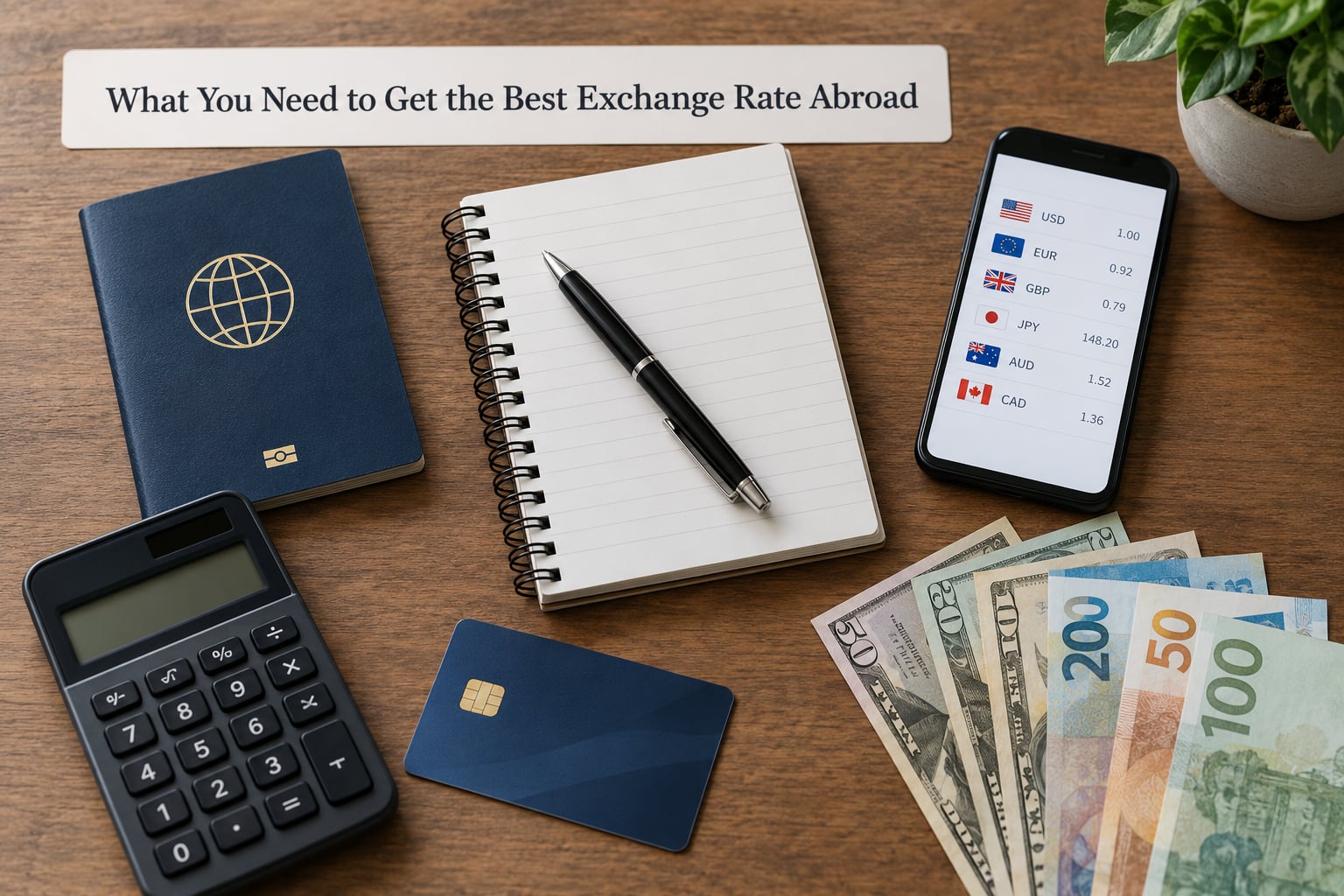
You do not need much, but you do need to check one thing many people skip: whether your everyday bank card charges a foreign transaction fee. Most do not advertise it on the front of the card, and it is usually somewhere in the schedule of fees in your banking app.
A debit card that adds 3 percent to every overseas purchase wipes out most of the gains from a good exchange rate. A card with no foreign transaction fee, or a multi-currency travel card, does not. Finding that out before you book is the single highest-value thing on this list.
Here is what to have ready:
- The destination currency and its code, so you are comparing the right pair. Japan is JPY, not yen-per-euro.
- A card with no foreign transaction fee, ideally a second one held somewhere separate.
- Photo identification, for airport arrivals and for exchange counters that ask.
- A second payment method, in case one card is blocked or skimmed.
- A phone with reliable data or a screenshot of the rate. You need this at the counter, not two weeks earlier.
- A calculator on your phone, because comparing two rates by eye is where people lose money.
- A rough idea of how much cash you need, so you are not converting the whole trip budget on arrival.
Step-by-Step: How to Get the Best Exchange Rate Abroad
The order matters. Most people do this backwards, grabbing cash at the arrival hall before they know what the rate should be. Work through these four steps instead, and the rate problem solves itself most of the time.
Check the Current Mid-Market Rate
The mid-market rate is the midpoint between what banks pay each other for a currency on the global market, before any fees, commissions or margins. Search your currency pair on Google or XE and you are looking at it. The European Central Bank publishes reference rates daily for euro pairs, which is a good neutral benchmark for anything priced in euros.
Treat it as a measuring stick, not a shopping price. A provider has to cover staff, rent, compliance and profit, so the honest question is not “who pays mid-market” but “who gets closest to it”. Anyone more than about 1 to 2 percent away is charging you something you could have avoided.
One warning that came up repeatedly in traveller forums: the number in your bank app and the number on Google can look wildly different, and it is usually not a scam. Your bank may quote a rate with its own margin baked in, or it may simply be a stale rate from earlier in the day. Either way, compare against the live mid-market figure, not against the bank’s own app.
Compare the Final Exchange Rate and Total Fees
Every provider earns in one of two ways: a fee printed on the screen, or a markup hidden inside the rate itself. Because the second one is invisible, the only fair comparison is the amount of foreign currency that actually lands in your account or hand.
Do the arithmetic yourself. If the mid-market rate is 1.20 and the provider offers you 1.19, the markup is (1.20 minus 1.19) divided by 1.20, which is 0.83 percent. It looks like almost nothing on the screen. It is the number that matters.
Scale it up and it gets uncomfortable. On a 3,000 dollar budget, a 10 percent markup costs about 300 dollars, and a 3 percent foreign transaction fee costs about 90 dollars. Those are the two figures to hold in your head when a provider quotes you a “no fee” rate. Working out how to get the best exchange rate abroad is mostly about which of those two numbers you are really paying.
| Where you exchange | Typical markup over mid-market | Who it suits |
|---|---|---|
| Airport kiosk or arrival hall | 8 to 15 percent | Nobody, unless you genuinely have nothing else |
| Hotel or guesthouse desk | 8 to 15 percent | Convenience only, and it is rarely cheap |
| Bank branch | 2 to 5 percent | Account holders who already have a relationship |
| Bureau de change in town | 3 to 7 percent | Small cash amounts in a cash-heavy city |
| Dynamic currency conversion | 3 to 8 percent | Nobody. Always decline |
| Online FX service | 0.5 to 2 percent | Planned conversions with delivery time |
| Multi-currency travel card | 0 to 3 percent | Most travellers who want a good default |
Credit and debit cards run on the card network’s wholesale rate, which is usually about 0.2 to 0.4 percent off mid-market rather than several percent above it. That spread is small and predictable, which is why a no-foreign-fee card beats almost every cash option for everyday spending.
Choose Where to Exchange or Withdraw Money
The cheapest places to get local money are the ones a resident would use: a bank branch in town, a supermarket, a convenience-store ATM, or a specialist exchange office on a main street rather than in a tourist strip. Airport counters exist because travellers have no choice at that moment, and the price reflects exactly that.
For cash specifically, compare three things: the quoted rate, any commission charged per transaction, and whether that commission is a flat fee or a percentage. A small bureau de change with a low markup but a fixed commission can be better for 100 euros and worse for 1,000. Travellers on r/PersonalFinanceCanada described a Vancouver currency shop selling 100 euros for 152 Canadian dollars, about 1.3 percent above mid-market, and treating that as a good outcome. It is a reasonable rate. It is not the best one.
If you do need airport cash, convert a small amount, maybe 50 to 100 in local currency, enough for transport, a tip and a coffee on arrival. Then get the rest in town. That is the standard advice on r/TokyoTravel, where people also point travellers toward convenience-store ATMs like 7-Eleven over money changers, because the rate is better and it takes about a minute.
Withdraw in fewer, larger amounts. Most banks charge a flat fee per withdrawal, sometimes a couple of dollars, so five withdrawals at 40 dollars each can cost more in fees than one withdrawal at 200. Check the daily withdrawal limit in your app first so you do not get stuck at a machine mid-city with a declined card.
Get the Best Exchange Rate Abroad and Confirm the Transaction
At the counter or the terminal, set the transaction to the local currency before you confirm anything. If a machine or a card terminal offers to convert the amount into your home currency, that offer is dynamic currency conversion, and the rate in it is 3 to 8 percent worse than letting your card network do the conversion. Say no every time.
The wording on the terminal is designed to sound helpful. You will see “Pay in USD?”, “Convert to your home currency?”, or “Charge you in your currency instead?” It reads like a convenience and it is a markup. One r/CreditCards thread describes a traveller picking dollars at a restaurant terminal in Rome because it seemed simpler to reconcile the spending later. That is a completely understandable instinct and it cost them roughly 4 percent.
Before you press confirm, check three things: that the amount is in the currency you intended, that the rate on the screen is close to the live mid-market figure, and that no “conversion fee” line has appeared that was not there before. If the numbers look wrong, walk away. There is always another option.
Then keep the evidence. Photograph the rate screen before you confirm, save the emailed receipt, and note the transaction in your banking app on the same day. Those receipts are what you use when you query a fee your bank charged, and querying is often successful.
Common Mistakes That Lead to a Worse Exchange Rate
Accepting dynamic currency conversion. It is the most common and most expensive mistake, usually 3 to 8 percent. Fix: always choose the local currency, and never let anyone tell you paying in dollars is “safer” or “simpler”.
Converting at the airport. Arrival hall kiosks commonly sit 8 to 15 percent above mid-market. Fix: take a small amount for the first few hours and do the rest in town.
Using the hotel desk. Convenience is priced at a markup, often similar to the airport. Fix: ask at the front desk which exchange office nearby has the best rate, then walk there.
Comparing headline rates instead of final amounts. A “0 percent fee” offer can still hide a 5 percent markup. Fix: calculate what you receive after fees, for a fixed amount of home currency, every time.
Ignoring your card’s foreign transaction fee. Three percent on every purchase adds up faster than most rate markups. Fix: check the fee schedule before you travel and switch to a no-foreign-fee card if yours charges one.
Using the first ATM you find. Independent machines in tourist areas are the ones most likely to add an operator fee of 3 to 8 dollars per withdrawal. Fix: use ATMs inside banks, supermarkets or convenience stores, where fees are lower or absent.
Withdrawing small amounts often. Flat per-withdrawal fees from your own bank quietly reverse the benefit of using an ATM. Fix: one larger withdrawal covers several days.
Carrying more foreign cash than you need. Unspent banknotes are hard to get rid of once you are home, and converting them back costs another spread. Fix: withdraw what you will realistically spend, then spend the rest in small shops before you fly.
Thinking timing the market matters. Rates move, but for a typical holiday the difference between a good and bad conversion date is noise next to the cost of a bad channel. Fix: choose the right method, not the right day. Long stays and expats are the exception, where holding several currencies or using rate alerts does have real value.
Frequently Asked Questions
Where can I get the best foreign currency exchange rate?
The best rates come from channels that add the smallest markup to the mid-market rate: a multi-currency travel card at 0 to 3 percent, an online FX service at 0.5 to 2 percent, or a no-foreign-fee bank card on card network rates about 0.2 to 0.4 percent off mid-market. For physical cash, use a bank branch or a reputable exchange office in town at 2 to 7 percent. Avoid airport kiosks and hotel desks, which commonly sit 8 to 15 percent above the benchmark.
How do I avoid a 3 percent international transaction fee?
Pick a card that charges no foreign transaction fee, and check the fee schedule in your banking app before you travel because it is rarely printed on the card. Pay in the local currency and decline every conversion offer at the terminal. Withdraw cash from ATMs inside banks or supermarkets rather than tourist-area machines, where operator fees of 3 to 8 dollars are common.
Is it better to get euros before I leave or once I arrive in Europe?
Once you arrive, if you can. Buying euros in advance means paying a home-market markup on top of whatever rate the market does. If you need some before departure, order from a specialist online FX service at 0.5 to 2 percent rather than a bank or airport counter, and take a small amount for the first hours. A traveller on r/UKPersonalFinance quoted 1.26 per pound on one service against 1.08 at a high-street holiday exchange on the same day.
Is it better to take cash or a card abroad?
Card, for most trips. A no-foreign-fee card uses the card network wholesale rate, roughly 0.2 to 0.4 percent off mid-market, with no cash handling risk. Cash still wins in cash-heavy destinations such as Japan and parts of Southeast Asia, at street markets, small shops, taxis and tips. Bring enough for arrival and the first day, then rely on cards or a bank-affiliated ATM for the rest.
What is dynamic currency conversion and how do I avoid it?
Dynamic currency conversion is an offer from a terminal or ATM to charge you in your home currency instead of the local one, using a rate the provider chooses rather than the card network’s rate. The markup runs about 3 to 8 percent. Always choose the currency of the country you are in. If the terminal asks whether to charge you in your home currency, the answer is no, every time.
What do I do with unspent foreign cash when I get home?
Spend it before you fly, in a supermarket, a cafe or a donation box at the airport. Most banks and exchange offices no longer accept foreign coins, and notes you bring back can only be sold back at roughly the same spread you paid, so you lose twice. Some airlines and travel cards will buy small amounts back, but at a poor rate. Converting ahead and bringing more cash than needed is the expensive version of this problem.
Conclusion
Check the current mid-market rate first, then compare what each option actually delivers after fees, not the headline rate it advertises. With that benchmark in your phone, an airport kiosk or a terminal offering to convert to your home currency becomes obvious and easy to refuse.
Most of the work happens a week before you fly: confirm your card charges no foreign transaction fee, tell your bank you are travelling so a card block is not a surprise, and decide how much cash you genuinely need. Do those three things and knowing how to get the best exchange rate abroad stops being a problem on the trip.