Yes, you can bring a cooler on a flight, in carry-on or checked baggage, as long as the cooler itself fits your airline’s size rules and the cooling medium passes security. Frozen gel packs and frozen water bottles are fine. Wet ice, slushy packs and dry ice each have their own rules. The container is almost never the problem; what is inside it usually is.
That is the whole answer in a paragraph, and the rest of this guide is the practical version. Last reviewed October 2026 against the published TSA and FAA guidance, but rules do change, so check tsa.gov and your carrier’s baggage page the week you fly.
The three things that actually derail people are predictable: an oversized cooler that gets forced into a sizer bin at the gate, ice packs that went slushy in the car park, and a leaking cooler that ruins everything around it in a checked bag. Each has a straightforward fix.
Table of Contents
- What You Need
- Step-by-Step: How to Bring a Cooler on a Flight
- Choose a Cooler and Cooling Method
- Check the Airline and Airport Rules
- Pack Food and Liquids Safely
- Get Through Security and Boarding
- Common Mistakes
- Frequently Asked Questions
- Can I bring a cooler as a carry-on?
- Is a cooler allowed through TSA security?
- Can I bring ice or dry ice on a plane?
- What foods can I take on a flight in a cooler?
- Should I pack the cooler or buy food after security?
- Do international airlines follow the same cooler rules?
What You Need
Gather these before you pack the car, because the shopping trip is what ruins the plan later.
- A cooler that fits your airline’s allowance. Measure it empty. A soft cooler you can compress and a hard cooler that fits 22 x 14 x 9 inches are very different objects to a gate agent holding a sizing bin.
- Cooling medium sized to the trip, not to the cooler. More packs than you need is just extra weight to check.
- Leakproof packaging. Sealable bags or containers, a heavy-duty bin liner, zip ties, and a towel or two.
- Ice packs frozen as solid as you can manage, plus a backup plan for slushy ones.
- Airline policy information for your exact carrier and route, including connecting airports.
- Customs and agriculture information for your destination if the food crosses a border. Homemade and fresh food is restricted far more often than people expect.
If you are carrying refrigerated medication, a doctor’s letter and a copy of the prescription are worth having in the cooler, not just in your phone.
Step-by-Step: How to Bring a Cooler on a Flight
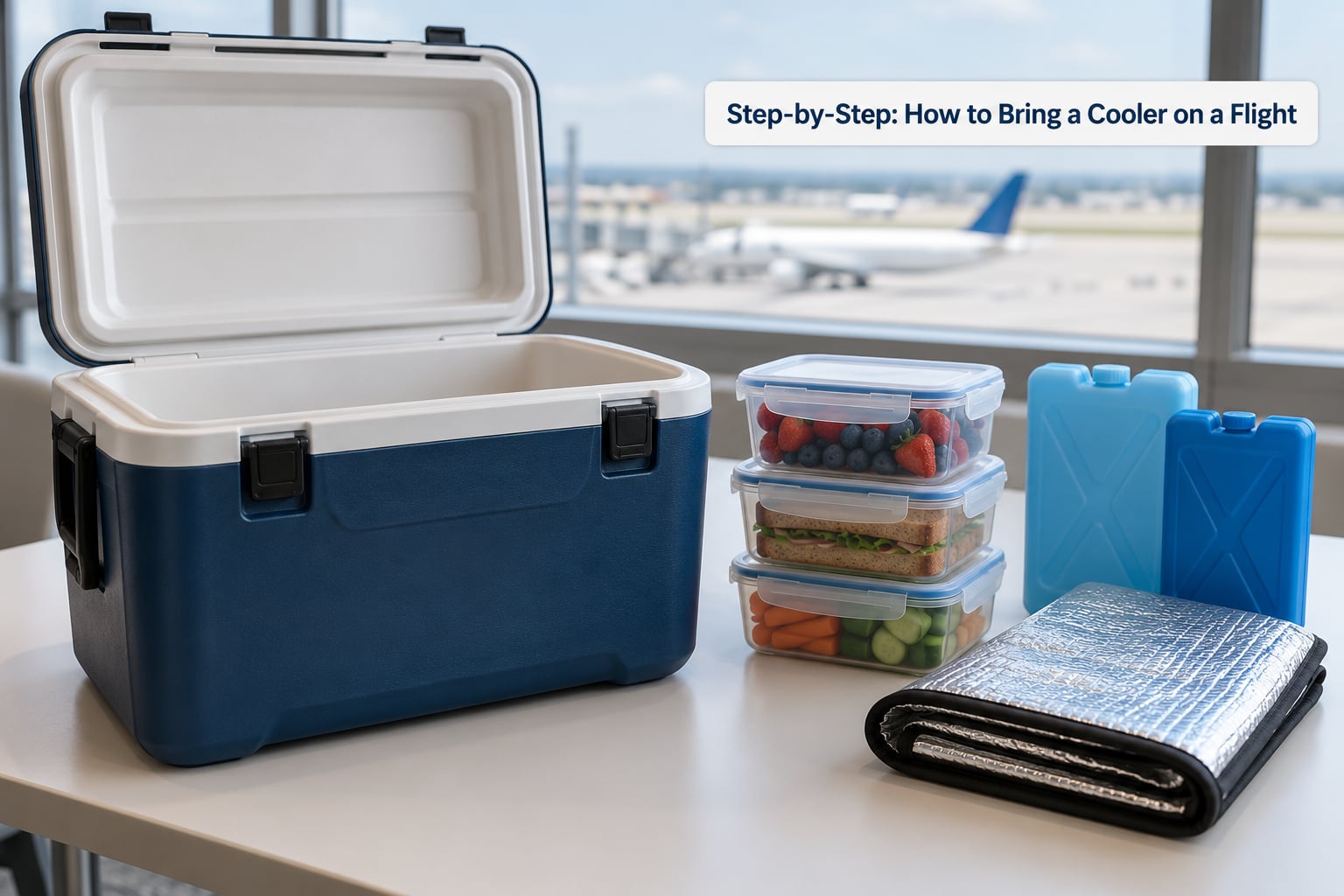
Choose a Cooler and Cooling Method
Any hard or soft cooler is allowed through security. Size and cooling method are what you have to get right, and those two decisions are really one decision: a short trip with a small carry-on cooler, or a long trip with a checked cooler holding a week of food.
A soft-sided cooler is the easier carry-on because it compresses into a sizer, and a hard cooler is the better checked bag because it survives handling. Neither is disallowed. What follows is how the cooling media that travel inside one compare.
Five options account for almost every cooler people fly with:
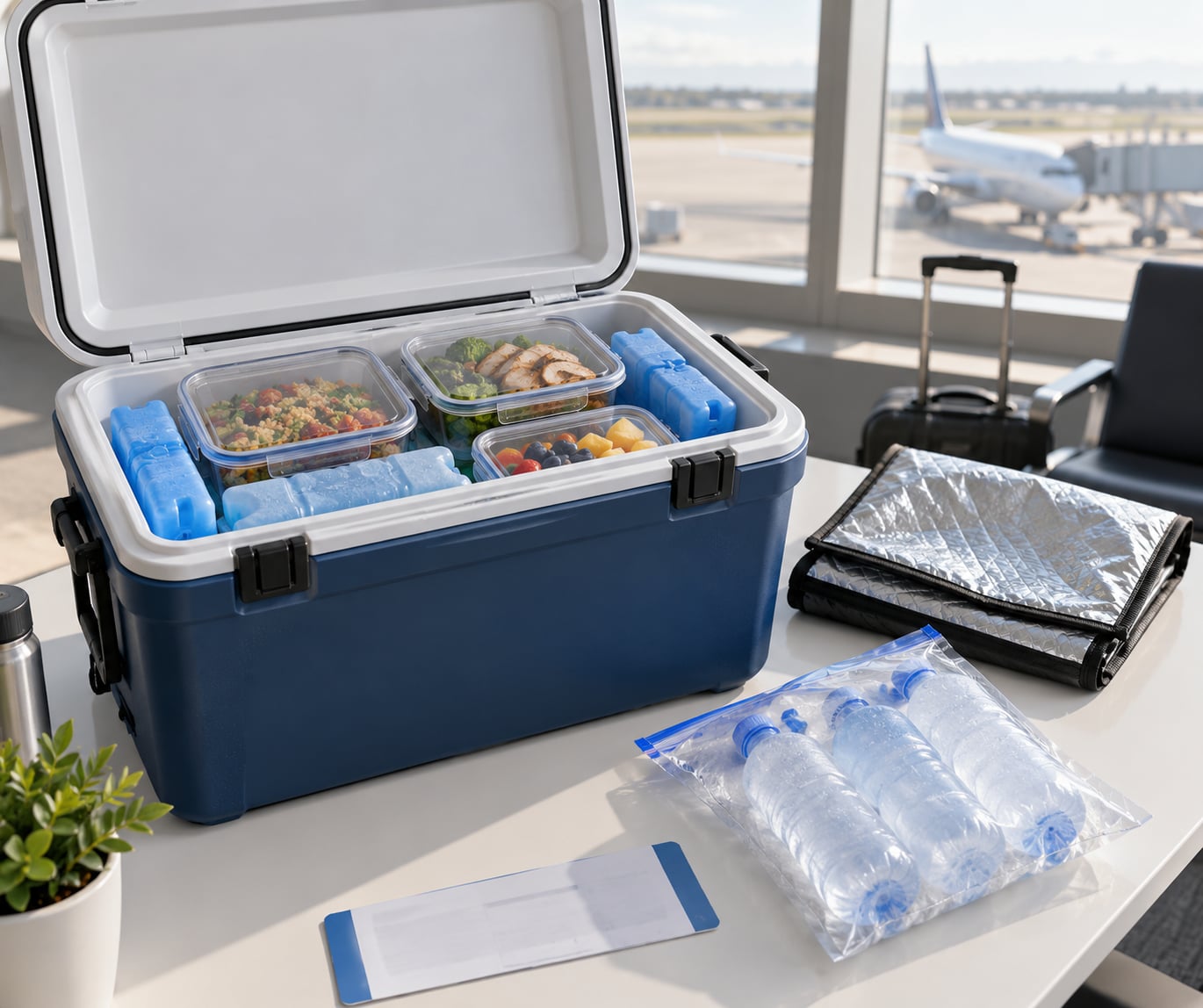
- Frozen gel packs. Allowed in carry-on and checked baggage, provided they are frozen solid at screening. The most predictable option, and the one a slushy pack can undo.
- Frozen water bottles. Same rule, and they double as drinking water on arrival.
- Ice in a cooler. Checked baggage only. At screening it is simply water, so it cannot pass in a carry-on, and expect meltwater in the bag.
- Dry ice. Allowed in both, up to 5.5 lb per passenger, with the airline’s written approval first, a vented container, the net weight labeled and the UN 1845 marking.
- Block ice frozen solid. Allowed in a carry-on if fully frozen. This is the one to judge at the checkpoint rather than at home.
The frozen solid test is the whole ballgame. TSA officers judge by looking at and handling the item, and their standard is whether anything is slushy, seeping or visibly melted at that moment. A pack frozen solid at 6am can be halfway to slush by the time you reach the queue at 9am on a hot day.
The frozen water bottle trick solves a surprising number of problems. Bottles are less prone to slushing than gel packs, they never raise a liquid question, and by the time you land they are often drinkable. Freezing them the night before, laid flat, gives you the best shot at a solid block.
Dry ice is the one people get wrong most. The FAA limit is 5.5 lb per passenger, the container has to be vented rather than airtight so the gas can escape, and the package needs to show the net weight of the dry ice plus the UN 1845 marking. Airlines also require you to get their approval in advance, in writing, and to state the amount. If any of that is missing, the package can be refused outright.
Check the Airline and Airport Rules
The security checkpoint and the airline are two separate authorities, and passing one tells you nothing about the other. TSA governs what goes through the scanner. The airline decides whether your bag fits in the overhead bin or on the carousel, and whether you pay a fee to check it. When you bring a cooler on a flight, treat those as two separate checklists.
The common domestic carry-on box is 22 x 14 x 9 inches, measured as length, width and height. Airlines also express the limit as 45 linear inches, which is length plus width plus height. A personal item is a second, smaller allowance, often around 18 x 14 x 8 inches, and only some carriers allow it. Checked bags on domestic routes are typically capped near 50 lb, and overweight fees climb fast.
Perishable food is a separate question again. Most carriers permit it, some count a heavy cooler toward your checked weight, and a few ask you to declare it. Read your carrier’s actual page rather than assuming, because the answer that travels with you on United is not always the answer you get on Southwest or JetBlue, and international carriers follow their own published limits.
If you connect, check every airport on the itinerary, not just the departure point. Rules in Europe, Canada, the UK and Australia differ from US domestic screening, and the strictest rule on the route is the one that gets your cooler opened at a mid-trip transfer.
On long connections, the time between screening and landing is the number that decides whether the food is still safe. Add the walk, the wait and the transfer to your packing calculation.
Pack Food and Liquids Safely
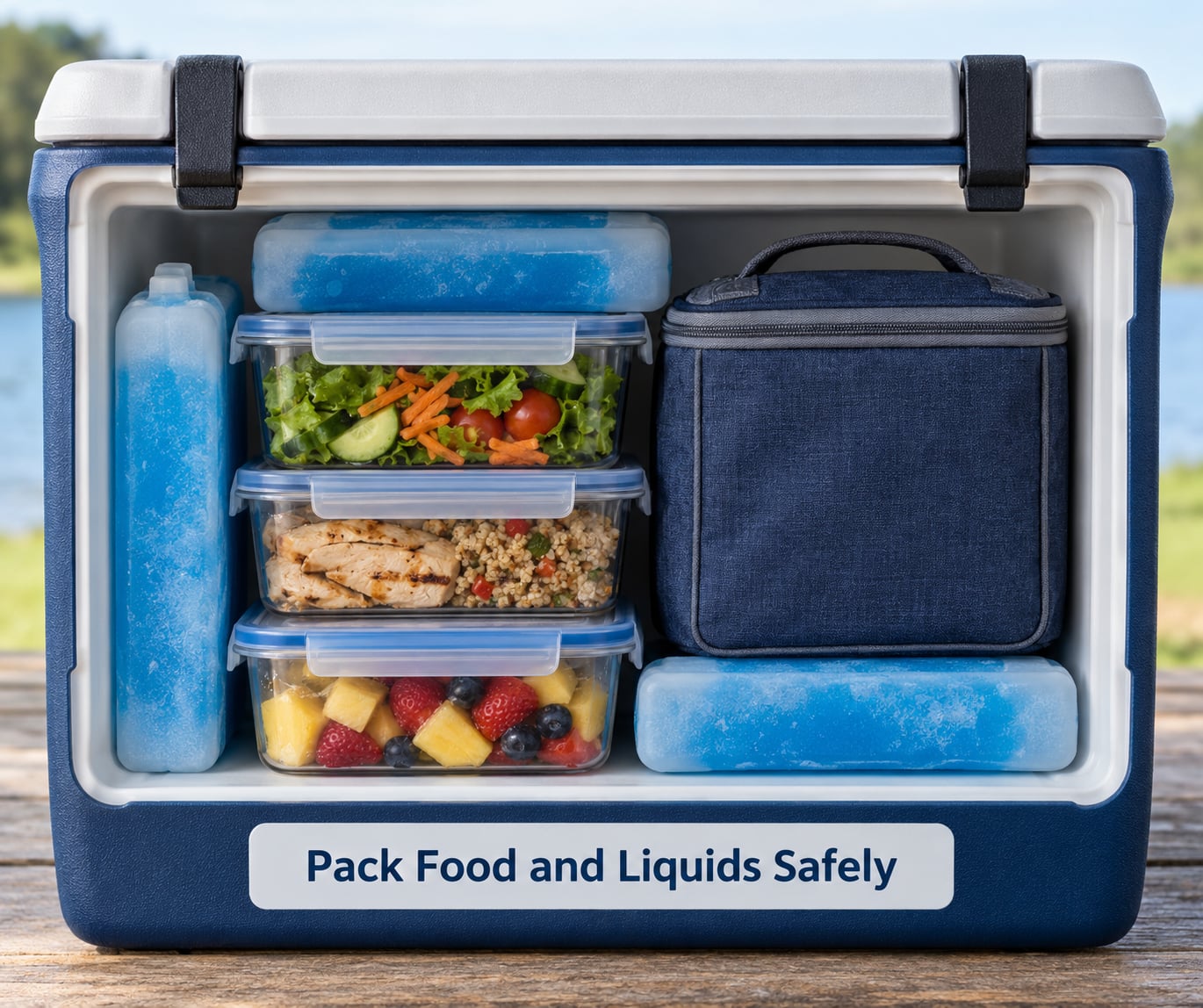
Solid food is the easy half. Sandwiches, cheese, crackers, whole fruit, dried snacks and cooked meat can all go through security in a carry-on with no liquid restriction. Repackaging is fine; nobody needs your food in the original store container, and original packaging is a source of leaks rather than protection.
Liquids are the regulated half. Sauces, dressings, condiments, beverages and anything that pours count as liquids, and in carry-on each container needs to be 3.4 oz or smaller, with all of them fitting in one clear quart-sized bag. Ice and gel packs are exempt only while they are frozen solid. Once melted or partly melted, they fall under the liquid rule and get thrown away at the checkpoint.
A few packing habits prevent nearly every problem:
- Double bag anything wet, in case the first seal gives.
- Keep raw meat, raw seafood and anything leaky physically separate from ready-to-eat food.
- Wrap the entire cooler in a heavy bin liner before it goes in a checked bag, and tape the liner closed. Meltwater then stays inside the liner.
- Lock or zip the drain plug, if the cooler has one, and put a towel in the bottom as a last line of defense.
- Fill empty space with a towel so containers do not slide and crack during handling.
- Label the outside with your name, phone number and destination address, since checked coolers are more likely to be delayed and less likely to be traced back to you quickly.
On cold-chain timing, be honest with yourself about the trip length. A well-packed cooler holds food safely through a long afternoon and an overnight, but a 14-hour itinerary with a four-hour layover is a different problem. For anything like that, frozen packs plus dry ice in a vented, labeled container is the combination experienced travelers use, and it is the one case where the extra paperwork pays for itself.
Get Through Security and Boarding
At the checkpoint, take the cooler out of your larger bag and put it on the belt by itself. That single move shortens the inspection and keeps you from unpacking a full roller in front of a line.
Tell the officer what is inside before you are asked, and open the cooler yourself if you can. TSA officers answering on Reddit advise strongly against wrapping or taping a cooler shut, because a sealed container gets a closer look and can slow you down or draw secondary screening. Easy to open is not a trick, it is just faster.
If a pack is slushy, expect to have it discarded. The practical backup is a bag of frozen items in a separate insulated tote that you keep closed until you are through, or packs that went into a freezer rather than a cooler right up until the last minute.
After security, keep the cooler closed. If it is your carry-on, put it in the overhead bin and expect gate agents to ask you to check it when the flight is full. If you want it guaranteed, check it at the counter on purpose rather than losing the fight at the door with perishables inside. In the cabin it also needs to be stowed, and an open cooler on a lap is not stowage.
Common Mistakes
Packing a cooler that is too big for the carry-on allowance. Measure the empty cooler, not the packed one, and add a small buffer. Fix: if the packed cooler will not compress into 22 x 14 x 9 inches, plan on checking it from the start.
Using loose ice in a carry-on. Ice is water, and water over 3.4 oz does not pass. Fix: use frozen gel packs or frozen water bottles instead, or check the cooler.
Arriving with slushy packs. The frozen solid test is applied at the checkpoint, not at home. Fix: freeze the night before, transport them in an insulated bag, and have a backup plan for anything that has gone soft.
Ignoring the dry ice paperwork. Over 5.5 lb, a sealed container, a missing net weight label or a skipped airline approval can all get the package refused. Fix: get written airline approval first, vent the container, and label the net weight and UN 1845 marking before you leave home.
Checking a cooler that leaks. Meltwater in a baggage system damages clothes and electronics, and other passengers’ bags sit next to yours. Fix: double bag, use a bin liner, and test the whole thing over your kitchen sink for an hour before you leave.
Overpacking perishables for the trip length. Food that thaws on a warm tarmac and sits is worse than food that was never packed. Fix: pack for the actual door-to-door time including layovers, and freeze anything that must last more than a day.
Assuming every airline treats a cooler the same. One carrier may count a heavy cooler as your checked bag, another may not, and a third may restrict dry ice more tightly. Fix: read your carrier’s current policy, and recheck when you fly, since these pages change without announcement.
On international routes, add one more layer. Customs and agriculture rules at your destination govern what you bring in, and they are far stricter than anything the departure airport will tell you. Fresh meat, raw seafood, homemade dairy and unpackaged food are the usual problem categories. Declare everything at the border, and expect to bin items you spent money on.
Frequently Asked Questions
Can I bring a cooler as a carry-on?
Yes, if it fits your airline’s carry-on allowance, which is commonly 22 x 14 x 9 inches. A soft-sided cooler that compresses into the sizing bin is the easiest option, though hard coolers within the limit are also accepted. Everything inside follows normal security rules: solid food is fine, liquids over 3.4 oz are not, and ice or gel packs must be frozen solid at screening. Be prepared to open the cooler for the officer on request.
Is a cooler allowed through TSA security?
TSA allows both hard and soft coolers in carry-on and checked baggage. The container is never the issue; the contents are. Solid foods clear without restriction, ice and gel packs must be frozen solid at the moment of screening, and dry ice is capped at 5.5 lb per passenger in a vented container with the net weight labeled. Tell the officer what is inside and open the cooler yourself rather than leaving it sealed.
Can I bring ice or dry ice on a plane?
Wet ice cannot pass through security in a carry-on because it counts as a liquid. Frozen gel packs and frozen water bottles are allowed only while frozen solid, and anything slushy or partly melted is treated as a liquid and discarded. Dry ice is allowed in both carry-on and checked baggage up to 5.5 lb per passenger, but the container must be vented, marked with the net weight and the UN 1845 designation, and approved in advance by the airline.
What foods can I take on a flight in a cooler?
Solid foods such as sandwiches, cheese, crackers, dried snacks, whole fruit and cooked meats pass security with no size limit, and they do not need to be in their original store packaging. Sauces, dressings, dips and beverages are liquids limited to 3.4 oz per container in carry-on. On international flights, check your destination’s customs and agriculture rules before packing, since fresh and homemade food is restricted in many countries.
Should I pack the cooler or buy food after security?
Pack it if the food matters to your trip, for example a special diet meal, breast milk, refrigerated medication or fish you caught. Pack it lightly and buy drinks after the checkpoint instead, since sealed beverages above 3.4 oz will be confiscated. A smart split is to bring the essentials in the cooler and pick up water, coffee and ice at your destination, which also saves weight.
Do international airlines follow the same cooler rules?
No. Security rules differ by country, so the screening standard at your departure, connection and arrival airports may not match the US domestic rules described here. International carriers also set their own size and weight limits and often require written approval for dry ice. On arrival, customs and agriculture officials apply the destination country’s import rules, which can override what security let you board with.
If you do one thing differently after reading this, measure the empty cooler against your airline’s carry-on limit and freeze your packs the night before. Those two steps prevent the majority of problems people run into. Then confirm the rest against tsa.gov and your carrier’s baggage page a few days before departure, because both change more often than anyone expects.