What items are not allowed in carry on bags boils down to four categories: liquids, gels and aerosols in containers larger than 3.4 oz (100 ml), knives and other sharp objects, weapons and self-defense items, and flammables or pressurized chemicals. Everything on the banned list either gets thrown away at the checkpoint or moves into your checked bag. Rules below are U.S. TSA screening rules, last checked in October 2026; your airline and your destination country can be stricter, so treat this as the floor rather than the ceiling.
One thing worth saying up front, because it causes more airport stress than any single item: the officer at the checkpoint has discretion. The written rules are the rules, but “allowed” is not a guarantee, and “banned” does not always mean confiscated. Everything below is what the Transportation Security Administration permits to pass into the cabin.
Table of Contents
- What Items Are Not Allowed in Carry On Bags at a Glance
- Liquids, Aerosols, and Gels That Cannot Go Through Security
- Toothpaste, mascara, and lipstick all count as liquids
- Things that look solid but are treated as liquids
- Powders and supplements
- Duty-free purchases and the exceptions
- Weapons, Tools, and Sharp Objects
- Lighters, Matches, and Smoking-Related Items
- Medicines, Medical Devices, and Special Needs Items
- Food, Animals, and Agricultural Items
- Items That May Be Allowed but Are Often Rejected
- Items travelers wrongly assume are not allowed in carry on bags
- How Airline and Airport Rules Differ
- How to Check Your Bag Before Leaving
- Frequently Asked Questions
- Can I bring a full-size bottle of shampoo in my carry-on bag?
- Are prescription medicines allowed through airport security?
- Can I carry a disposable lighter or matches in my carry-on?
- What should I do if I bought liquids after the security checkpoint?
- Are power banks allowed in carry-on bags?
- What if I am not sure whether an item is allowed?
- What to Do First
What Items Are Not Allowed in Carry On Bags at a Glance
Here is the fast version. Check your bag against this table before you leave the house, not at the checkpoint.
| Category | Not allowed in carry-on bags | Where it goes instead |
|---|---|---|
| Liquids, gels and pastes | Liquid, gel, cream, paste or aerosol containers over 3.4 oz (100 ml), including water, soda, shampoo, lotion, peanut butter, yogurt and soup | Checked baggage, or travel-size containers in one quart-size bag |
| Sharp objects | Pocket knives, multi-tools with blades, box cutters, straight razors, safety-razor blades, ice axes, tools longer than 7 inches | Checked baggage |
| Weapons and self-defense | Firearms, ammunition, pepper spray, mace, stun guns, brass knuckles, tasers, clubs | Checked baggage with airline notice, or left behind |
| Flammables and pressurized goods | Strike-anywhere matches, butane and lighter fluid, gasoline, spray paint, cooking spray, bleach, bear spray | Checked baggage or shipped ground |
| Aerosols and batteries | Non-toiletry aerosols, spare lithium batteries, cordless hair tools with gas cartridges, power banks in checked bags | Toiletry aerosols in the cabin; power banks carry-on only |
| Sporting equipment | Bats, golf clubs, hockey and cricket sticks, ski poles, pool cues, bows and arrows, skates with blades | Checked baggage, often as a separate sporting-equipment item |
| Items allowed with conditions | Medical liquids, prescription medicine, infant formula, breast milk, ice packs, duty-free purchases, e-cigarettes | Carry-on, declared to the officer and screened separately |
The table hides an important distinction. Some items are banned in the cabin but perfectly fine in a checked bag, like a hunting knife. Some are banned from checked bags but required in the cabin, like a power bank. A few are banned from both, like pepper spray and most flammables.
Liquids, Aerosols, and Gels That Cannot Go Through Security
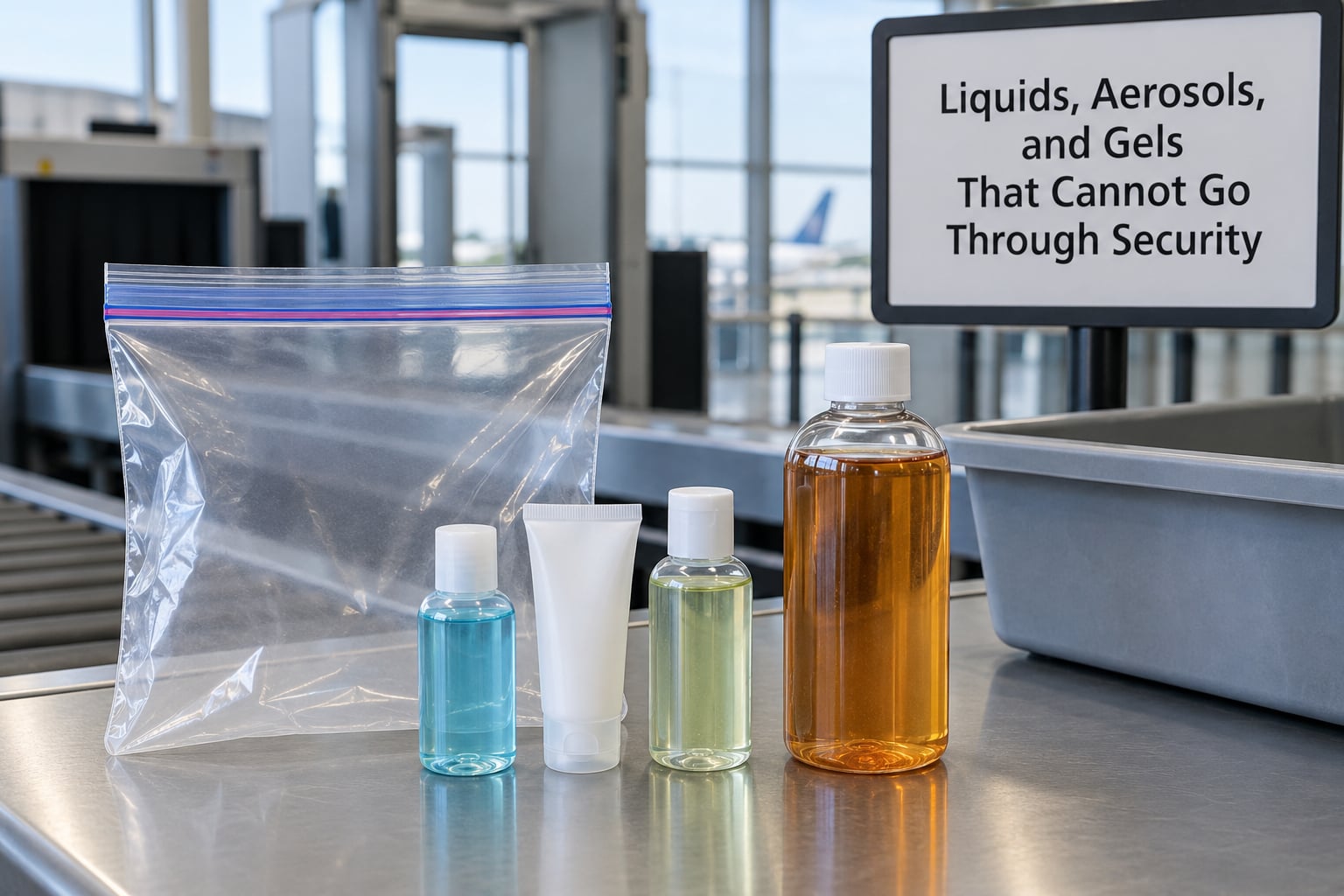
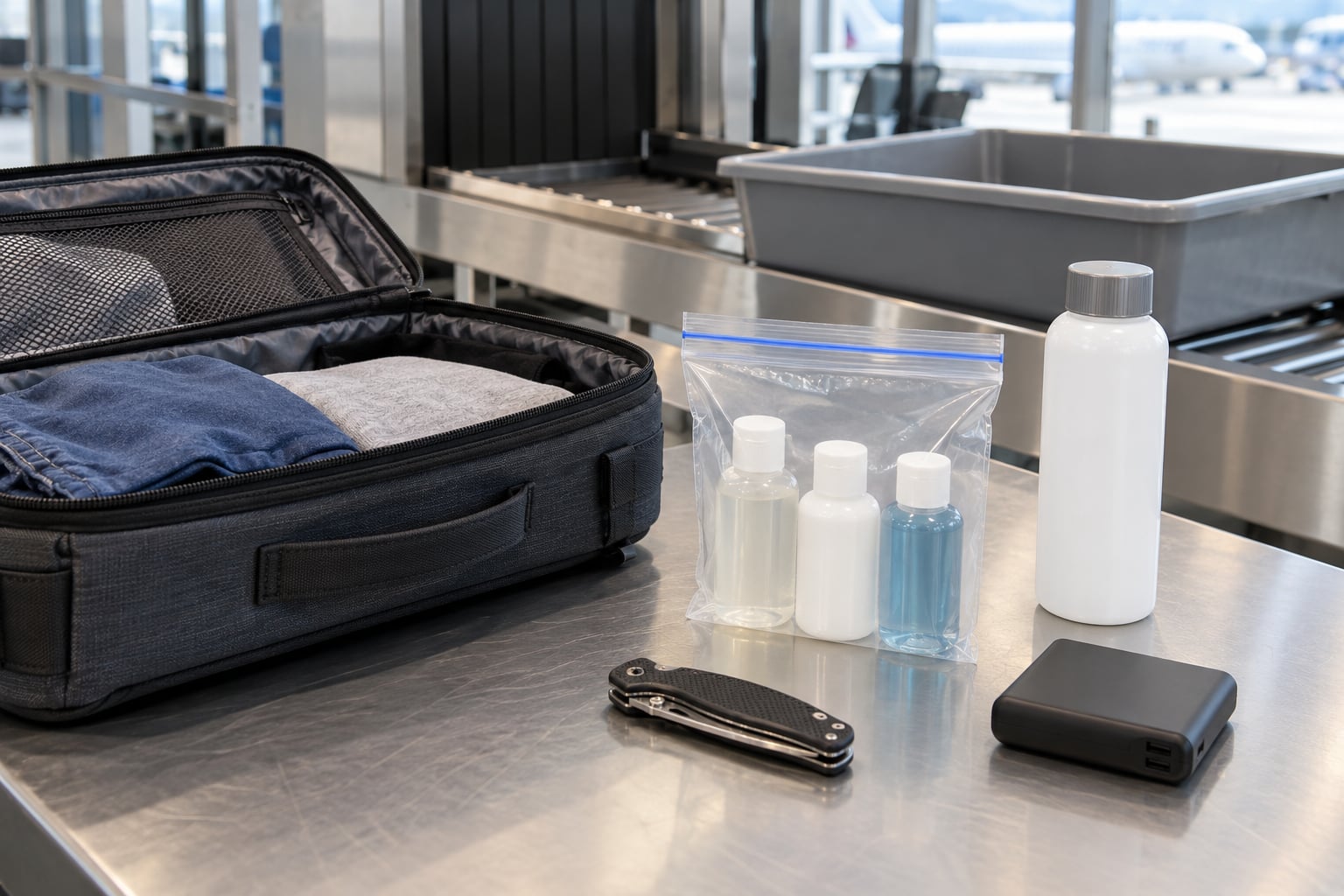
The liquid rule is the one that catches people out, and it comes down to a limit on container size, not on the amount inside. Under the 3-1-1 rule, each container may hold no more than 3.4 oz (100 ml), you may carry one quart-size resealable bag per passenger, and all of your liquid containers have to fit inside that one bag.
A worked example: three 3 oz travel bottles of shampoo, conditioner and body wash go through, because each is under the limit and all three fit in the quart bag. One 8 oz bottle of the same shampoo does not go through, even if it is half empty. A 4 oz bottle does not go through either, and TSA officers do open larger containers to check.
Toothpaste, mascara, and lipstick all count as liquids
Toothpaste is a paste, and paste is a liquid under this rule. Gel toothpaste is doubly so. A full-size 6 oz tube gets confiscated; a 3.5 oz or smaller tube goes through. That is the whole answer, and it is the same answer for mascara, liquid eyeliner, foundation, lotion, sunscreen, and lip gloss. Lipstick and chapstick are solids and pass through, though a large tube of lipstick can draw extra screening.
Things that look solid but are treated as liquids
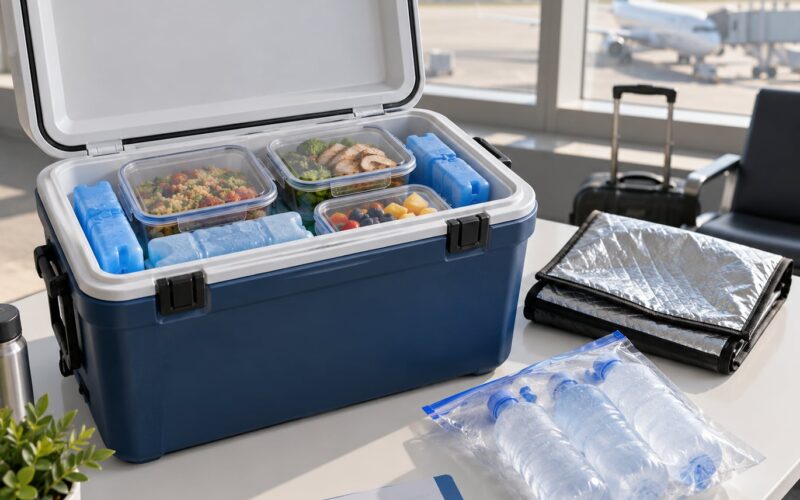
This is where most surprises happen. Peanut butter, yogurt, soup, ranch dressing, honey, salsa and gel candy are all liquids or gels. Wet wipes are allowed but can be pulled aside for a closer look because the packaging can resemble a liquid. Snow globes are not allowed in carry-on at all, liquid and all. Ice packs and frozen gel packs are allowed, though they need to be frozen solid at screening or they count as liquids.
Powders and supplements
Loose powder in a container larger than 12 oz (350 ml) triggers secondary screening, so a family-sized protein powder tub is a good candidate for a longer checkpoint conversation. Pre-packaged supplement capsules are generally fine.
Duty-free purchases and the exceptions
Liquids bought past the checkpoint are allowed into the cabin when the receipt is attached and the item stays sealed in a tamper-evident bag, and you are asked to keep it closed. Items bought in duty-free before screening still have to meet the liquid limit. Separately, the limit does not apply to infant formula, breast milk, medically necessary liquids, and prescription medicine. Declare those to the officer before screening and expect a second bag and a visual inspection.
Weapons, Tools, and Sharp Objects
Blades are the other big confiscation category, and the line is drawn at the blade, measured from the pivot point. A folding knife with a blade under 4 inches is technically allowed, and a Swiss Army knife is allowed only with the blade fully folded and locked. A multi-tool with an exposed blade of any length is not.
Blades that never make it into a cabin include box cutters and utility knives, straight razors, loose safety-razor blades, cleavers, and ice axes. Hair clippers, small scissors for sewing, and nail clippers are fine, and so is a disposable razor with a cartridge attached. Tools are measured differently: anything over 7 inches is treated as a potential weapon, which covers most screwdrivers, wrenches, hammers and pliers. Hiking gear like crampons and trekking poles fall in the same pile.
Weapons are a flat ban in the cabin. Firearms, ammunition, unloaded included. Pepper spray, mace, tear gas, stun guns, brass knuckles and tasers are all prohibited, and most of them are prohibited in checked bags too. The reasons differ, but the outcome for you is the same: leave them home.
Lighters, Matches, and Smoking-Related Items
One disposable lighter is permitted in your carry-on, and a small book of safety matches is permitted if the strike surface is covered. What is not allowed is any book of strike-anywhere matches, and torch lighters and butane refills are prohibited outright.
There is also a separate airline rule that catches travelers: once you board, smoking and vaping are banned on every US flight, and no one may light a lighter or a match in the cabin at any point. E-cigarettes and vaping devices may travel in your carry-on with the device and any removable battery protected, but never in checked baggage. Spare lithium-ion batteries for those devices stay in the cabin too.
Medicines, Medical Devices, and Special Needs Items
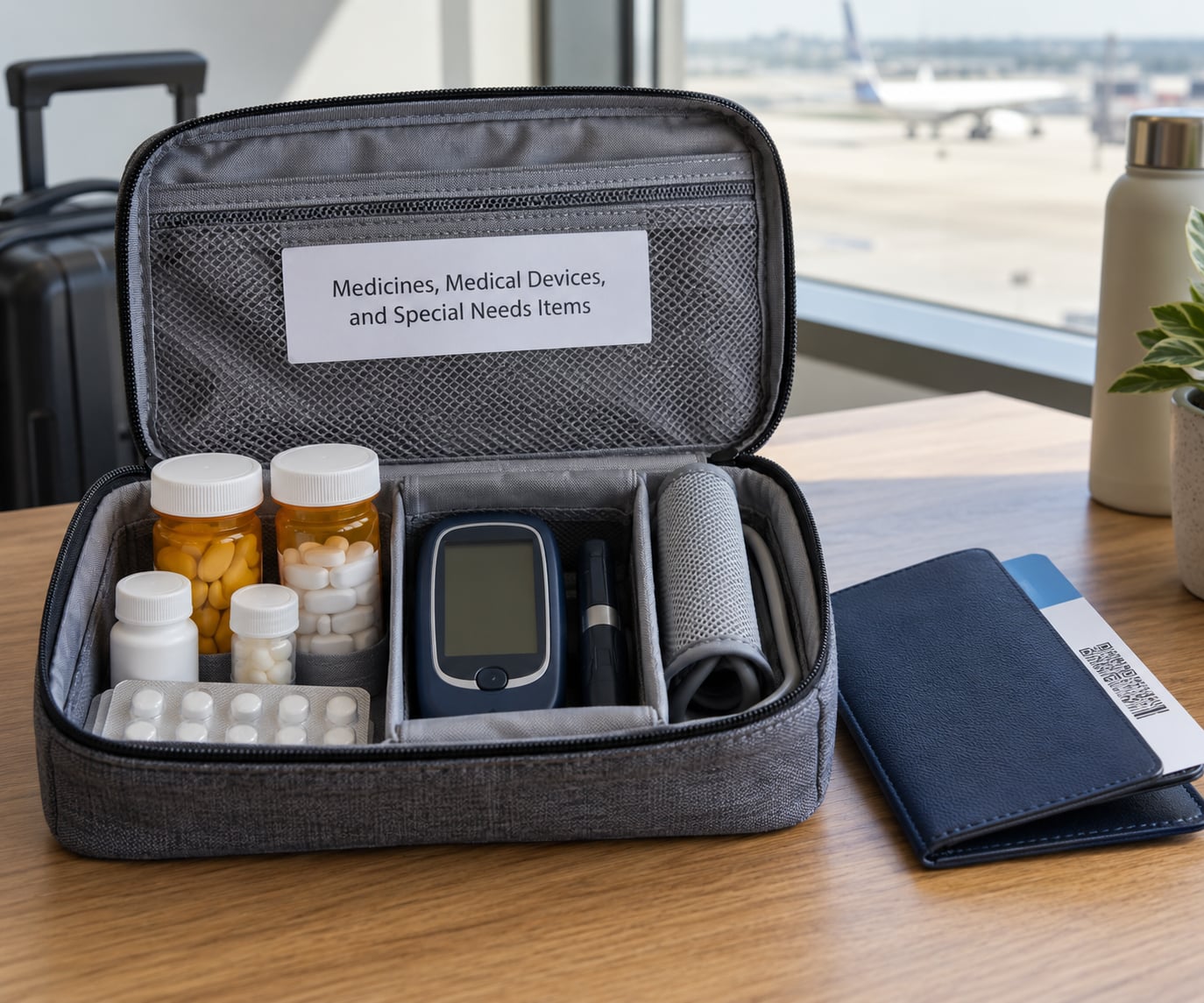
Prescription medicine is allowed through security, and so is any liquid medicine you need medically. That includes cough syrup, injectable medication, epinephrine auto-injectors, inhalers, and contact lens solution. These are exempt from the 3.4 oz limit.
You are not required by federal screening rules to keep pills in the original pharmacy bottle, and moving them to a clearly labeled pill organizer or a Ziploc bag is a common and accepted practice. The practical reasons to keep the label anyway are the ones that bite you later: a domestic flight almost never asks, but a secondary screening officer, a customs agent, or a pharmacist abroad may. A photo of the label or a copy of the prescription is cheap insurance. Keep medication in your personal item, not in a checked bag you might lose or delay.
A few categories need airline notice in advance rather than a quick explanation at the belt. Wheelchairs, oxygen concentrators, CPAP machines, and some powered mobility devices fit that description. If you are not sure whether a device counts, call the airline before you travel rather than finding out at the gate.
Food, Animals, and Agricultural Items
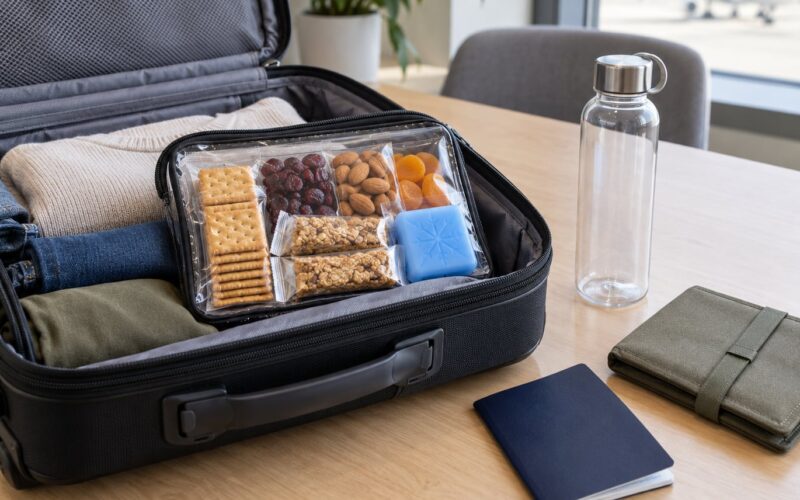
Food follows the liquid rule first: solid snacks, crackers, nuts, dried fruit, and most bars pass through, while anything wet, spreadable, or pourable follows the 3.1.1 limit. Fresh fruit and vegetables are a separate matter, because the answer depends on where you land rather than where you took off.
Domestically, whole fruit in your carry-on is generally fine. Internationally, most countries refuse fresh produce, meat, dairy, and untreated wood on arrival, and the restriction applies whether you check the bag or carry it on. Australia and New Zealand are strict about undeclared food, and the UK and EU require declarations for anything made from animal products. Plants, seeds, soil, and live cuttings are restricted almost everywhere. A jar of homemade jam or a bag of trail mix with raisins can end a trip at the border.
Live animals are not permitted in the cabin, with the documented exception of service dogs meeting the airline’s requirements. Emotional support animals no longer fly as pets in the cabin on most US carriers. If you are bringing fish, insects, or a reptile, that is a checked-bag and airline-permit conversation.
Items That May Be Allowed but Are Often Rejected
Some of the most frustrating rejections involve items that are legal in principle but get held, questioned, or delayed. Power banks and spare lithium batteries are the main example, and the rule runs opposite to what many travelers assume.
Power banks are allowed in carry-on bags and not allowed in checked bags, because a battery that ignites in a cargo hold is far harder to detect. The size limit is expressed in watt-hours, printed on the battery itself. Up to 100 Wh is allowed; 101 to 160 Wh needs airline approval in advance, with a maximum of two batteries; above 160 Wh is not permitted on a passenger flight. Spare lithium batteries get the same treatment. Install the batteries in your devices where you can, and cover the terminals of any spares with tape or a battery case.
Cordless hair styling tools are another frequent surprise. A corded hair dryer, flat iron, or curling iron is allowed in carry-on, and a cordless one is allowed in checked baggage only when its fuel cartridge is removed. A tool still containing butane or another gas cartridge is prohibited entirely. Curling and straightening irons are also fine in the cabin when they have a safety cover engaged, which older models sometimes lack.
Musical instruments, large electronics, camera gear, and camping equipment are usually allowed but frequently sent to secondary screening because of size or because an officer cannot identify the function at a glance. A fishing rod, a tent pole, a hiking stove, and a laptop are all permitted. A camping stove that uses liquid or gas fuel is allowed in checked baggage once you drain the fuel and air it out, and running the stove briefly is not an acceptable substitute.
The Samsung Galaxy Note 7 remains the one device explicitly banned from air travel, in carry-on and checked bags, because of its battery fires.
Items travelers wrongly assume are not allowed in carry on bags
Several persistent myths cost people money and packing space. None of these are banned: nail clippers, tweezers, small scissors, razors with the cartridge attached, belts, shoes, laptops, solid deodorant, pill bottles, dentures, glass bottles and picture frames, and fishing rods. The myth about nail clippers and tweezers dates to the period right after 2001 and has never been true since.
On the clothing side, the items officers most often ask you to remove are not banned so much as problematic in the machine: thick belts with metal buckles, boots with heavy hardware, necklaces, and anything that creates an alarm image. A heavy belt buckle triggers a pat-down. It is friction, not confiscation.
How Airline and Airport Rules Differ
Three different sets of rules get confused constantly, and knowing which is which solves most of the confusion. TSA rules govern the security checkpoint in the United States. Airline policy governs what you may bring into the cabin at all, including bag size, bag weight, and the number of items. Destination customs law governs what may enter the country where you land.
These can contradict each other. A power bank passes TSA and then goes into a checked bag your airline refuses to accept as a personal item. A candle is fine at the checkpoint and rejected on arrival. A carry-on that is comfortably inside your airline’s size allowance can still be made to check at the gate if the flight is full, which strands you with a bag full of items you just verified as legal.
On international itineraries, add the connection. You are screened at departure, then customs clears you on arrival, and a connecting flight can screen you again under a different country’s rules. The UK and Australia use container rules that resemble the U.S. 3-1-1, but a bag compliant in three countries can still fail in a fourth. Check the departure airport, the destination, and every connection.
Finally, expect discretion to matter. Officers apply the rules with judgment, some refer ambiguous items such as cannabis to local law enforcement rather than making the call themselves, and items that look improvised can get extra attention. The realistic way to think about it is that a compliant bag passes quickly and a marginal bag depends on who is working the line. You cannot plan around the second one.
How to Check Your Bag Before Leaving
Ten minutes at home saves a full-size bottle of something you paid real money for. Work through this in order.
- Search the item in the official TSA “What Can I Bring?” lookup. It has separate carry-on and checked columns, and it is the only source that is definitive for U.S. screening. If your item is not listed, ask on the AskTSA channel rather than guessing from a listicle.
- Pull out every liquid, gel, paste and aerosol. Each container must be 3.4 oz (100 ml) or smaller, and all of them must fit in one quart-size resealable bag. Anything larger goes to checked baggage or gets left behind.
- Move every blade and long tool to checked baggage. Folding knives with blades under 4 inches and tools under 7 inches are the most likely to be judged borderline, so decide before you are standing at the belt.
- Check for the items that are not obvious. Pepper spray, a stun gun in a pocket, a Swiss Army knife with an open blade, a full-size water bottle, protein powder over 12 oz (350 ml), and a lighter inside a checked bag.
- Sort your batteries. Power banks and spare lithium batteries go in the cabin, never in checked baggage, terminals covered. Note the watt-hour rating and confirm it is 160 Wh or under before you go.
- Protect your documents and medication. Keep prescriptions, doctor’s letters for injectable medication, and a photo of the pharmacy label in your personal item.
- Separate the items that need extra screening. Formula, breast milk, medical liquids, ice packs and duty-free purchases go in their own bin and get declared at the top of the queue.
- Build in time for secondary screening. Leave an extra 20 to 30 minutes on your schedule, because the second look is where medication, powders, and unfamiliar gear usually land.
- Check the destination rules separately. Food, plants, meat, and unprocessed animal products are a customs question, not a TSA question, and they apply when you land.
- Re-check the airline’s own limits the night before. Bag dimensions, weight, and the number of personal items are airline rules, and they are not the same list.
Frequently Asked Questions
Can I bring a full-size bottle of shampoo in my carry-on bag?
No, unless the container holds 3.4 oz (100 ml) or less. The rule applies to the size of the bottle, not how much liquid is left inside it, so a half-empty 8 oz shampoo still gets confiscated. Full-size toiletries go in checked baggage. Toiletries you do want in the cabin need decanting into travel-size containers that all fit inside a single quart-size resealable bag.
Are prescription medicines allowed through airport security?
Yes. Prescription medicine is exempt from the 3.4 oz liquid limit, and pills, capsules, and blister packs pass through normally. Liquids, syrups, injectables, and epinephrine auto-injectors are also allowed when medically necessary. You are not required to keep pills in the original pharmacy bottle, though keeping the label or a copy of the prescription helps at secondary screening and with customs abroad. Keep medication in your personal item rather than a checked bag.
Can I carry a disposable lighter or matches in my carry-on?
One disposable lighter is permitted, and so is a small book of safety matches with the strike surface covered. Strike-anywhere matches, torch lighters, and butane refills are prohibited. On top of screening rules, no one may light a lighter or match anywhere in the cabin, and smoking and vaping are banned on every US flight once you board. Spare lithium batteries for e-cigarettes stay in your carry-on, never in checked baggage.
What should I do if I bought liquids after the security checkpoint?
Duty-free liquids bought after screening are allowed into the cabin when the receipt is attached and the item stays sealed in the tamper-evident bag the store gives you. An officer will ask you to keep it sealed and may look at the receipt, so keep both accessible rather than buried. Liquids bought before screening still have to meet the 3-1-1 limit, and a bag that opens mid-flight is not the way to test the rules.
Are power banks allowed in carry-on bags?
Yes, and they are not allowed in checked baggage. That direction confuses a lot of people, but the reason is that a battery fire in a cargo hold is much harder to detect and fight. The size limit is in watt-hours, printed on the battery. Up to 100 Wh is allowed without asking; 101 to 160 Wh needs airline approval in advance, with a maximum of two batteries; anything above 160 Wh cannot travel as passenger baggage.
What if I am not sure whether an item is allowed?
Search the exact item name in the official TSA u0022What Can I Bring?u0022 lookup, which has separate carry-on and checked columns. If it is not listed, ask the AskTSA social channel with the specific item rather than posting your whole bag. Avoid third-party listicles, which are often years out of date, and remember that a yes for U.S. screening says nothing about your destination country’s customs rules, which is where food, plants, and some medications get refused.
What to Do First
Look up the item in the official TSA “What Can I Bring?” database for every airport you will pass through, then check your destination country’s customs rules separately. Anything that comes back prohibited in the cabin moves to your checked bag or stays home. Doing that one step at your kitchen table replaces almost all of the stress that happens at the checkpoint.