Airport security screening is a checkpoint every departing passenger passes through before boarding, where officers and screening technology check you and your carry-on bags for weapons, explosives and prohibited items. Understanding how airport security screening works step by step takes about five minutes to read and removes most of the surprise: you show your documents, put your belongings into bins, walk through a scanner, and deal with an alarm if one goes off.
I’ve written this for nervous first-time flyers as much as for people on their fortieth trip. The queue, not the scan, is what makes people late. Everything else is a short, ordered routine that repeats thousands of times a day at every airport in the world.
One thing to know up front: screening is operated by a national authority and the airport, not by one global rulebook. Document, liquid, device and prohibited-item procedures differ by country, by airport, and sometimes by lane. Where a rule below is US-specific, I’ve said so. Last checked October 2026.
Table of Contents
- How Airport Security Screening Works Step by Step
- The seven stages of how airport security screening works step by step
- What Happens Before You Enter the Security Queue
- How the Screening Process Moves Through Each Stage
- How Airport Security Screening Works Step by Step at the Checkpoint
- Step 1: Joining the lane and showing your documents
- Step 2: Sorting your items at the divest table
- Step 3: What goes in the screening bin
- Step 4: How your bags are screened
- Step 5: The personal screening step
- Step 6: What happens when an alarm goes off
- Step 7: Reassembling your belongings and leaving the checkpoint
- What Security Officers May Inspect
- What Happens If You Are Selected for Additional Screening
- Why Airport Security Can Take Longer
- How Airport Rules Differ Around the World
- What You Can Do to Move Through Security Smoothly
- Frequently Asked Questions
- Can I bring a full-size bottle of water through airport security?
- How should medication, syringes, and other medical items be presented?
- Do I need to take my laptop and other electronics out of my bag?
- What identification do I need for airport security in another country?
- Can airport security make me miss my flight?
- Does passing through airport security mean my bags will never be inspected again?
- Conclusion
How Airport Security Screening Works Step by Step
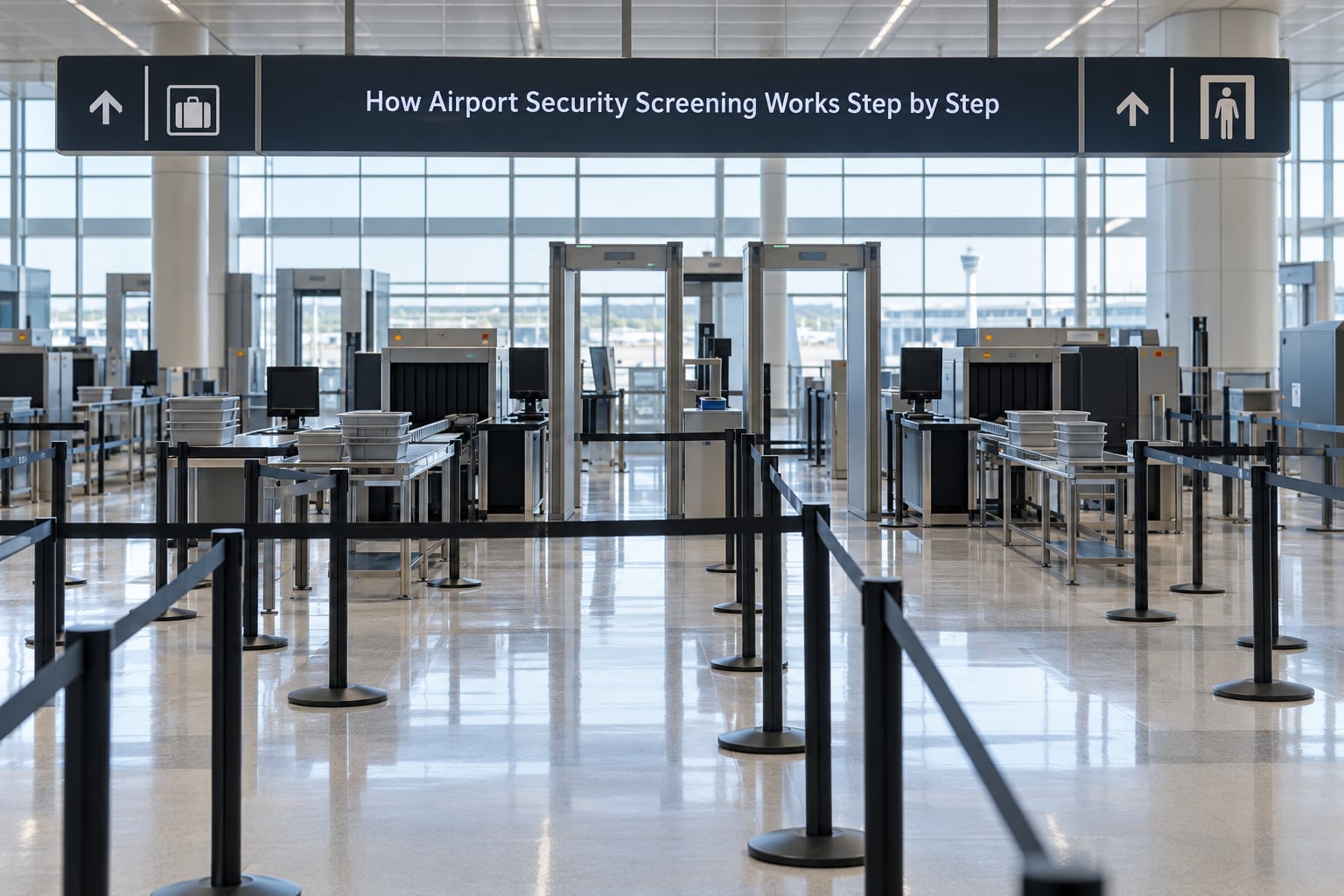
The full sequence, in order: you check in and get a boarding pass, join the security queue, show your ID and boarding pass to the officer at the document podium, empty the items that need emptying into a bin, watch your bags go through an X-ray machine, walk through a metal detector or a body scanner, resolve any alarm with a search or a pat-down, then collect your belongings and head to the gate.
Seven stages, and most travellers spend under five minutes in the building itself. The stages that catch people out are stage two, because a boarding pass is a condition of entry, and stage six, because alarms are usually a false alarm rather than a problem.
The seven stages of how airport security screening works step by step
- Check in and collect your boarding pass. You cannot enter a screening lane without one, and most airlines close check-in 30 to 60 minutes before departure.
- Join the queue for your lane. General, enrolled-passenger and assistance lanes are usually separate.
- Present identification and your boarding pass. The officer matches the name on your ID to the name on the boarding pass.
- Divest what the lane requires. Liquids, laptops, large electronics, belts and sometimes coats or shoes go into the bin.
- Bags and bins are X-rayed. An officer or an automated tool reads the image on a monitor.
- You are screened personally. A walk-through metal detector, a handheld wand, or a full-body imaging scanner.
- Any alarm is resolved, then you collect and go. Clear, grab your bag, walk out of the checkpoint and never come back through it.
What Happens Before You Enter the Security Queue
Check-in comes first. You drop checked bags, get a boarding pass and, if your airport uses them, clear any e-gate or automated document check before the security hall. Security screening sits between check-in and the gate, not the other way round.
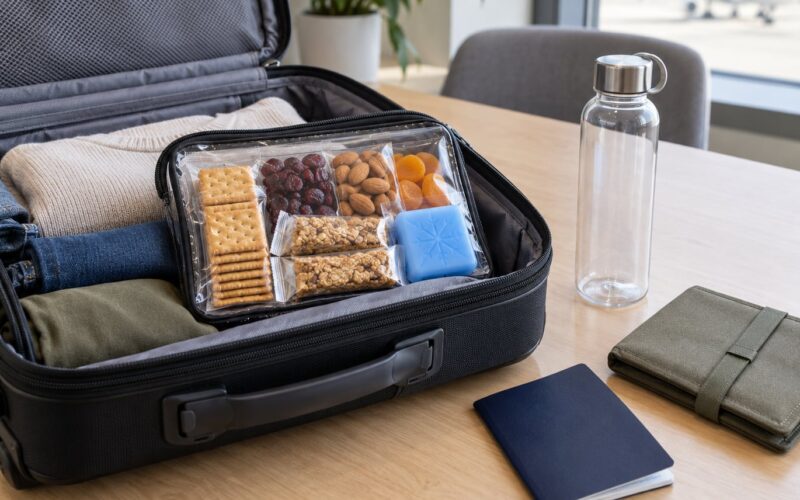
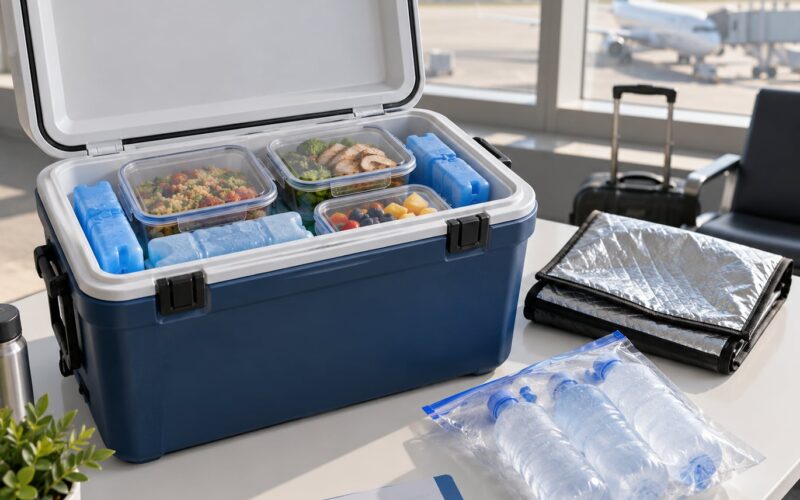
Before you travel, sort the likely problems. Liquids over 100 ml belong in checked luggage, or in checked-baggage-free trips go through a duty-free sealed tamper-evident bag. Prohibited items like tools, full-size scissors and anything resembling a weapon are worth checking against your authority’s current list. Spare lithium batteries and power banks have seen their rules tightened repeatedly, so confirm where yours may travel before you pack rather than at the podium.
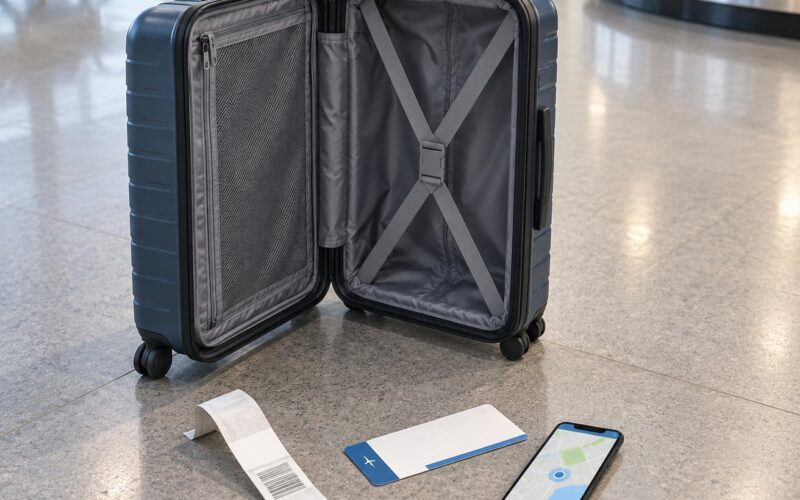
Documents are the other thing to sort. Domestic trips usually need a government photo ID. International trips typically need a passport valid for the destination’s required period, sometimes a visa, sometimes proof of onward travel. Names must match across ID, ticket and booking, with the exact spelling you used when you booked.
On the day, have your ID and boarding pass in one hand, not buried in a bag. Keep coats, belts and loose change out of your pockets before the divest table rather than in the middle of the queue.
How the Screening Process Moves Through Each Stage
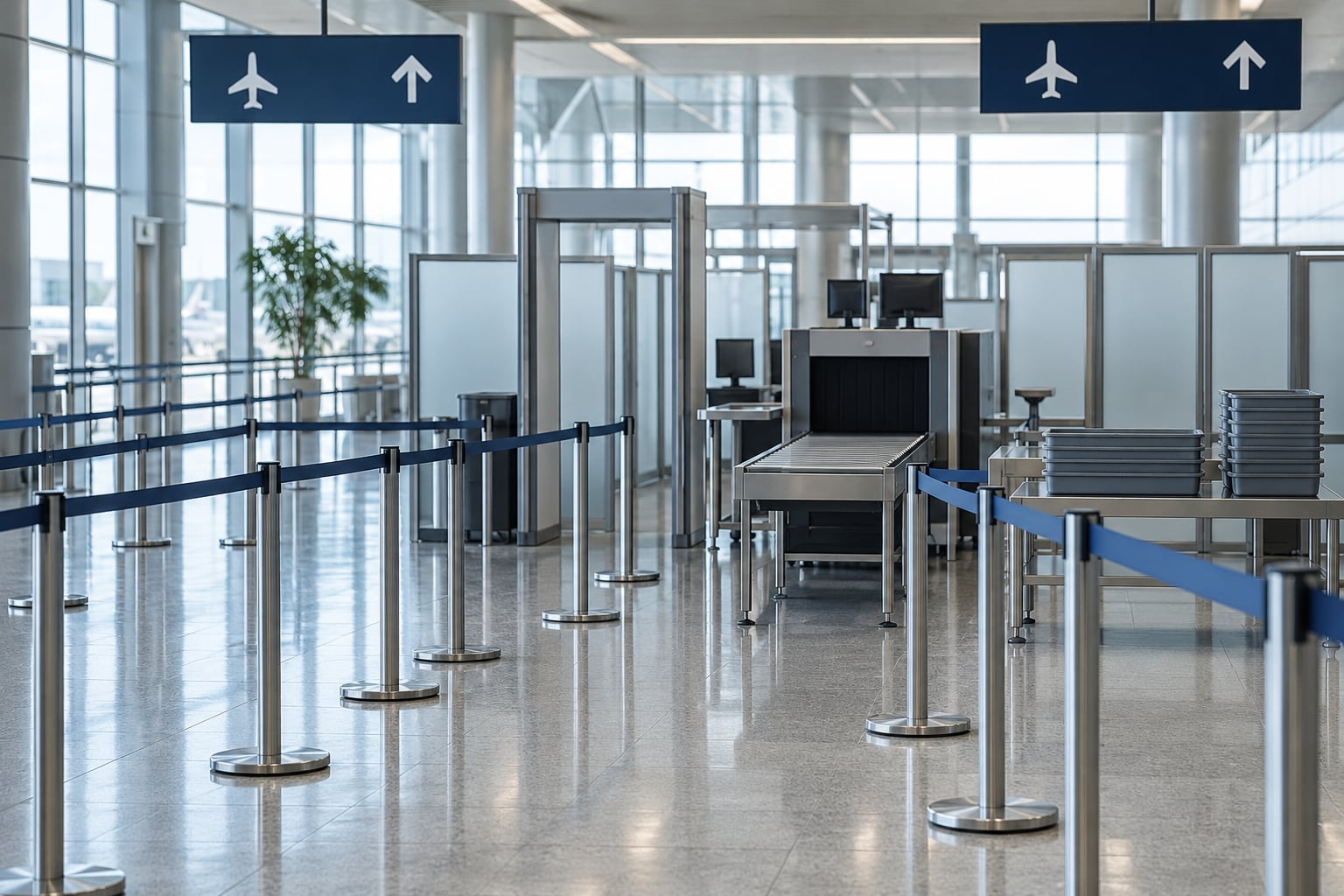
Each lane is a small assembly line with four stations: document podium, divest table, screening equipment, and reassembly table. You move through them in that order, and the order is fixed even when the physical layout looks different.
At the document podium the officer checks identity and ticket, and may ask a short neutral question about your bag. Nobody is searching your phone at this point. At the divest table, items go into bins according to the lane’s signs. At the equipment station, your bags and belongings are imaged and you are screened. At reassembly, you take everything back and leave.
The lanes are not interchangeable. A general lane usually asks for laptops and liquids out of the bag. An enrolled-passenger lane in the US, such as TSA PreCheck, often does not, which is why a laptop that flies through untouched one day comes out the next day. A private screening contractor’s lane may run a different configuration again. Read the signs at the head of the lane you are standing in; they outrank anything you read online.
How Airport Security Screening Works Step by Step at the Checkpoint
Step 1: Joining the lane and showing your documents
Walk forward with your ID and boarding pass visible. The officer takes both, checks the photo against your face, and checks the name on the boarding pass against your ID and the passenger manifest. This is the stage where a name mismatch gets caught, and it is much easier to fix here than twenty minutes later.
Step 2: Sorting your items at the divest table
At the table before the belt, pull out what the lane requires. Counters at the front of the table hold phones, wallets, keys, coins, loose cables and jewellery. Anything you could not pick up from a pocket goes there rather than into your bag.
Step 3: What goes in the screening bin
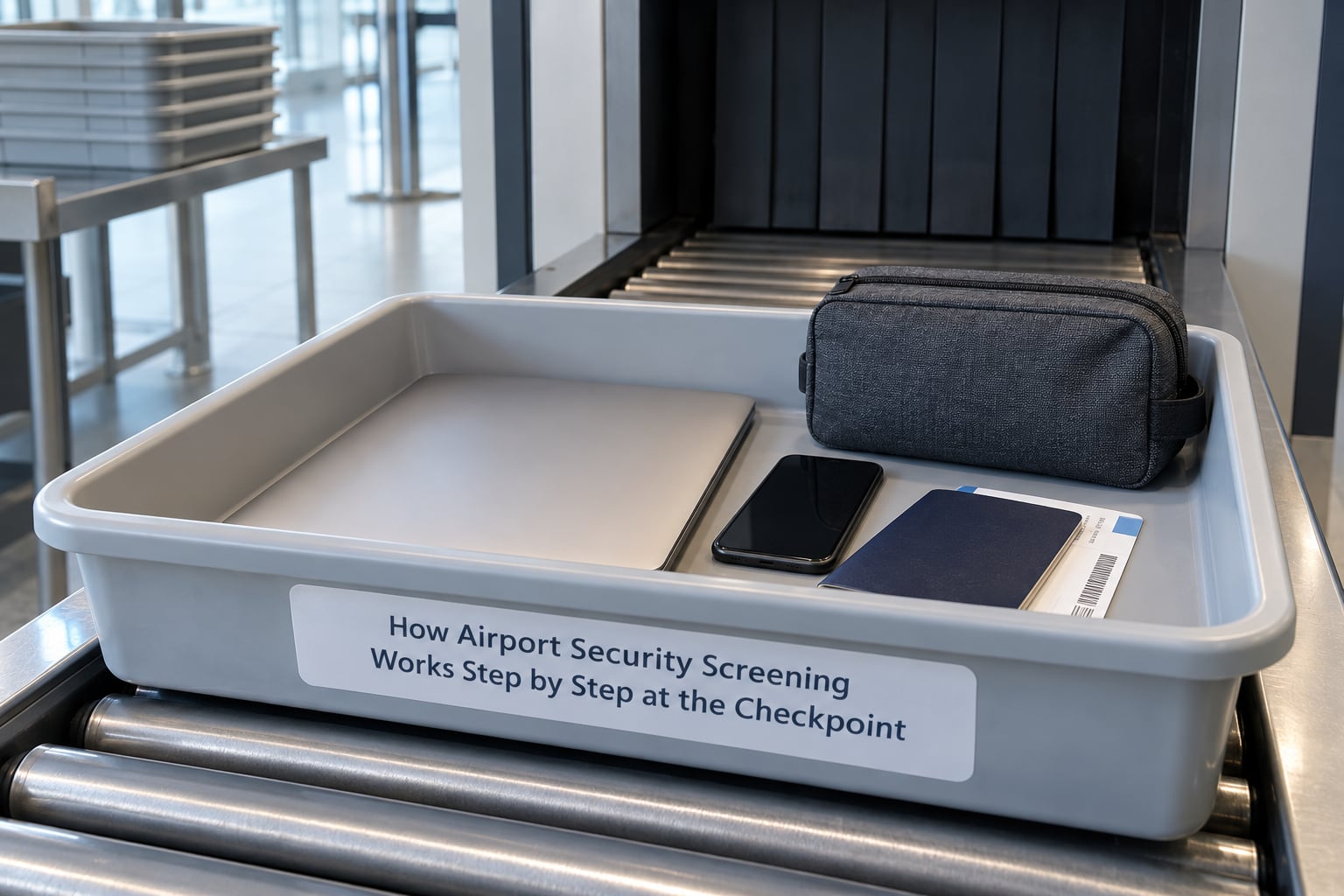
Put your carry-on bag plus laptop, tablet, large camera gear and travel documents in one bin, and liquids, medication and small electronics in another. The division is about throughput: heavy items on the belt, light items for hand-carrying. Liquids go in a clear, quart-sized bag with each container at 3.4 ounces or 100 ml or under, under the common 3-1-1 liquids rule. Exceptions exist at many airports, so check your authority’s page rather than assuming a universal container size.
Take your phone out of your pocket in a standard lane. In a US enrolled-passenger lane it often stays in the bag, which is the single most common source of the “the rules change every time” frustration travellers report.
Step 4: How your bags are screened
Your bins travel a conveyor belt through an X-ray machine. Behind a screen, an officer or an automated detection tool looks for prohibited or dangerous items. A second technique, explosive trace detection, is sometimes used: a swab is taken from your bag or bin and checked for trace explosive material. If the officer wants to look inside, you open the bag yourself at the table, and everything goes back in before you leave.
Step 5: The personal screening step
Remove any belt and walk through a metal detector, or step into a full-body imaging scanner and hold a moment in position with your arms raised. If the detector alarms, an officer resolves it with a handheld wand. Depending on the technology and the airport, screening may also include a wanding at a table or a walk-through.
Step 6: What happens when an alarm goes off
An alarm is a question, not a verdict. It means something in your bag or on your body triggered a threshold, and an officer resolves it. You are usually asked to step to one side while other passengers continue through. Resolution takes anywhere from a few minutes to considerably longer if the item needs to be repacked or your bag needs a closer search.
Step 7: Reassembling your belongings and leaving the checkpoint
You gather your bag, repack at the table if you opened it, and walk out through the exit lane. Once you are through, you are in the secure area: no liquids from outside, no going back through the machine, and no unattended bags.
What Security Officers May Inspect
Inspections are risk-based, not random in the sense of picking a person to inconvenience. Items fall into broad categories: bags opened at the table, clothing, electronics, and medical items. The officer also has discretion to ask questions about your route, your destination and your connection, and those answers feed the assessment rather than being a quiz.
Some items attract attention more often than others, and a lot of that is about what an image cannot resolve. Dense, layered electronics, dense cables, shoes, dense clothing, food from abroad, medical devices and anything with a battery all read poorly on an X-ray or a millimeter wave image, so they generate more questions.
| Screening type | What it does | What it is good at |
|---|---|---|
| X-ray bag screening | Generates an image of a bag or bin | Seeing shapes, densities and objects hidden under other items |
| Explosive trace detection | Checks a swab or the bag surface for trace material | Finding explosive residue on hands or in a bag |
| Walk-through metal detector | Detects metal on the body | Fast, general, low privacy cost |
| Millimeter wave imaging | Maps the body’s outer surface | Flagging metallic or dense objects worn under clothing |
| Computed tomography | Builds a 3D image of a bag | Resolving overlapping items inside a full suitcase |
| Explosive-detection canine team | Sniffs the air and bags | Working quietly in crowded public areas |
Technology varies a lot by airport. Some countries restrict the use of body-imaging scanners that emit ionising radiation, and screening is often run by a private contractor rather than a national security service. That is normal, and it is one reason the same traveller can have a completely different experience in two different terminals.
What Happens If You Are Selected for Additional Screening
Most alarms resolve quickly. A common pattern: the scanner or the image flags the waistband, the wrists, the ankle line or the chest, and the officer inspects that specific area, finds nothing prohibited, and clears you. Waistbands and wrists get flagged often because that is where metallic items, watches, belt buckles, underwire and jewellery sit, and where a body scan’s sensitive areas concentrate.
If you would rather not go through a body scan, you can ask for a pat-down instead. Tell the officer before you step in. An officer may still route you to a scan if they judge it required, and a pat-down usually takes longer, so ask for it early and politely rather than at the machine. Travellers report the majority choose the scan because it is far quicker, but the choice is yours to make and to ask about.
What the image shows is worth being precise about, because the fear is usually worse than the reality. In the US, body-imaging images are viewed remotely at a monitor, shown to the officer as an unclothed outline on a generic human figure, and image storage on screening equipment is disabled. The image is a surface map, which is why dense or metallic objects under clothing show up but soft-tissue detail does not. Screening devices that use ionising radiation are restricted in a number of countries, including across much of the EU, for that reason.
A search can also happen on the spot: you open your own bag at the table, remove a jacket or belt, or provide your boarding pass and ID again. A private screening room exists at most airports for situations where a public-area search is not workable. For travellers with a medical device, an implanted device, a language barrier or a disability, ask for a private screening request, and in the US you can also use TSA Cares or a disability notification card.
Why Airport Security Can Take Longer
Delays are usually structural rather than personal. Busy departure banks, early morning and evening waves, and a terminal with fewer lanes than arriving flights create queues. A screening officer at a document podium who wants to resolve a name mismatch holds up the line behind you. An alarm that needs a bag search or a repack adds minutes to your own trip rather than to the queue.
Some common causes of a slower checkpoint:
- Peak departure banks, when many flights leave within the same 30-minute window
- Reduced staffing, including lanes closed for breaks or shift changes
- Aircraft arriving in waves and funnelling passengers into a short queue window
- Prohibited or undeclared items that must be surrendered, repacked or disposed of
- Unresolved alarms, especially when a bag needs a full re-screen
- Accessibility or medical accommodations that take longer to arrange
- Damaged or unusual baggage that slows the belt or needs manual handling
- Connecting itineraries where late-arriving passengers get held for their flight
The honest time budget: at a mid-size airport, an ordinary pass can take a few minutes, while a major hub at the wrong hour can mean a long queue. These are typical ranges, not promises. If your flight is tight, tell a queue attendant that you are close to boarding, check the airline’s app for the gate status, and keep your boarding pass in hand.
How Airport Rules Differ Around the World
Screening is run by national authorities, and the rules they enforce are not identical. Document requirements differ first: an ID that works for a domestic flight in one country may be entirely inadequate as the travel document for a flight out of another. Check the destination’s entry rules and the departure airport’s document rules separately.
Liquids are the clearest example. The US approach of a clear bag with small containers is common but not universal; the UK and much of the EU use the same 100 ml container threshold, while other countries apply a different container size, test at a kiosk, or screen a different way. Some airports have re-introduced additional liquid checks for particular flights. Device rules also differ, with some countries still requiring laptops and cameras out of bags as a matter of policy rather than lane practice.
Body-scanning technology and privacy rules vary as well. Data retention is restricted in a number of jurisdictions, and some countries ban the use of ionising scanners outright, leaving metal detectors or non-ionising imaging in use instead. Where screening is outsourced to private contractors, the authority still sets the rules and the training, but the person checking your bag may work for a company rather than a government.
The practical takeaway is simple: the airport you are departing from, on the day you are departing, publishes the rules that apply. That page beats any guide, including this one, whenever the two disagree.
What You Can Do to Move Through Security Smoothly
A short checklist, in the order that helps most:
- Check the rules for your departure airport and country a few days before you fly, especially for liquids, medication and batteries.
- Match names exactly across your ID, your ticket and your booking before you travel.
- Sort liquids into a clear bag in advance, with every container at 100 ml or under.
- Empty your pockets into your hand before the queue, not at the belt.
- Keep medication, documents and devices accessible rather than buried under everything else.
- Charge your power banks and keep them in your carry-on if your rules require that placement.
- Tell the officer about a medical device, implant or mobility aid before screening starts rather than after an alarm.
- Plan for a pat-down if you would prefer one, and ask early.
- Arrive with enough margin to absorb a queue, a bag repack or a walk to a distant gate.
- Consider a fast-lane programme if you fly often. In the US, enrolment options such as TSA PreCheck remove the laptop and liquid divestment step; CLEAR is a separate document and identity service that does not replace screening.
On fast-track programmes generally: they cut the document queue and the divest step, not the security requirement itself. Every passenger in the main queue is screened, and being enrolled does not make anyone exempt from it.
Frequently Asked Questions
Can I bring a full-size bottle of water through airport security?
Not in most airports. Under the common 3-1-1 liquids rule, each container must hold 3.4 ounces or 100 ml or less and must sit inside a single clear, quart-sized bag, and officers apply the rule at the podium rather than trusting a declaration. A full-size bottle has to go in checked baggage, be poured out, or be bought after the checkpoint. The exact container size and bag rules vary by country and airport, so check your departure airport’s published list before you travel.
How should medication, syringes, and other medical items be presented?
Keep them in original labelled packaging and tell the screening officer before you put anything in a bin, so they can be handled through the medical exemption process instead of the normal x-ray. In the US you can declare them at the document podium, ask for a private screening request, and use TSA Cares or a disability notification card. The items are generally allowed, but the screening method differs and rules outside the US vary, so check the departure authority’s guidance.
Do I need to take my laptop and other electronics out of my bag?
In a standard lane, yes. Laptops, tablets, large cameras and travel documents usually go into a separate bin so the x-ray can read them properly. Many enrolled-passenger lanes, such as US TSA PreCheck, have no divestment requirement, so electronics stay packed. This is the most common reason travellers think the rules change randomly: the same person goes through two different lanes the same morning. Read the signs at the head of the lane before you unload your bag.
What identification do I need for airport security in another country?
A domestic ID from your home country is usually not accepted as the travel document for an international flight. Most international departures require a passport, often valid for six months beyond your trip, plus a visa where the destination requires one. Some airports accept national identity cards for specific routes. The name must match your booking exactly. Check the destination’s entry requirements and the departure airport’s document rules separately, because they are not the same list.
Can airport security make me miss my flight?
It can, though it is uncommon, and the delay is usually a queue or an unresolved alarm rather than the screening technology itself. A body scan takes roughly twenty seconds, while a physical pat-down can take closer to two minutes, and a bag search or repack adds more. If you are running late, tell a queue attendant, keep your boarding pass handy, and monitor gate changes on the airline’s app. Airlines also hold connecting passengers at some airports rather than screening them straight through.
Does passing through airport security mean my bags will never be inspected again?
No. Your carry-on can be re-screened on a connecting flight, and checked bags can be opened on arrival and re-screened during transit. Connecting passengers often pass through a second checkpoint at the transfer airport, particularly when arriving from an international flight and departing on a domestic one. Do not assume you are finished after the first checkpoint, and keep travel documents, medication and anything needed for a few extra hours accessible rather than buried in checked luggage.
Conclusion
Do four things before you fly, and the checkpoint will be uneventful. Check the rules published by your departure airport and national authority, because that is the version that applies. Have your identification and boarding pass ready in one hand, with the name matching your booking exactly. Sort your liquids, your electronics and your medication before you reach the divest table rather than in the middle of it. And leave time in your plan for an alarm, because a secondary screening adds minutes and that is the one delay you cannot schedule away.