An airport layover is the scheduled break between two flights on your itinerary. You land at a connecting airport and wait before boarding the next plane. How long you need depends on one thing above all: whether both flights sit on a single ticket or were booked separately. Short stops work on one booking. Two tickets means every minute is your problem.
Most guides give you one number. That number is wrong for about half the tickets people actually book. So below is the honest version: what a layover is, how long the different kinds take, and how to check whether your specific connection is realistic before you turn up.
Updated for October 2026.
Table of Contents
- What Is an Airport Layover and How Long You Need One?
- What is an airport layover and how long you need at a large international hub?
- What Is the Difference Between a Layover and a Connection?
- How Long Is a Typical Airport Layover?
- How Much Layover Time Is Enough for an International Flight?
- How much time should I leave between international flights?
- Does Your Layover Depend on Separate Tickets or One Booking?
- How Do You Find and Calculate Your Connection Time?
- What Can You Do During a Short or Long Layover?
- How Should You Prepare for an Airport Layover?
- Frequently Asked Questions
- Is a two-hour layover enough for an international connection?
- What happens if my layover is too short and I miss the second flight?
- Do I need to collect and recheck my luggage during a layover?
- Can I leave the airport during a long layover and return?
- Is an overnight layover allowed at every airport?
- Conclusion
What Is an Airport Layover and How Long You Need One?
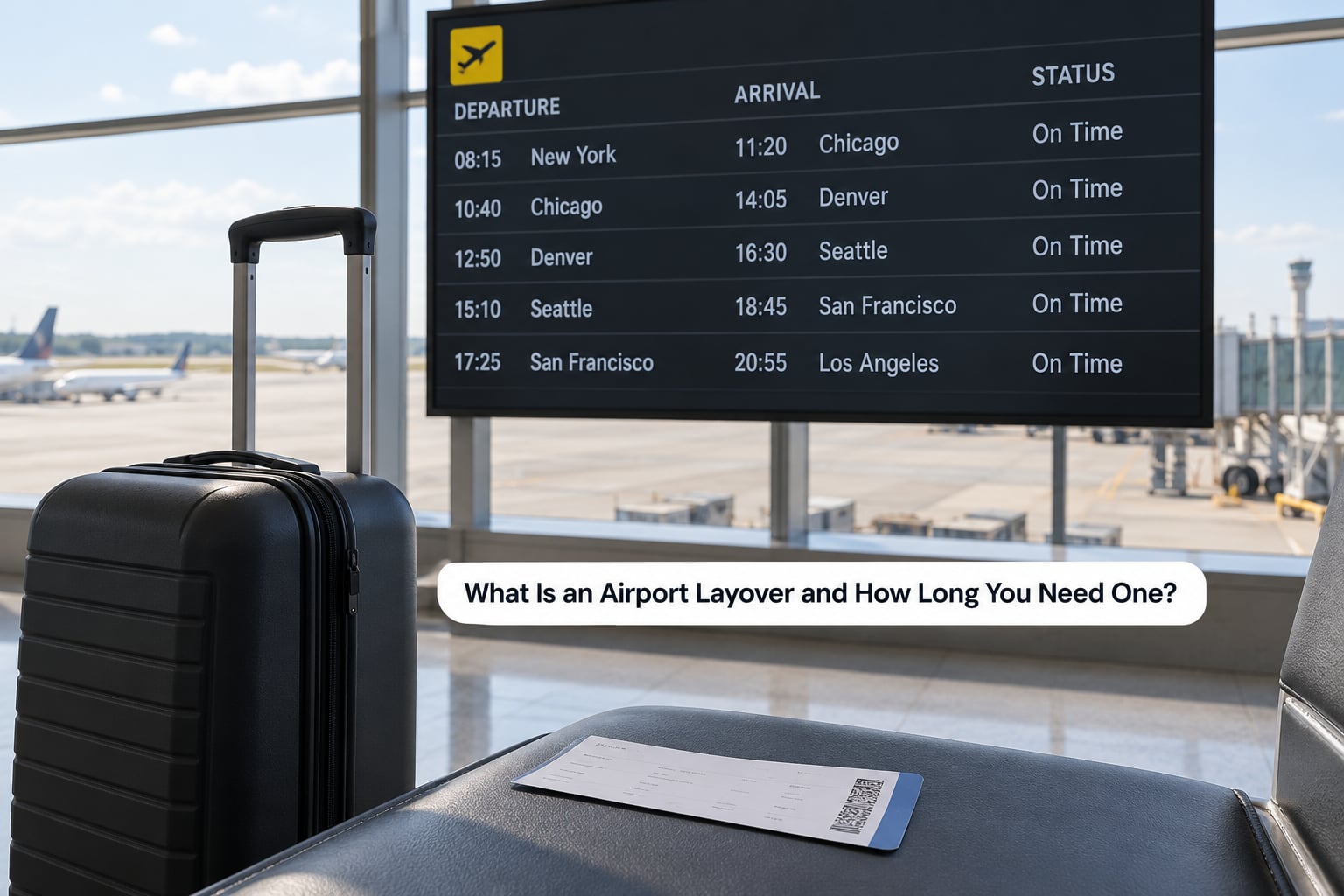
A layover is the gap between an arriving flight and the next flight on the same itinerary. It starts when the doors open and ends when the second flight boards. It is not the same as a stopover, which is a deliberate break of 24 hours or more that some airlines sell as a fare feature.
What is an airport layover and how long you need one? The short version: 60 to 90 minutes for a domestic connection on one ticket, two to three hours for an international one, and three to four hours if you booked the flights separately.
Those ranges assume you stay on one ticket and your bag is checked through. Add time for a terminal change, a checked bag you have to reclaim, a child who needs a bathroom, or an airport you have never walked through before.
What is an airport layover and how long you need at a large international hub?
At a big hub the walk itself is the difference. Atlanta, Chicago O’Hare, Dallas/Fort Worth and Los Angeles all spread connections across concourses that require a train or a long tram ride. In winter, add time for weather de-icing queues, because the second flight waits on the first one.
Amsterdam Schiphol is famously walkable, which is why minimum connection times there can be as low as 40 minutes for a domestic arrival and around 50 for international. Heathrow treats three hours as a legal connection time when you have checked bags, because bags have to be ferried, sorted and reloaded. That is not the airline being cautious for fun. It is the physical layout.
What Is the Difference Between a Layover and a Connection?
A layover is the waiting period. A connection is the arrangement that gets you onto the second flight. People use the words interchangeably, and that is where a lot of confusion comes from, because the two words carry very different amounts of protection.
Say you fly a domestic leg and then an international one, with two hours in between. During those two hours you might clear security twice, pass through immigration on arrival, collect a checked bag, hand it back in, and then pass through immigration again for the departure. That is one connection, and the two hours is the layover.
An overnight stop is the same mechanics with a different clock. A red-eye arrival at 11:40 p.m. with a 6 a.m. departure is a layover too, just an unpleasant one, and the practical question becomes where you sleep rather than whether you can make it.
The word stopover is the odd one out. Airlines use it to mean a break of 24 hours or more, sometimes at no extra fare, sometimes priced as a separate ticket. Icelandair, Qatar Airways, TAP Air Portugal and Finnair all run stopover programs, and if you want a real layover in a city for a day, that is the mechanism rather than a missed connection.
How Long Is a Typical Airport Layover?
Most connections fall into four buckets, and each one calls for a different behaviour from you.
| Layover type | Approximate time | What travelers usually do | Practical for |
|---|---|---|---|
| Short | Under 1 hour | Walk straight to the gate, no stops | One ticket, same terminal, carry-on only, no immigration |
| Standard | 1 to 2 hours | Find the gate early, then eat or rest nearby | Domestic connections on one ticket |
| Long | 3 to 5 hours | Lounge, shower, airport hotel, or a short trip into the city | One ticket with a terminal change, or an international arrival |
| Overnight | 6 hours to a full day | Hotel, sleep pod, or a deliberately planned stopover | Anything, if you planned for it |
Under an hour is the bucket people panic about, and the panic is usually deserved. A traveler on r/travel described a 55-minute connection against a 50-minute minimum connection time where a five-minute delay on the inbound flight was all it took to break the plan. That is the whole margin, five minutes, and delays rarely arrive politely.
It is not always bad. Someone connecting at Dallas/Fort Worth with an hour and 45 minutes reported a gate only five to ten minutes from the transfer point, which is a completely different experience from a 90-minute stop at an unfamiliar airport. Layout matters as much as the clock.
How Much Layover Time Is Enough for an International Flight?
International connections need more time because the arrival is not the end of the process. You land, you clear immigration, you collect any bags, you pass customs, and if you are connecting onward rather than entering the country you queue again. In many hubs those queues are long enough to consume an entire nominal connection.
Common airline guidance is to be at the airport about two hours before a domestic flight and three hours before an international one. That advice is about the first departure of your day, not a connection, but the instinct behind it holds.
How much time should I leave between international flights?
Plan on two hours as a floor for an international connection with checked bags, and three hours if you are entering a country you have not transited before, changing airports in the region, or flying with kids. Four hours is the number the solo travel community settled on after a few chaotic summers, and it is a reasonable default when the cost of being wrong is high.
What you should not do is treat any of these as guaranteed. Arrival immigration queues at major hubs can and do stretch past an hour, and nobody can tell you in advance on the morning of travel.
Does Your Layover Depend on Separate Tickets or One Booking?
This is the question that decides whether a layover is a minor inconvenience or a disaster, and it has nothing to do with how long the layover is.
One ticket means the airline sold the whole journey. If the first flight is late and you cannot make the second, the airline rebooks you onto the next available flight, and if that is tomorrow, it typically covers a hotel and meals. Your bag is usually checked through to the final destination. If both flights are on one reservation, the airline holds the connection and the minimum connection time exists precisely so it can.
Two tickets means the first airline is finished with you the moment you deplane. If you are late, the second airline sees an unused ticket that has already departed, and their obligation to you is close to zero. The TripAdvisor Air Travel forum is full of stories from travellers sent back and forth between airlines, each pointing at the other, after a delay on a self-transfer itinerary.
Self-transfers add another wrinkle. Even on separate tickets, some airports route you through an arrivals hall rather than a sterile transit corridor, which means immigration, baggage reclaim and a fresh security screening in the middle of your journey. Some airlines and airports cooperate on a “self-transfer” arrangement that handles the bags for you. Read the terms before you assume it applies to you.
| What happens | One ticket | Separate tickets |
|---|---|---|
| First flight delayed past connection | Airline rebooks you, usually free | You are on your own |
| Checked bag | Usually tagged to final destination | You reclaim and recheck it |
| Overnight caused by a miss | Hotel and meals often covered | You pay |
| Minimum connection time | Set by the airline within airport limits | None, you set it yourself |
If you find yourself on separate tickets, treat the layover as if you have to catch a completely independent flight. Three hours minimum domestically, four internationally, and more if the airport is unfamiliar or you need to reclaim a bag.
How Do You Find and Calculate Your Connection Time?
Your connection time is simply the scheduled departure of the second flight minus the scheduled arrival of the first, both in local time. That sounds trivial, and it is exactly the step people skip when they are reading a booking confirmation in one time zone and the itinerary in another.
Here is how to work it out properly.
- Open the itinerary and find the scheduled arrival of the first flight, in local time at the connection airport.
- Find the scheduled departure of the second flight, also in local time at the connection airport.
- Subtract. Ignore the time zone entirely, because both numbers are already local to the same airport.
- Check the terminal on each segment. Different terminals usually mean a walk, a tram or a train ride.
- Check whether your bag is tagged through to the final destination, or whether you are collecting it.
- Look for the airport’s minimum connection time. It is published by the airport, and it is the floor the airline was allowed to schedule against.
- Subtract a buffer. Thirty minutes for a domestic one-ticket stop in one terminal, an hour for anything involving bags, terminals or immigration.
One more thing to check: whether the connection involves a change of airport rather than a terminal. A few cities have more than one airport, and a “connection” through them is really a domestic flight with all the risk that implies.
What Can You Do During a Short or Long Layover?
What you do depends almost entirely on how much time you have.
| Time available | Where to be | What to do |
|---|---|---|
| Under 60 minutes | Airside, closest point to the gate | Nothing. Walk directly, find the gate, board |
| 1 to 2 hours | Near the gate or its concourse | Eat something, use a restroom, check the departure screens |
| 3 to 4 hours | Gate lounge, or a lounge if you have access | Shower, rest, charge, message people, get a proper meal |
| 5 to 8 hours, daytime | City, if you can clear immigration and return | A short visit. Confirm visa rules, allow generous return time, keep alerts on |
| 6 hours or more, overnight | Airport hotel, lounge with sleeping pods, or airside seating | Sleep, shower, charge. Check whether your bag is staying with you |
Two rules for the city option. Your boarding pass usually has to be scanned again on re-entry, and you need to clear immigration on the way out, which can take an hour you did not budget for. Some airports have no practical way back into the secure area for a departing passenger, so check the airport’s own guidance before you commit.
For overnight stops, find out whether your checked bag goes with you or gets unloaded at the connection city. That determines whether you need anything from your bag for the night.
How Should You Prepare for an Airport Layover?
Most layover problems are decided before you leave home. A short checklist covers nearly all of them.
- Confirm the connection type. Check whether the two flights share one booking reference. If they do not, budget extra time before you book anything else.
- Check the terminal for each segment and look for the transfer method between them. A change of airport is a much bigger deal than a change of concourse.
- Know whether bags are checked through. One ticket usually means yes. Separate tickets almost always mean no.
- Check transit visa rules if you plan to leave the airport or if your itinerary changes airports in the region.
- Download the airline app and turn on flight alerts. Gate changes are normal and often happen while you are in the wrong concourse.
- Bring a portable charger and keep your phone alive. It is your boarding pass, your map and your only way to hear about a change.
- Keep medication, a change of clothes and water within reach rather than buried in a checked bag you may not have.
- Save your onward documents offline before you land, since some airport networks are unreliable.
- Note the minimum connection time for the airport so you can judge how much margin you actually have.
One habit pays off more than the rest: when you land, look at the arrival screens first and not the departure screens. Delays show up on the arrival board before they propagate, and that early warning is what buys you a phone call to the airline before everyone else is queuing.
Frequently Asked Questions
Is a two-hour layover enough for an international connection?
Two hours is enough for an international connection when both flights are on one ticket, you have no checked bag to reclaim, and the terminals are close. Add at least an hour if you clear immigration on arrival, change terminals, travel with children, or land at a large hub with long arrival queues. Four hours is the safer default if you are unsure, and more if the two flights were booked separately.
What happens if my layover is too short and I miss the second flight?
On one ticket, the airline rebooks you on the next available flight at no charge, and if that is the following day it will usually cover a hotel and meals. On separate tickets, the second airline sees an expired unused ticket and owes you nothing, so you rebook and pay yourself. This is the single biggest reason connection length matters more than airport size.
Do I need to collect and recheck my luggage during a layover?
On a single ticket with a checked bag, it is normally tagged through to your final destination and you do not see it. Exceptions exist, including some self-transfer arrangements, codeshare itineraries and connections where the tag is printed short. Check the bag tag or the itinerary details, and assume you will need a short window to collect and recheck if the booking does not confirm through-checking.
Can I leave the airport during a long layover and return?
Usually yes, if you have a long enough stop, a passport that allows entry, and no transit visa requirement for your nationality. You will clear immigration and security to leave, and your boarding pass is normally scanned again when you return, so budget time for both. Some airports are poor at re-admitting connecting passengers, so check the airport website before you plan a city visit.
Is an overnight layover allowed at every airport?
No. Overnight stops can be capped at a stated maximum, and some airports close parts of the secure area overnight or restrict lounge access, which is why the airline will not always sell you a long connection there. Airports with good overnight facilities, a transit hotel and 24-hour food are common choices, but the limits are set per airport and per itinerary, so confirm your specific connection is bookable.
Conclusion
Start by checking whether your two flights share one booking reference. That single fact tells you more about how much time you need than any general rule of thumb, because it decides who is responsible if the connection fails.
Then calculate the real transfer window: scheduled departure minus scheduled arrival in local time, adjusted for terminal changes, bags and immigration. Sixty to 90 minutes is comfortable for a domestic connection on one ticket. Two to three hours handles most international ones, and four is the number to plan around when the flights are separate or the airport is unfamiliar.
What is an airport layover and how long you need one comes down to that. Check the booking, measure the window, and leave a buffer. Everything else is just how you spend the time while you wait.