There is no universal winner between an airport shuttle and a rideshare. A shuttle usually costs less per person and guarantees a vehicle, while a rideshare gives you a private, door-to-door trip on your own schedule. Choose a shuttle for groups, pre-dawn flights and late-night arrivals into smaller airports; choose a rideshare for solo travelers on short trips who want a direct route and control over the pickup time.
Updated for October 2026. Fares change constantly, so every cost note here is a direction of travel rather than a quote. Check the live price in the app or on the shuttle operator’s booking page before you commit.
Table of Contents
- Airport Shuttle vs Rideshare Which Is Better at a Glance
- Price and Total Cost
- Why a shuttle is often cheaper for a group
- What pushes a rideshare price up
- Tipping, fees and other hidden costs
- Is an airport shuttle cheaper than a taxi?
- Pickup and Drop-Off Convenience
- How much does the pickup walk really add?
- Wait Times and Schedule Flexibility
- Why the timing of your booking matters more than the mode
- Luggage, Families, and Groups
- Groups of five or more
- Children and car seats
- Solo travelers and business trips
- Route Flexibility and Extra Stops
- Reliability, Delays, and Flight Tracking
- Four steps when a flight is delayed and a shuttle is already booked
- Accessibility and Mobility Needs
- Which Should You Choose?
- Choose a shuttle when…
- Choose a rideshare when…
- Scenario decision table
- The Other Options: Taxi, Transit and Rental Car Baselines
- Frequently Asked Questions
- Is an airport shuttle cheaper than a rideshare?
- What is the best airport transportation for a family with luggage?
- Can I take an airport shuttle after my flight is delayed?
- Which is better for getting to a hotel or resort quickly?
- Are airport shuttles accessible for travelers with mobility needs?
- Should I book a rideshare before or after my flight lands?
- The One-Line Rule
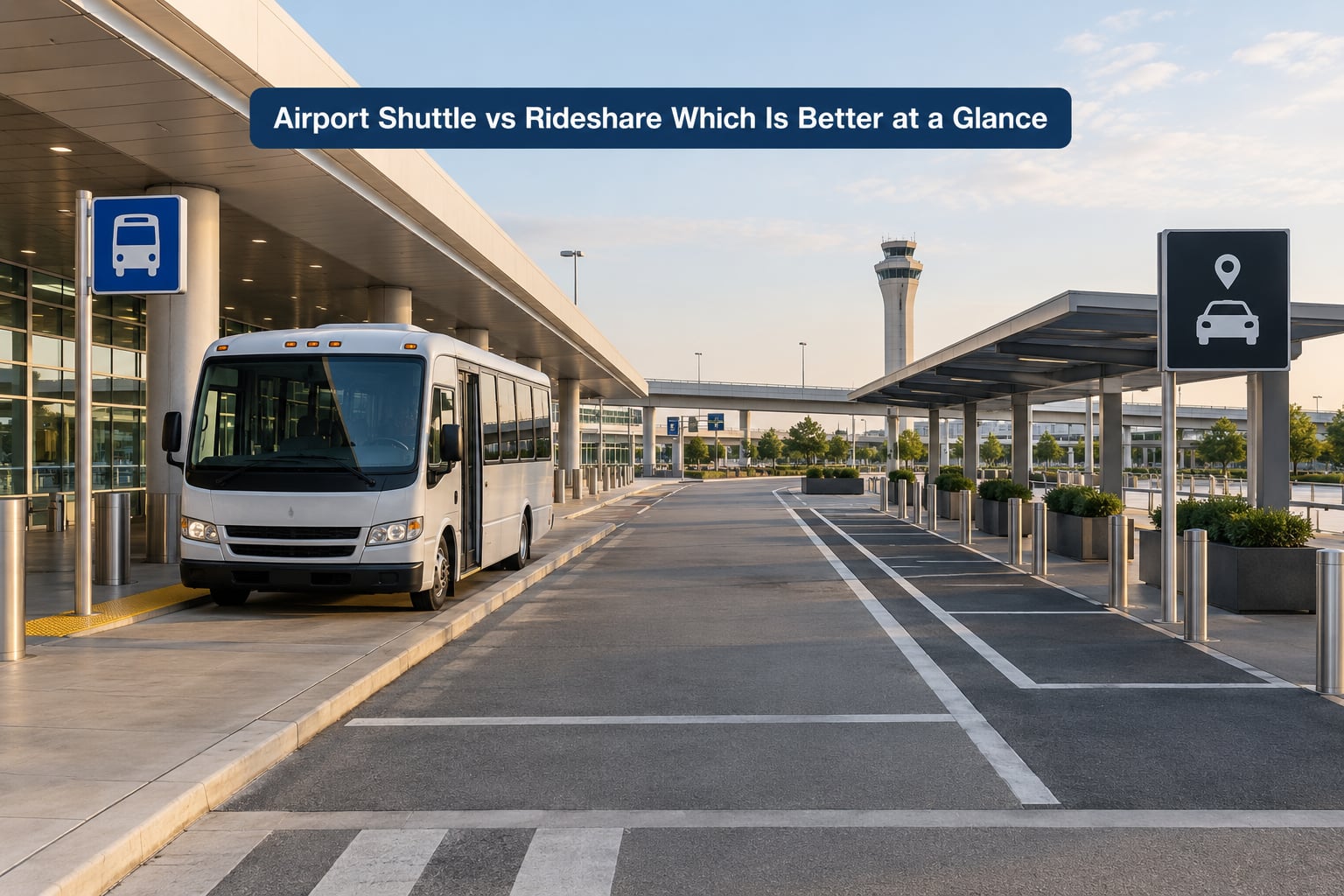
Airport Shuttle vs Rideshare Which Is Better at a Glance
| Criterion | Airport shuttle | Rideshare |
|---|---|---|
| Typical price | Flat fare or per-passenger rate, often tiered by group size | Demand-priced estimate that changes minute to minute |
| Pickup process | Book ahead or join a scheduled loop at a marked bay | Request in an app, walk to the pickup zone, match by plate |
| Wait time | Schedule-based, plus time while the van makes other drops | Match time plus queueing during arrival waves |
| Luggage capacity | Under-floor bays sized for suitcases, skis and golf bags | Varies by vehicle class; compact cars fit one or two bags |
| Route flexibility | Fixed routes and hotel loops, with scheduled stops | Point-to-point, changed in the app up to pickup |
| Accessibility | Lift-equipped vehicles usually available with advance notice | Wheelchair-accessible cars requestable but supply-limited |
| Late-night and pre-dawn | Reliable if the schedule runs, unreliable after the last loop | Thin supply in small markets before dawn and after midnight |
| Best fit | Groups, families with luggage, fixed destinations, tight early flights | Solo travelers, short trips, flexible arrival plans |
Price and Total Cost
Why a shuttle is often cheaper for a group
Shuttle fares are built around a published rate, and most operators divide the vehicle cost across the passengers booked. Two people in a minivan can pay less each than two separate car trips, and the gap widens as the group grows to five or six.
Rideshares are priced per vehicle, not per passenger. Two adults with four bags will request a larger car class, and that class costs more than the standard one a single traveler would book.
What pushes a rideshare price up
Demand is the biggest lever. When a bank of flights lands together, every traveler on that bank opens an app at the same moment, and estimates climb — travelers on forums like r/UniversalOrlando describe arrival-wave pricing running well above a normal fare.
Tolls, airport concession fees and wait-time charges get added on top. The app shows an upfront estimate, but the final charge can carry extras if the route changes or the driver waits at the curb.
Tipping, fees and other hidden costs
Tipping norms differ enough to trip people up. In a rideshare, the app prompts a tip after the ride and drivers generally expect one; you can set a percentage in the app so you are not deciding in a car park at midnight. Shuttle drivers are usually tipped in cash at the vehicle, and many hotel shuttles run a tip box instead. Some operators state a service charge in the booking terms, so read that line before adding a second tip on top.
A simple way to compare true cost: shuttle fare per person, plus tip, plus the cost of any parking or toll pass you avoid by taking it. Rideshare estimate, plus expected tip, plus tolls and airport fees, plus the cost of the time you spend queued.
Is an airport shuttle cheaper than a taxi?
Usually, and it is worth checking the fixed airport rate before you book. Taxis meter from a set airport rate plus per-mile time and distance, so a long trip in traffic costs more than a published flat shuttle fare. Where the shuttle route loops through several hotels, a taxi can win on speed alone.
Pickup and Drop-Off Convenience
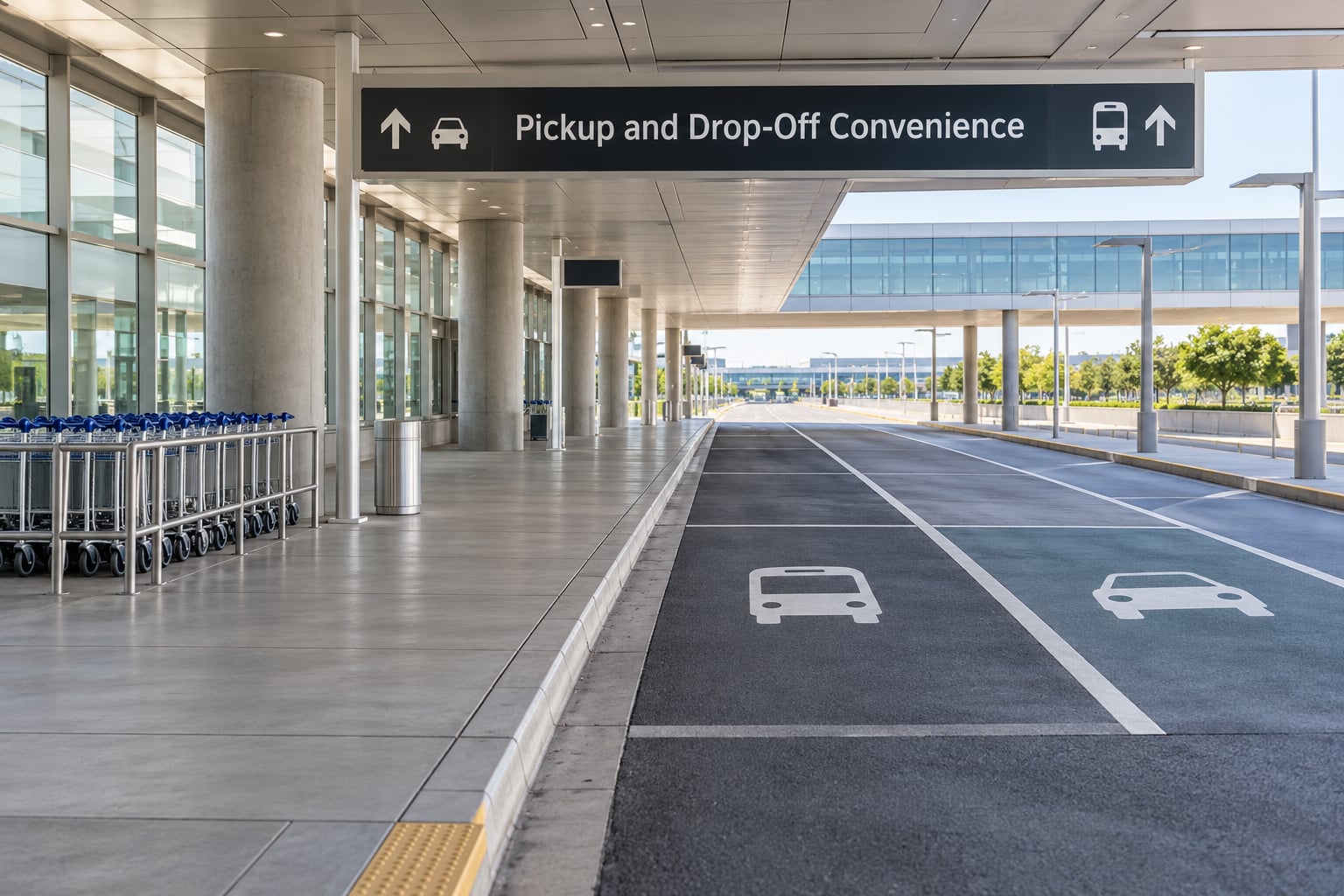
A shuttle pickup means finding the right bay and boarding when the vehicle arrives. Scheduled loops publish their stops and times, so there is no app to open, and a pre-booked transfer will usually meet you curbside or inside the terminal.
A rideshare pickup means opening the app, watching the driver approach, and then finding the staging lot. This is where the two options diverge most often in practice. Travelers report that pickup areas move when a terminal is renovated, adding a five to ten minute walk with bags. Quora threads about Las Vegas come down to exactly this: a curb drop versus a walk from a distant lot.
Drop-off runs the same way in reverse. Shuttles deposit you at a designated hotel stop on a loop, which can be a walk from the front door. A rideshare drops at the address you typed.
How much does the pickup walk really add?
Ten minutes with two suitcases on a hot curb adds up fast. That is the strongest practical argument for the shuttle when you have mobility limits, oversized bags, or a hotel that sits far from the loop.
Wait Times and Schedule Flexibility
Both options can make you wait, but the wait is structured differently. A shuttle wait is knowable: the timetable tells you when the van leaves the terminal, and if you miss it, you wait for the next one rather than an unknown. A rideshare wait has two parts — the match time and the queue — and at a busy arrival bank the queue part can run long.
Pre-dawn is where rideshare availability collapses. Between roughly 4 AM and 6 AM, driver supply drops in most markets while airport traffic does not, so quotes stretch and cancellations rise. Late at night, the same pattern repeats after midnight, and it bites hardest at regional airports where the driver pool is thin to begin with.
Shuttles have their own gap: once the last scheduled loop leaves, there is no later one. A pre-booked private transfer handles that window because the vehicle is committed to your reservation.
Why the timing of your booking matters more than the mode
People on r/TravelHacks report booking in off-peak hours and paying far less than a ride requested at the busy moment. Waiting 30 to 60 minutes after you land, if your schedule allows, often beats booking the instant you reach baggage claim.
Luggage, Families, and Groups
Vans and minivans are built for bags. Under-floor compartments take suitcases that would block visibility in a sedan, which is why shuttle operators mention golf bags and ski equipment without being asked. A rideshare gives you exactly the vehicle class you request, and a compact car holds one bag comfortably.
Groups of five or more
Two large vehicles beat one impossible one. A rideshare booking for five people with luggage may need an XL vehicle plus a second car, and coordinating two drivers at the same pickup zone takes longer than it looks. A single shuttle van seats the whole party and their bags in one trip at one fare.
Children and car seats
Shuttles rarely carry infant seats. Rideshare apps let you request one, but supply is limited and it must be requested in advance rather than assumed. Whichever route you take, bring your own seat if the child still needs one — it is the least flexible part of either booking.
Solo travelers and business trips
A solo traveler carrying a backpack is the strongest rideshare case: one bag, no coordination, direct to the door. Business travelers get an itemised receipt through the app, which matters more than comfort if the trip is billed.
Route Flexibility and Extra Stops
A scheduled shuttle follows a fixed loop. That is why it is cheap — the van runs the same path whether it is full or half empty — and it is also why your ride can take 40 minutes longer than a direct run when it stops at four other hotels first.
A rideshare is point-to-point. The driver routes around traffic, takes you to the exact address, and lets you add a stop in the app before pickup. That flexibility is the whole reason to pay more.
When the extra stops genuinely hurt: an early meeting, a tight connection, a checked bag that is already circling, or a hotel far off the loop. When they do not: a resort area where most guests share the same three hotels, where a loop shuttle is the sensible way around.
Reliability, Delays, and Flight Tracking
Neither option monitors your flight unless the operator says it does. Assume nothing and confirm it. Many shuttle companies will adjust a reservation for a delay if you tell them, and many rideshare companies cannot track your flight at all because the driver is dispatched when you request it.
The failure mode people complain about most is specific: a pre-booked shuttle waits, the flight lands, the traveler collects bags and leaves the terminal without the shuttle, and the driver goes home. Plan for it.
Four steps when a flight is delayed and a shuttle is already booked
Open the operator’s app or number and push your ETA out to the real landing time plus time to clear baggage. If they have a rebooking line, use it, because a rebooked slot is a slot and an informal message is not. Confirm the meeting point rather than assuming the driver knows. Have a fallback ready, since a rideshare quoted at a busy hour costs more than the shuttle would have. Keep the shuttle as the first choice, because a guaranteed vehicle is still cheaper than a surged one.
On the rideshare side, the failure mode is a cancellation. Request earlier than feels necessary during peak arrival banks, and request again if no driver has accepted within a few minutes.
Accessibility and Mobility Needs
Both options can be booked with an accessible vehicle, and both have a supply problem at the edges of the day. Shuttle operators usually fit lift-equipped vans but deploy them by reservation, so accessibility needs to be stated when you book, not at the curb. Rideshare apps let you request a wheelchair-accessible car, but those are a small slice of the fleet and they are easiest to get in the middle of the day.
Boarding help is part of the comparison. A shuttle driver who lifts bags into a compartment is doing the loading for you. A rideshare driver will typically expect passengers to load their own bags, which is harder with a walker or a heavy case.
One more factor: transfer distance. A shuttle pickup bay may be closer to the accessible terminal door than a rideshare staging lot, or the reverse. Ask the operator for the exact meeting point and how far the walk is before you commit.
Which Should You Choose?
Use the rule below rather than a general preference. It comes down to how many of you there are, how much luggage, how fixed your timing is, and how late you land.
Choose a shuttle when…
You are travelling with four or more people or one big group. You have multiple suitcases, strollers, or sports equipment. Your destination sits on a common hotel or resort loop. You are catching a pre-dawn flight and want the vehicle guaranteed rather than hoped for. You land after midnight at a smaller or regional airport where app supply is thin. You want one fixed, all-in number instead of a moving estimate.
Choose a rideshare when…
You are travelling alone with one bag. You need to be somewhere at a specific time and extra stops would hurt. Your hotel is off the shuttle route or you are visiting more than one place. You want curb-level pickup and no waiting for a loop to come around. You are comfortable managing an estimate, a tip prompt and a possible cancellation. You arrive in the middle of the day when both options are at full strength.
Scenario decision table
| Trip situation | Better fit | Why |
|---|---|---|
| Solo traveler, short hop, daytime arrival | Rideshare | Direct route, one bag, no coordination |
| Family of four with luggage | Shuttle | One vehicle, one fare, bags fit properly |
| Group of five or more | Shuttle | Avoids coordinating two cars at the pickup zone |
| Flight leaving before 6 AM | Shuttle or pre-booked transfer | Driver supply is thinnest before dawn |
| Arriving after midnight | Shuttle or pre-booked transfer | Late-night app availability drops, especially regionally |
| Holiday weekend arrival bank | Shuttle | Avoids surge pricing at the peak moment |
| Small or regional airport | Shuttle | Short driver pools and long staging-lot walks |
| Business traveler with a fixed meeting | Rideshare | Door-to-door timing and an itemised receipt |
| Trip of three or more nights | Compare against rental car and parking | Daily costs change the maths entirely |
The Other Options: Taxi, Transit and Rental Car Baselines
A rideshare is not always the most expensive door-to-door option. An airport taxi works out well on short runs where the metered fare undercuts a car booking, and on the Strip in Las Vegas specifically, forum consensus is that taxis often come in cheaper than an app ride until you are moving around the city.
Public transit is the cheapest baseline and the least flexible. Airport rail links and express buses run on published schedules and fixed fares, which suits a traveller with a long check-in margin and light luggage. Anyone on the r/AskNOLA transit threads ends up making the same trade: cheap and predictable on one leg, awkward with bags on the other.
For stays of three nights or more, price the rental car and the airport parking against the total shuttle and rideshare spend. Counter fees, insurance and parking add a fixed daily cost that rideshares never carry. Short stays rarely justify a rental; longer ones often do.
Frequently Asked Questions
Is an airport shuttle cheaper than a rideshare?
Usually per person, and especially for groups, because the vehicle cost gets split across passengers. A rideshare is priced per car, so the fare per head rises as the group and luggage count grows. Compare the shuttle fare plus tip against the app estimate plus tip, tolls and airport fees, and check both in real time before you book.
What is the best airport transportation for a family with luggage?
A shuttle or pre-booked private transfer. Vans have under-floor luggage bays that hold multiple suitcases without blocking visibility, and one vehicle at one fare beats coordinating an XL plus a second car at the pickup zone. Book early and state how many bags you have so the right vehicle is sent.
Can I take an airport shuttle after my flight is delayed?
Usually yes, but only if you tell the operator. Scheduled loops run to a timetable, so you simply join the next one. A pre-booked shuttle may hold for a period and then leave, so push your ETA out by phone or app, ask them to rebook the slot, and keep a rideshare as a fallback in case the vehicle departs.
Which is better for getting to a hotel or resort quickly?
A rideshare wins on speed because it routes point-to-point with no intermediate stops. A shuttle wins on cost and on hassle if your hotel sits on the loop, since it may drop at the door. If the shuttle makes four stops before yours, add that time to the fare before deciding the cheaper option is the better one.
Are airport shuttles accessible for travelers with mobility needs?
Most shuttle operators offer lift-equipped vehicles, but they are deployed by reservation rather than kept at the curb. State accessibility needs when you book, confirm the exact meeting point and how far the walk is, and ask whether the driver loads bags. A rideshare can also be requested with a wheelchair-accessible car, though supply is limited.
Should I book a rideshare before or after my flight lands?
After, once you have cleared baggage and know your real time. The app prices against live demand, and booking at the exact arrival moment during a landing bank is the most expensive way to ask for a car. If you are picking up a senior relative or travelling with kids, request earlier so you have time to match a vehicle and walk to the pickup zone.
The One-Line Rule
Choose a shuttle when the fare is being split between several people and your timing is fixed. Choose a rideshare when you are alone, flexible, and want a direct route. Pick the airport taxi or airport rail link when the trip is short and light, and price the rental car against both before you commit to a week of rides.