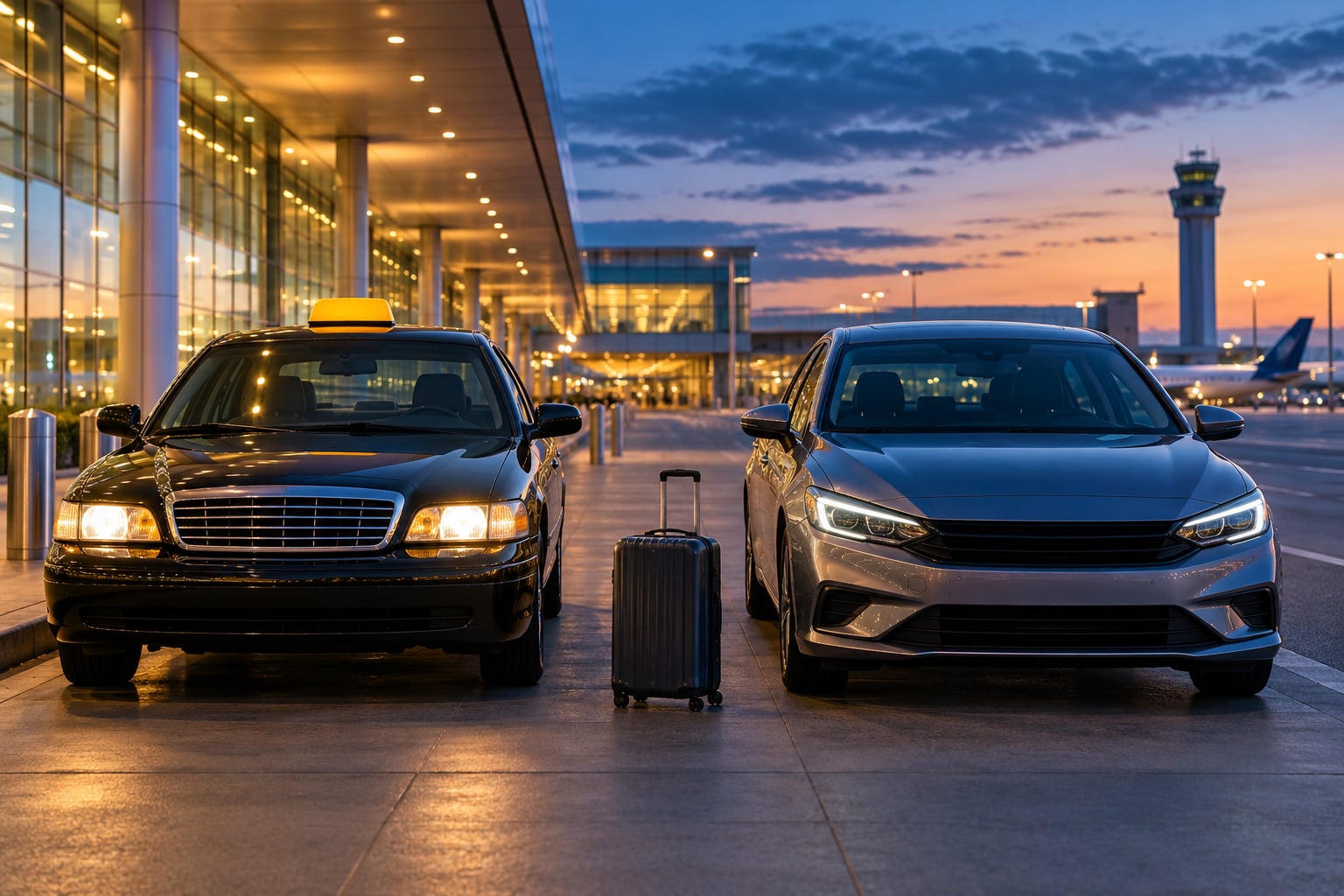
Is a rideshare cheaper than a taxi for an airport trip? Usually yes, off-peak and on longer runs, while a metered cab wins at dawn departures, at airports with a regulated flat rate, and whenever surge pricing is active. This rideshare vs taxi cost comparison for airport trips looks at the all-in number rather than the headline fare, because that is where the two actually separate.
Three things decide it: what time you travel, which airport, and how much luggage you are hauling. Get those three right and the choice takes about two minutes. Get them wrong and you can pay twice the sensible fare, or worse, save ten dollars and miss the flight.
Table of Contents
- Rideshare vs Taxi Cost Comparison for Airport Trips at a Glance
- How Much Do Rideshares and Taxis Usually Cost for Airport Trips?
- What Hidden Fees Should Airport Travelers Compare?
- Is a Rideshare Cheaper Than a Taxi for Airport Trips?
- When a rideshare is the cheaper option
- When a taxi is the cheaper option
- Do Taxis or Rideshares Cost More When You Have Luggage?
- How Do Wait Times and Airport Pickup Rules Affect the Price?
- Which Should You Choose?
- The six variables that flip the answer
- Checking the rideshare vs taxi cost in under two minutes
- By traveler type
- Frequently Asked Questions
- Is Uber cheaper than taxis at airports?
- Is it cheaper to go by taxi or Uber?
- Does Uber charge more to go to the airport?
- Which is better for seniors, Uber or Lyft?
- Are taxis in Chicago cheaper than Uber?
- How much does a 20-minute Uber ride cost?
Rideshare vs Taxi Cost Comparison for Airport Trips at a Glance
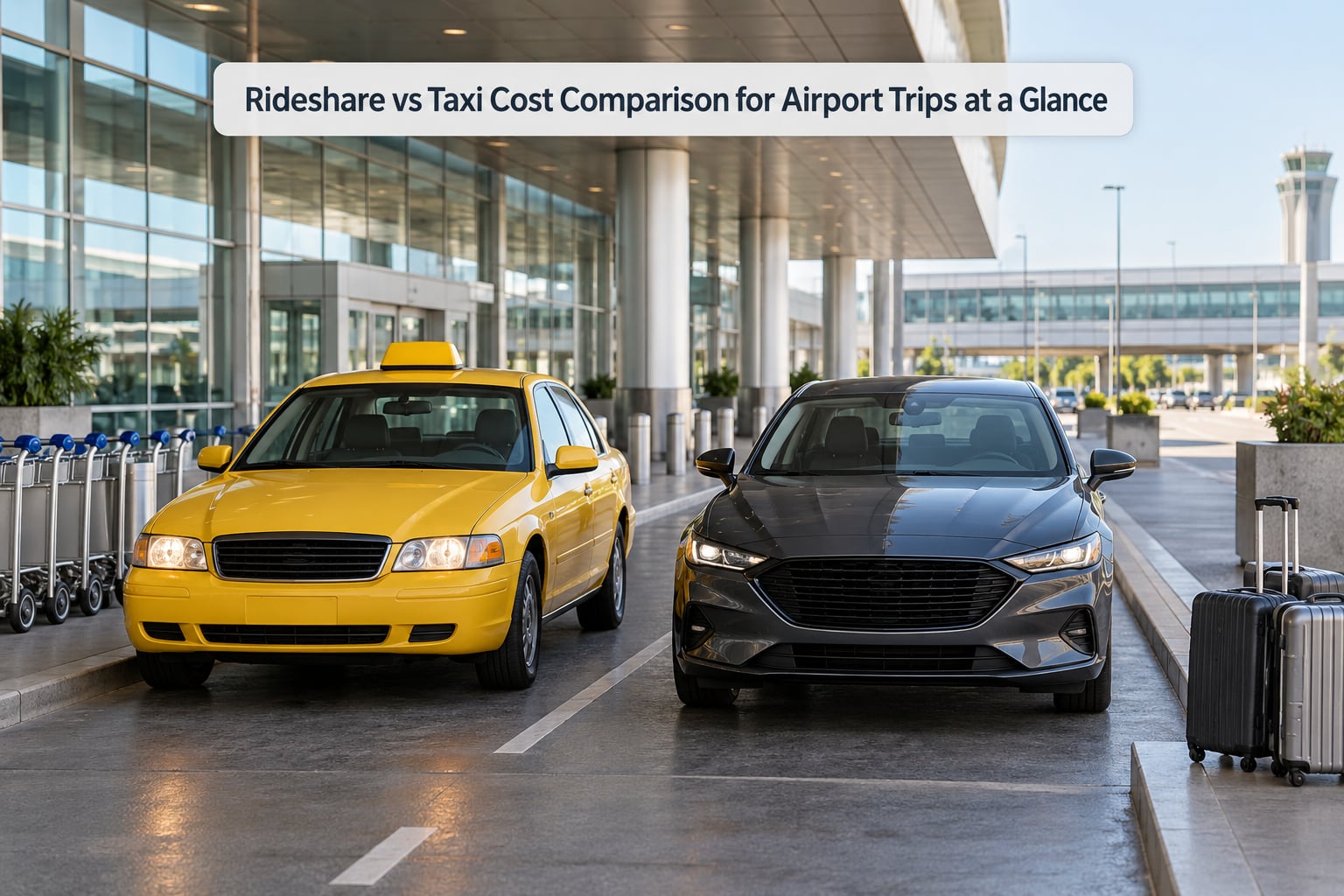
Taxi fares are set by a local structure, so the number barely moves. Rideshare fares are set by live supply and demand, so the number moves constantly, and it moves most at exactly the times airports are busiest.
| Factor | Taxi | Rideshare |
|---|---|---|
| Pricing model | Regulated meter, flat airport rate, or pre-arranged quote | Demand-based quote shown before you book |
| Price stability | Same fare at 4 a.m. and 4 p.m. for the same route | Can change several times before you confirm |
| Surge risk | None | Highest during airport peaks and events |
| Airport fee | Often a flat curb or facility charge, sometimes built into the rate | Airport facility fee added at checkout, varies by app |
| Tolls and bridge crossings | Passed through, sometimes paid in cash | Added to the fare automatically |
| Payment | Cash or card, tip decided at the curb | Cashless, tip set in the app before the trip |
| Pickup | Queue at a staffed or marked taxi stand | Designated staging zone, often a walk with bags |
| Late flight | Driver usually waits, then waiting time applies | Instant cancel, but a driver can decline the request |
| Best when | Early morning, flat-rate airports, heavy bags, no app access | Off-peak, long transfers, when you want a door-to-door quote |
The short version: a rideshare usually wins off-peak and on long runs, and a taxi usually wins when you are leaving at dawn, when the airport has a flat rate to downtown, or whenever a surge multiplier is showing. Forum consensus on Bogleheads puts the rideshare advantage for typical airport runs at 20 to 30 percent, with surge named as the main limit.
How Much Do Rideshares and Taxis Usually Cost for Airport Trips?
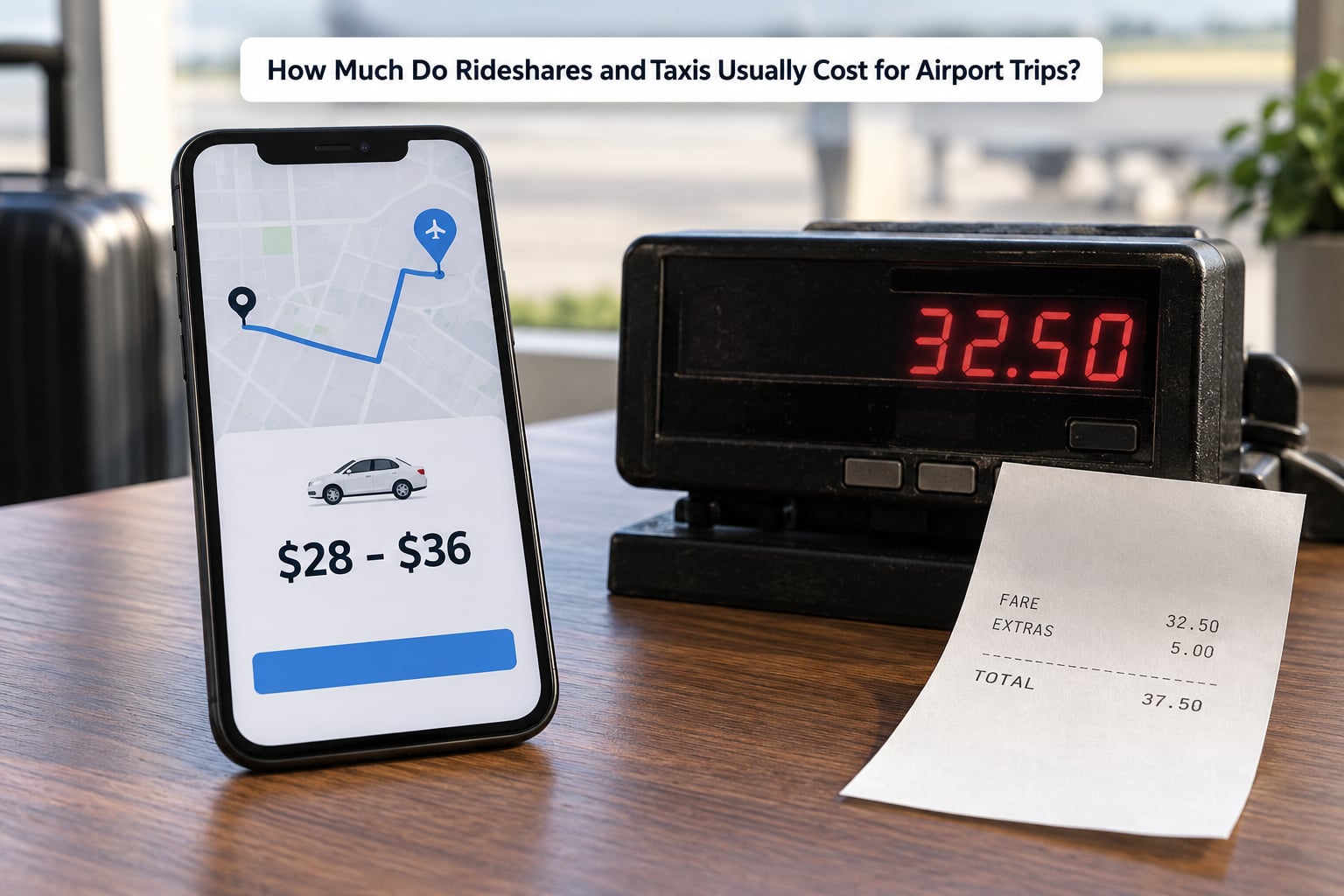
Both services charge for the same underlying things: a base fare, distance, and time. After that they diverge completely. A taxi adds regulated surcharges you can look up in advance. A rideshare adds a demand multiplier you cannot look up in advance.
On the taxi side, the fare is usually a drop charge plus a per-mile or per-time rate, plus whatever the city adds: a state or MTA surcharge, an improvement fee, an overnight surcharge, a weekday rush-hour surcharge, and tolls. Where a flat airport rate exists, the meter never runs and the number is fixed. In New York, for example, the metered structure includes a drop charge, a per-fifth-mile rate, an MTA surcharge, an improvement fee and a state congestion surcharge on top of tolls.
On the rideshare side, you get a base fare, a per-mile charge, a per-minute charge while moving slowly or stopped in traffic, a booking or marketplace fee, any tolls, an airport facility fee, and a tip you set yourself. The rate card looks tidy. The final number is what the market allows at the moment you book.
Here is a realistic all-in range for a one-way transfer between downtown and the airport, including tip and typical tolls. Prices last checked in 2026; they are typical ranges rather than quotes, they change over time, and they vary by city, airport, time of day and service level.
| City and airport | Taxi, all-in | Rideshare, all-in | What usually decides it |
|---|---|---|---|
| New York, JFK to Midtown | About 90 to 110 | About 60 to 100 | A regulated flat rate to Manhattan keeps the taxi steady; the rideshare swings with peak demand |
| New York, LaGuardia to Midtown | About 45 to 60 | About 45 to 75 | Short hop, metered either way, so the multiplier decides |
| Newark, EWR to Manhattan | About 95 to 120 plus an outbound airport surcharge near 20 | About 75 to 130 | Long run, so both are metered; tolls and surcharges stack up |
| Los Angeles, LAX to downtown | About 50 to 70 | About 40 to 70 | Historic taxi averages run near 60 one way; a walk to a staging zone adds time, not fare |
| Chicago, O’Hare to the Loop | About 50 to 75 | About 35 to 70 | Taxi flat rate plus tolls versus a quote that surges either way |
| Chicago, Midway | About 30 to 45 | About 25 to 50 | Short transfer, so the airport fee hurts the rideshare more |
| San Francisco, SFO to downtown | About 45 to 65 | About 40 to 70 | Tolls are large on both and frequently decide it |
| Boston, Logan to downtown | About 35 to 55 | About 30 to 55 | Tunnel toll applies to both services |
| Atlanta, ATL to downtown | About 28 to 40 | About 22 to 40 | Road-train and MARTA are genuinely cheap, so compare them first |
| Miami, MIA to downtown or Brickell | About 22 to 32 | About 20 to 38 | Tolls and the airport fee push both up |
| Dallas/Fort Worth, DFW | About 35 to 50 | About 30 to 55 | Long sprawling run, meters and time charges both bite |
| Denver, DEN to downtown | About 28 to 42 | About 25 to 48 | A train option undercuts both for a solo traveler |
One honest note before you read those numbers: for a solo traveler on a short route, an airport rail link, a public bus or a shared shuttle can cost a small fraction of either. At JFK, AirTrain plus the subway runs around 12 dollars end to end, and in Atlanta and Denver a downtown train link is cheaper still. The car only wins when you have heavy bags, several people, a late hour, or a tight schedule.
What Hidden Fees Should Airport Travelers Compare?
Neither quote tells you the whole number. Here is the stack that turns a fare into a cost, and where it shows up.
- Airport facility or curb fee. Charged for operating inside the airport zone. Taxis often fold it into a flat rate; rideshares usually add it as a line item at checkout. It is small, but it is the line that surprises people who assumed a metered cab has no extras.
- Tolls, bridges and congestion charges. Automatic on a rideshare, and the reason a pre-booked taxi quote is never the final number. Congestion pricing zones in some cities apply to both services alike.
- Booking or marketplace fee. A rideshare pass-through fee, or a booking fee if you reserve a cab through an app or a hotel instead of walking to the queue.
- Waiting time. The metered taxi keeps charging when the driver is circling or when you are queuing. The rideshare shows a waiting fee after a few minutes of a stationary trip.
- Airport-run or outbound surcharges. Some cities add a specific charge for trips originating at the airport, separate from any toll. This is a real line item, not a rounding error.
- Tip expectations. Airport taxi drivers usually expect a larger tip than an app default, partly because the tip is a bigger share of a short fare. Rideshare lets you set it before the trip, which quietly caps that line.
- Cancellation and no-show terms. A cancelled reservation can carry a fee, and a metered driver who waits past the grace period bills the waiting. Read the terms if your flight might shift.
- Luggage and passenger charges. Standard sedan capacity is four passengers and a small number of bags. Anything larger means a different vehicle class at a different price.
| Charge | Taxi | Rideshare |
|---|---|---|
| Airport fee | Flat curb charge or built into the rate | Facility fee added at checkout |
| Tolls and bridges | Added to the fare, sometimes paid in cash | Automatic |
| Congestion charge | Applies in regulated zones | Applies in the same zones |
| Booking fee | Only if you reserve through an app or hotel | Standard marketplace fee |
| Waiting time | Meter runs, including in the queue at some airports | Fee after a few minutes stationary |
| Tip | Larger expectation on short airport fares | Set in the app, capped by you |
| Cancellation | Terms depend on the booking | Free within the window, then a fee |
Reddit users on r/uber have posted cab quotes coming in near 20 percent under the app for the same 25-mile airport run, and one poster counted a 27-dollar taxi against a 90-dollar rideshare quote for a comparable trip in the same market. That spread is the argument for actually looking twice instead of assuming.
Is a Rideshare Cheaper Than a Taxi for Airport Trips?
Yes most of the time, and no at predictable moments. The variable is not distance, it is demand at the moment you book.
When a rideshare is the cheaper option
Off-peak, mid-morning or mid-afternoon runs usually price below a metered cab, because there are more drivers than requests. The same holds on longer airport transfers, where the app’s per-mile and per-minute math beats a regulated tariff that charges for time in traffic. If you are comfortable with a scheduled pickup and a quote you can see before you commit, this is where the app wins clearly.
Availability also favors the app in a way that is hard to price. A cab means standing in a queue, and a queue at a busy terminal can run twenty minutes or more. Time in a queue is not free if your flight is at seven in the morning.
When a taxi is the cheaper option
Three situations reliably favor the cab. The first is a regulated flat rate to the city center, which fixes the fare and removes the multiplier entirely. The second is any airport where the taxi has a published flat rate and the app adds a facility fee on top, which makes a short transfer a wash at best. The third is surge: when the multiplier is showing, a cab at the regulated rate is often the same money or less.
Add the practical cases. Anyone who does not want an app account, an older relative with a heavy bag, or a traveler who would rather not deal with a staging-zone walk after a long flight, and a metered cab is the calmer choice even when the app quote is lower. Regulars in r/askaustin say they take taxis to the airport specifically for the walk-up-and-go convenience and accept the fare difference as the price of certainty. r/AskChicago regulars recommend pricing Uber, Lyft and a cab app at the same moment before leaving O’Hare, because the multiplier can run in either direction.
Do Taxis or Rideshares Cost More When You Have Luggage?
Yes, and the jump lands in the same place for both. A standard sedan holds four passengers and a small number of suitcases. Past that, you are buying a larger vehicle, and the price step is real rather than marginal.
| Travelers | Bags | What you need | Effect on cost |
|---|---|---|---|
| 1 to 2 | Carry-ons only | Standard sedan or metered sedan | Baseline fare, no step up |
| 3 to 4 | Two or three suitcases | Standard sedan usually fine; XL or a minivan if bags are bulky | Expect a visible step, often a third to a half more on the app |
| 5 or more | Several large cases | XL, a large rideshare tier, or a taxi van | Two vehicles may be cheaper than one large one |
| Any | Ski or golf equipment, bikes | Vehicle with a rack or a larger body | Availability drops in peak season, so book ahead |
| Any | Mobility aids | Wheelchair-accessible van | Limited supply; reserve rather than request on demand |
Two rules of thumb travel well. A stroller plus two bags does not fit a sedan trunk, and the driver can refuse the trip, which at 5 a.m. is a genuine problem. And oversized items often need to be declared when you book a larger tier, because a driver who turns up with a car that cannot take them will cancel, and a cancel fee on a reserved airport trip lands directly on your total cost.
Airport taxi drivers are also used to luggage, and many cities run minivan or accessible taxi vehicles on request. A cab dispatcher can size the vehicle for you, which is worth something at dawn.
How Do Wait Times and Airport Pickup Rules Affect the Price?
Pickup logistics are a cost line, not a footnote. The fare may be settled, but the walk and the wait are not.
| Stage | Taxi | Rideshare |
|---|---|---|
| Where you wait | Marked or staffed taxi stand, usually close to the terminal door | Designated staging area, sometimes several terminals away |
| Does the clock run | In some airports the meter runs during the queue | Only after a driver accepts and the trip starts |
| With four bags | A short walk | A long walk, then a wait for the walk back |
| Your driver cancels | Rare; dispatch usually sends another | Happens on long airport runs, especially when a multiplier is showing |
| Flight is delayed | Waiting time billed after a grace period | Ride cancelled in the app, fee depends on timing |
| Flight is early | Not much you can do; you pay or wait | Not much you can do either |
Airports are tightening curbside rules. A growing number of them send ride-app pickups to a staging lot away from the terminal, which adds a walk with luggage and a wait on the way back. At LAX, for instance, the dedicated ride-app pickup area sits away from the terminal, so the walk is part of the trip even when the price looks good. Taxi stands, by contrast, are usually a door or two away, which is exactly why experienced airport travelers keep choosing them for early departures.
Reliability matters as much as the walk. A cheaper ride that cancels at 4:30 a.m. costs more than the pricier one that showed up, because the backup is surge-priced and the flight is not negotiable. Travelers in r/askvan say the same thing about pre-booked airport trips: they care far more about the pickup being confirmed than about the last few dollars. Treat waiting time and cancellation risk as part of the cost, and a fifteen-dollar difference stops looking like a decision at all.
Which Should You Choose?
Match the service to the trip rather than to a brand. Here is the order I would work through, and it takes less than two minutes.
The six variables that flip the answer
- Time of day. A 5 a.m. departure, a late-night arrival, and anything during a holiday peak all favour the cab. Mid-morning and mid-afternoon favour the app.
- Does your airport publish a flat rate? If yes, that is your taxi price, and it competes directly with the app quote.
- Is a multiplier showing? If yes, the cab wins. If no, the app usually wins.
- Party size and bags. Over four people or over three suitcases, compare a large tier or a taxi van rather than a sedan.
- How much walking can you do with luggage? A staging zone three terminals away is a real cost in effort and in wait time.
- How hard is your deadline? A fixed flight time is worth a guaranteed pickup. An open afternoon is worth the cheaper quote.
Checking the rideshare vs taxi cost in under two minutes
Open the taxi stand’s posted rates, or the airport’s ground transportation page, and note the flat rate or the metered estimate for your route. Then open two ride apps and look at the same route, off-peak, and note the quote. Compare the totals including tip and tolls, not the headline fares. If the multiplier is running, stop and take the cab. If it is not, and the app quote is at least a fifth lower, book the app.
By traveler type
For a solo traveler with a carry-on on a mid-morning run, take the app. For a 5 a.m. flight, take the cab, or reserve a scheduled ride the night before so the price is locked and the pickup is committed. For a family with a stroller and three cases, size the vehicle first and compare a large tier against a taxi van, since the step up is cheaper than booking two cars. For a business traveler on a fixed schedule, the guaranteed pickup is worth more than the saving. For seniors or anyone with limited mobility, a cab is usually the better experience: no account, no app, a door-side handoff, and a vehicle the dispatcher has sized for the bags.
Frequently Asked Questions
Is Uber cheaper than taxis at airports?
Usually, off-peak and on longer transfers. A metered cab is often cheaper at dawn, at airports that publish a regulated flat rate to downtown, and whenever a surge multiplier is showing. Forum consensus puts the rideshare advantage for typical airport runs at 20 to 30 percent, with surge named as the main limit. Compare all-in totals including tip and tolls, not the headline fare.
Is it cheaper to go by taxi or Uber?
It depends on three things: time of day, whether the airport has a flat taxi rate, and whether demand is high. Off-peak on a long run, the app is usually cheaper. Early morning, during a holiday peak, or when a surge multiplier is visible, a cab at the regulated rate wins. One exception worth remembering: a rail link or airport shuttle can undercut both for a solo traveler with light luggage.
Does Uber charge more to go to the airport?
Sometimes. Airport runs carry an airport facility fee, and tolls or bridge crossings are added automatically, so the final figure is higher than a simple distance estimate suggests. On top of that, airport pickups are the most requested routes in most cities, so a demand multiplier is more likely to be active. Reserve a scheduled ride if you want the quoted price locked in advance.
Which is better for seniors, Uber or Lyft?
For most older travelers, a cab. It needs no app account, no card setup, and no acceptance of a surge multiplier you did not choose. The vehicle can be sized by a dispatcher for bags or mobility aids, and the handoff is curbside. If a senior is comfortable with an app, a scheduled ride gives a locked price and a confirmed pickup, which solves the reliability problem that on-demand requests carry at odd hours.
Are taxis in Chicago cheaper than Uber?
At O’Hare, the cab is competitive and often cheaper once tolls and the airport fee are counted, particularly on a flat-rate journey to the Loop with no surge active. Midway is shorter, so the app quote can drop below the cab, but the airport fee makes the gap narrow. Regulars on r/AskChicago recommend pricing Uber, Lyft and a cab app at the same moment, since the multiplier can move either way.
How much does a 20-minute Uber ride cost?
A twenty-minute ride typically lands in the mid-teens to the upper twenties in most US cities, made up of a base fare, per-mile and per-minute charges, a marketplace fee, any tolls, and your tip. Short trips carry the fixed fees hardest, so the per-mile cost looks high. Airport versions of the same trip cost more because of the facility fee, longer distance and higher demand. Prices vary by city and change over time.
So here is the rule to take away. Book the rideshare when you are travelling off-peak, the trip is long, and no multiplier is showing. Book the cab when you are leaving at dawn, when the airport publishes a flat rate, when the bags outnumber what a sedan holds, or when the schedule has no slack in it. Either way, look at both prices in the two minutes before you book, and compare the totals rather than the headlines. On a short route with light luggage, also check the train or the airport shuttle before you commit to a car at all.