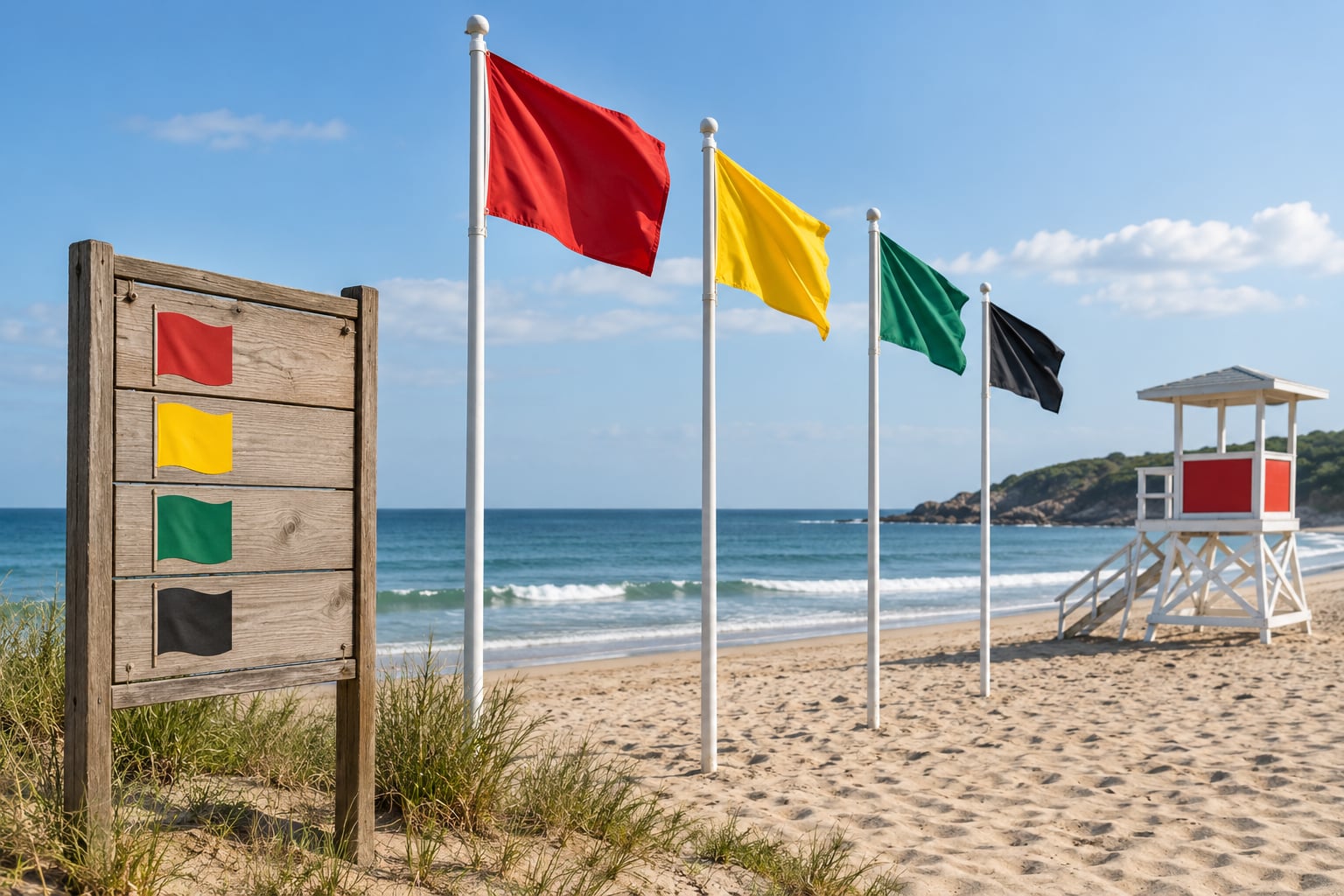
Beach warning flags are coloured flags flown on poles at lifeguard towers and beach entrances to show the current hazard level: green for low hazard, yellow for moderate, red for high hazard, double red for water closed to the public, purple for dangerous marine life, and blue for certified water quality. The colour set comes from an international standard developed by lifesaving bodies such as the International Lifesaving Federation, which means most of the world reads them the same way. Knowing how to read beach warning flags takes about two minutes, and doing it before you unpack your towel is the single most useful safety habit a beach day can have.
The awkward part is that flags are raised by whoever runs that beach. A city lifeguard department in Southern California, a county beach patrol on the Florida Gulf Coast and a local surf club on the Atlantic seaboard can all use slightly different colours, shapes and extra signals, and a flag meaning can be tightened by local rules or by the flag code posted right next to it.
So the habit worth building is simple: find the flag key first, read the flag against that key, and let the posted legend overrule anything you have read online.
Table of Contents
- What You Need
- Step-by-Step: How to Read Beach Warning Flags Safely
- Check the Beach’s Flag Key and Current Conditions
- Identify the Color or Symbol
- Translate the Warning Into a Water Decision
- Common Beach Warning Flags and What They Can Mean
- Recheck the Flags Before and During Your Visit
- What Each Warning Means in Practice
- Common Mistakes
- Quick Safety Tips
- Frequently Asked Questions
- Are beach warning flags the same at every beach?
- What should I do if no beach warning flag is posted?
- How often should I check the flags during a beach visit?
- Does a green beach warning flag mean the water is completely safe?
- What should I do if I get caught in a rip current?
- Conclusion
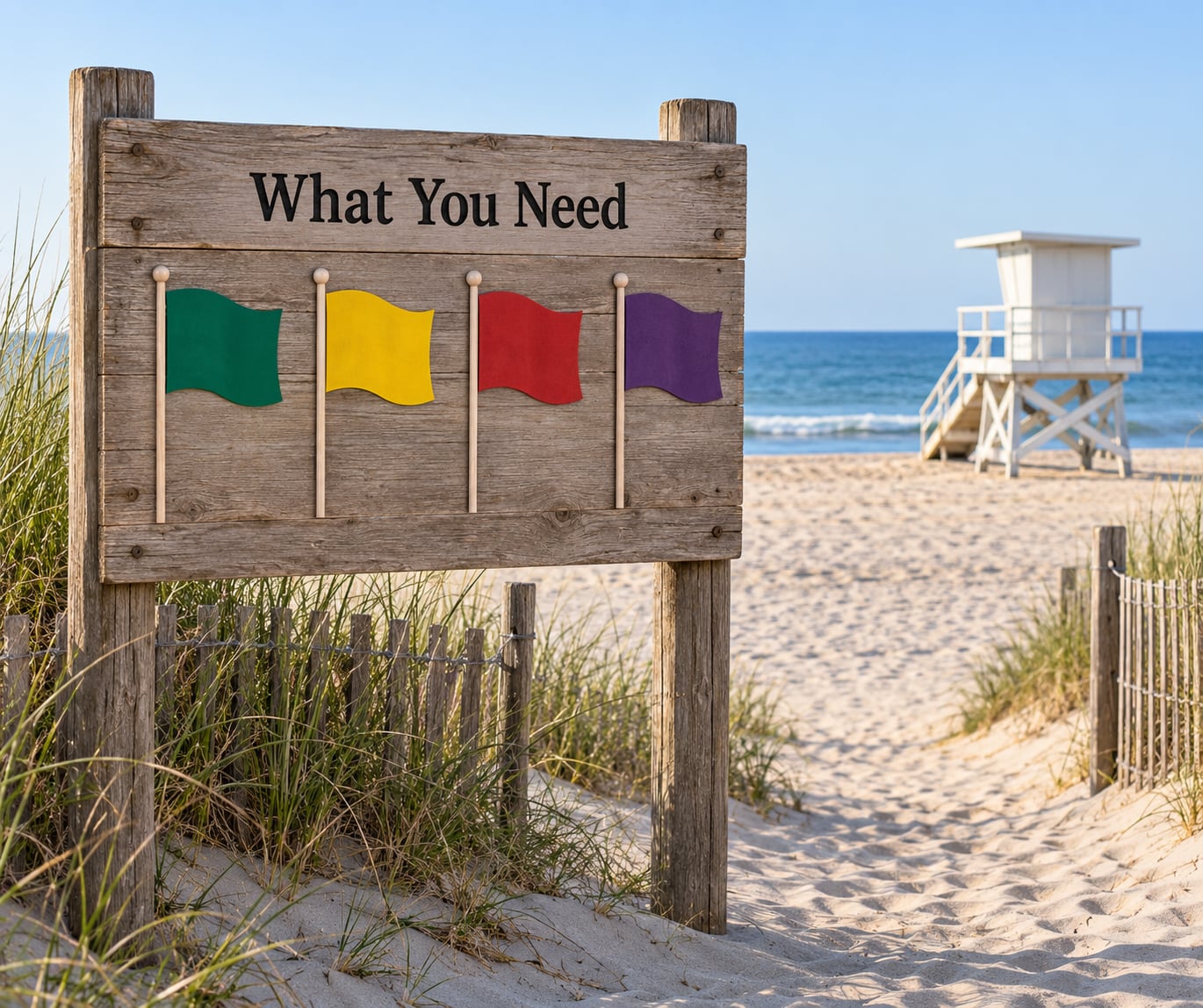
What You Need
You need very little, which is part of why people skip it. What you really need is the beach’s own flag key, a way to see today’s conditions, and a moment of attention before you get wet.
- The posted flag key. Usually a board, sign or colour-coded panel at the beach entrance, on the boardwalk, or mounted on the lifeguard tower. Some beaches also print the key on the back of the parking pass or the beach map.
- Current conditions. Surf height, tide state and wind, either posted on the same board or available from the local authority’s beach page or lifeguard feed.
- A reason to check again later. Wind shifts, storms build and tides turn during a single visit, so the flag you read at 10 a.m. may not be the flag at 3 p.m.
- A rough idea of your own limits. Flags tell you what the water is doing. Only you know whether you are a strong swimmer, wading with a toddler, or launching a paddleboard.
Two more things worth carrying: a charged phone, because the emergency number for most coastal areas is 911 in the United States and the local coastguard or marine rescue number abroad, and a watch or timer so you notice that conditions have changed rather than assuming they have not.
Step-by-Step: How to Read Beach Warning Flags Safely
Six steps, in order. It takes about two minutes from parking to waterline, and each one has an obvious sign that you did it right.
Check the Beach’s Flag Key and Current Conditions
Start at the sign, not at your phone. Beach entrances usually have a flag key board, and lifeguard towers carry a version of it too, often with extra local detail such as closure areas or watercraft rules. Look for a publication date or a seasonal note on the board; some fixed boards are several years old and occasionally lag behind the beach’s own current practice.
Then look up today’s status on the beach’s official page if there is one. Many county and city beach departments post the current flag status and, in season, photographs of the flag poles taken in the morning. If the beach has no page, the lifeguard station or the entrance kiosk is the next best source.
You have done this right if you can name the beach you are at and say which authority runs the water there, even if you cannot yet name a single colour.
Identify the Color or Symbol
Now match what is flying against what the key says. Three shapes and three colours cover most of the world: a rectangular green flag for low hazard, a rectangular yellow flag for moderate hazard, and a rectangular red flag for high hazard. Two red flags flown side by side is the near-universal signal that the water is closed to the public. Purple, in some countries, means dangerous marine life such as jellyfish or stingrays.
Here is the trap. Most people carry a mental list from a website, and most of that list is right most of the time. The exception is the exception that matters: local authorities add their own meanings, substitute colours, or use different symbols for wind and watercraft warnings. Read the key, not your memory.
You have done this right if you can say out loud, in a full sentence, what the flag currently flying means at this beach.
Translate the Warning Into a Water Decision
Now turn the colour into a decision, and separate informational flags from restrictions. A yellow flag describes conditions; a double red flag closes the water. A purple or blue flag adds information about what is in the water or how clean it is. Only the closure stops you by rule, but only you can decide whether a moderate hazard suits your group.
Match the flag to three things: your swimming ability, your intended activity, and your supervision. A yellow flag is often fine for an ocean-confident adult body-surfing, and a poor fit for a family wading with a five-year-old in an ankle-deep trough.
The conservative response is always the right one. Obey a closure, ask a lifeguard if you are unsure, move to a sheltered part of the beach or a calmer stretch, or stay on the sand. You lose an hour of swimming; nobody has ever regretted that trade.
Common Beach Warning Flags and What They Can Mean
This table is the standard international set. Treat it as a reference, not a promise, because the posted legend at the beach overrides every row below.
| Flag | Colour and shape | Usual meaning | What it usually asks of you |
|---|---|---|---|
| Low hazard | Green, rectangular | Calm conditions, low surf, no significant hazard expected | Enjoy the water, stay alert, keep children in reach |
| Moderate hazard | Yellow, rectangular | Moderate surf, rough water, longshore or rip currents, possibly strong wind | Swim with caution, check your ability, stay near a lifeguard |
| High hazard | Red, rectangular | High surf, strong currents, heavy shorebreak, dangerous conditions | Stay out of the water unless you are trained and equipped for it |
| Closure | Two red flags, side by side | Water closed to the public | Do not enter; closures are enforced and fines may apply |
| Marine life | Purple, rectangular or triangular | Dangerous marine life in the water, commonly jellyfish, stingrays or shark activity | Keep clear of the water or the shoreline area, ask a lifeguard what is being reported |
| Environmental standard | Blue, usually triangular or square | Water meets the standards of the Foundation for Environmental Education, a certification rather than a hazard warning | Nothing urgent; it tells you about water quality and management, not surf |
| Offshore wind | Orange windsock on a mast or pole | Wind blowing from the land out to sea | Expect glassy, confusing water offshore; keep inflatables and paddleboards near shore |
| Watercraft warning | Checkered, yellow and black or red and white | Boats operating in the area, or restricted zones such as a swim zone or a no-wake area | Do not swim or paddle inside the marked zone |
Two things in that table get confused more than the rest. A blue flag is not a warning about surf at all; it is a quality certification awarded by the Foundation for Environmental Education, and plenty of excellent swimming beaches never fly one. And an orange windsock is not decoration; offshore wind flattens the wave line, so the water looks calmer than it is while the bottom drops away quickly.
Recheck the Flags Before and During Your Visit
Look again before you enter the water, not just when you arrived. Look again when the sky changes, when you come back from a break on the sand, when the wind turns, and whenever a lifeguard says or signals anything at all.
The pace of change depends on the beach. On an exposed surf coast, a wind shift can take a green flag to a red one inside an hour. On a sheltered bay, flags may not move all day. That is why the flag pole is the authority on the day, not your forecast app from the morning.
What Each Warning Means in Practice
Under calm conditions, swimming is generally reasonable and the main risks are ordinary ones: supervision, sun, cold and rip currents that exist even on a flat sea.
Under a moderate hazard, stay where you can be seen, keep young children in arm’s reach or in a flotation device, and expect the shorebreak to be stronger than the calmer water further out suggests. Under a high hazard, the water is for experienced swimmers and surfers with the right equipment; everyone else stays ashore.
For rip currents, the flags tell you the water is more dangerous, not where the rip is. For severe weather, thunderstorm activity and lightning mean leaving the water entirely and moving away from the shoreline, not sheltering under a lifeguard tower.
For marine life alerts, ask the lifeguard what has actually been reported rather than guessing from the colour. For water-quality problems, treat the beach as closed for swimming until the notice is lifted, especially with children.
No flag, in any of these cases, is permission to ignore your own limits or an instruction from a lifeguard.
Common Mistakes
Assuming every beach uses the same code. The international colour ladder is shared, but local authorities add and adjust signals. The correction: read the key at the entrance every time, especially at a beach you have not visited before.
Treating green as a guarantee. A green flag means low hazard, not zero hazard. Rips, jellyfish and cold water exist on calm days. The correction: swim near a lifeguard on a green flag too, and keep the same supervision habits.
Reading the general web list instead of the posted key. This is the most common source of confusion in online discussions, where locals and visitors argue about what a flag means because they are looking at different sets. The correction: the flag on the sand wins, every time.
Assuming no flag means safe water. An unmanned beach, a beach with no lifeguard coverage, a closed or damaged flag pole, or early in the morning before flags go up all mean unknown conditions, not calm ones. The correction: treat a missing flag as no information at all, and swim close to shore.
Confusing single red with double red. People often assume both are hard bans. Double red is the closure. Single red is a high hazard warning, which in practice still means most people should not be in the water. The correction: if you are asking whether it is legal, it almost certainly is not your question to ask; ask a lifeguard.
Entering the water after a closure is posted. Closures are enforced, and fines are real. The correction: respect the closure and use the time for the beach, not the swim.
Checking once and forgetting. Conditions change during a visit. The correction: build a recheck into your routine, especially around a weather change.
Trusting a forecast over the flag. A generic forecast for the region does not know about the rip at your specific beach. The correction: use forecasts for planning, flags for decisions.
Quick Safety Tips
- Swim near a lifeguard. This is the advice every local authority gives, and it holds under every flag colour.
- Keep children within arm’s reach in shallow water, and use a flotation device rather than relying on a pool float.
- Protect your feet where there are rocks, reef or sharp shell. Sand and stones in hot conditions cause real burns.
- Leave alcohol out of the swim. It is one of the most reliable predictors of drowning.
- Know the rip-current escape routine. Float, do not fight the current, swim parallel to the shore until you are out of it, then angle back towards the beach.
- Leave the water for lightning and for any posted water-quality alert.
- Ask the lifeguard when anything is unclear. It is the fastest answer available and the people standing there are paid to give it.
Frequently Asked Questions
Are beach warning flags the same at every beach?
Mostly, but not exactly. The green, yellow, red and double-red hazard ladder comes from an international standard developed by lifesaving organisations such as the International Lifesaving Federation, so it reads the same nearly everywhere. Local beach authorities add their own signals for wind, watercraft, closures and water quality, and they can adjust what a colour means. The key posted at the beach entrance always overrides a general list.
What should I do if no beach warning flag is posted?
Treat it as no information rather than as good news. Beaches without lifeguard coverage, closed beaches, and early mornings before flags go up all look identical to a casual visitor. Stay close to shore, keep children in reach, avoid swimming alone, and assume there may be currents. If the beach has lifeguards, ask them directly; they can tell you what the conditions are today.
How often should I check the flags during a beach visit?
At least three times: before you get out of the car, immediately before you enter the water, and after any change in the weather or the wind. Look again whenever you return from a break on the sand. On an exposed coast a wind shift can move a beach from green to red inside an hour, so a flag you read two hours ago tells you very little about right now.
Does a green beach warning flag mean the water is completely safe?
No. A green flag means low hazard, which describes surf and currents, not every possible risk. Rip currents occur on calm days, jellyfish still drift in, cold water and sun exposure do not care what colour the flag is, and some beaches fly no flags at all. Green means the usual hazards are low, so it is a reasonable day to swim near a lifeguard with normal supervision.
What should I do if I get caught in a rip current?
Do not panic and do not swim straight back against it, because that is what puts most rip victims in trouble. Stay calm, float or tread water, and let the current carry you. When you feel yourself starting to ease off, swim parallel to the shoreline until you are clear of the flow, then angle back towards the beach at an angle. Signal for help early by waving your arms.
Conclusion
The first thing to do at any beach is find the flag key at the entrance and read the flag currently flying against it. Then check today’s conditions from the local authority’s beach page or lifeguard station, match the warning to your group and your activity, and choose the conservative option.
If anything is unclear, ask the lifeguard. That single question takes ten seconds and beats every article, app and memory of a flag colour you have ever read.