Park the two cars close enough that the cables reach, turn both engines off, and set the parking brake on each. Connect red to positive on the dead battery, red to positive on the donor, black to the donor negative, then black to an unpainted ground point on the dead car. Start the donor, start yours, and remove the cables in reverse order.
That whole sequence takes about five minutes and needs nothing more exotic than a set of jumper cables and a working battery to borrow. Knowing how to jump start a car safely comes down to one thing: the order feels arbitrary until something sparks and you assume you have ruined the car.
I have watched enough roadside drama to know the mistakes repeat. Cables touching metal, a jump pack that refuses to wake a fully dead battery, a car that clicks and does nothing because the fuel is fine and the starter is not. This guide walks through the safe procedure first, then the failures that a jump start cannot fix.
Table of Contents
- What You Need
- Step-by-Step
- How to Jump Start a Car Safely: Prepare Both Vehicles
- How to Jump Start a Car Safely: Connect the Cables
- How to Jump Start a Car Safely: Start and Remove the Cables
- Common Mistakes
- When the Car Still Will Not Start
- Safety and Battery-Care Tips
- Frequently Asked Questions
- Which jumper cable do you connect first, red or black?
- Is it normal to get sparks when jump-starting a car battery?
- Can jump-starting a car damage electronics or the alternator?
- How long should the car run after a jump start?
- Why won’t my car jump start even with a good donor battery?
- Can you jump start a car in the rain or in the cold?
- Conclusion
What You Need
You need one of two power sources, and everything else is comfort and protection.
- Jumper cables with intact insulation and clamps that grip tightly. Standard 16- or 20-gauge cables work for most cars. Thicker 10-gauge or 8-gauge cables carry more current and are better for trucks, SUVs and large engines.
- A donor vehicle with a healthy battery, parked within cable reach. It does not need to be the same make, but a similar-size vehicle is more forgiving.
- A portable jump pack if you plan to drive solo. Check the charge level before you leave the house, and keep it indoors in winter rather than in the trunk.
- Gloves and eye protection. Battery terminals are coated in whatever has been off-gassing out of that battery for three years.
- A flashlight and a rag for a night breakdown or a corroded terminal.
Before anything else, read the owner’s manual for both vehicles. Some manufacturers, including certain European models, warn against vehicle-to-vehicle jumping and instead point you to a dedicated battery ground post or a portable jump starter.
Weather matters less than people think. You can jump a car in the rain, and a light drizzle will not stop it, but standing water, a lightning storm or a highway with no shoulder are good reasons to call roadside assistance instead of improvising.
Step-by-Step
How to Jump Start a Car Safely: Prepare Both Vehicles
Position the vehicles close enough that the cables reach comfortably, but do not let them touch. Contact between the two bodies can create an unintended path for current, and on some vehicles the metal panels are part of the ground circuit.
Set the parking brake on both cars. On the donor, put the transmission in Park, or in Neutral for a manual. On the disabled car, leave the transmission in Park or Neutral too, and make sure the ignition is off while you connect the cables.
Open both hoods and find the batteries. On many modern vehicles the 12-volt battery sits in the trunk, under the rear seat or under a floor panel, with a pair of remote jump posts left in the engine bay. If you find two posts with a plus and a minus symbol, that is your connection point.
Now inspect the dead battery. Look for a bulging or swollen case, a crack, white or blue-green crust around the posts, any hissing, or a smell of rotten eggs. If you see any of that, stop and call for a tow. A damaged battery can vent hydrogen gas, and a spark near it is an ignition source.
Clean the terminals before you connect anything. A rag with a little baking soda and water on the crust, then a dry wipe, is often enough. Corroded terminals are the single most common reason a jump start fails, so check them first every time.
How to Jump Start a Car Safely: Connect the Cables
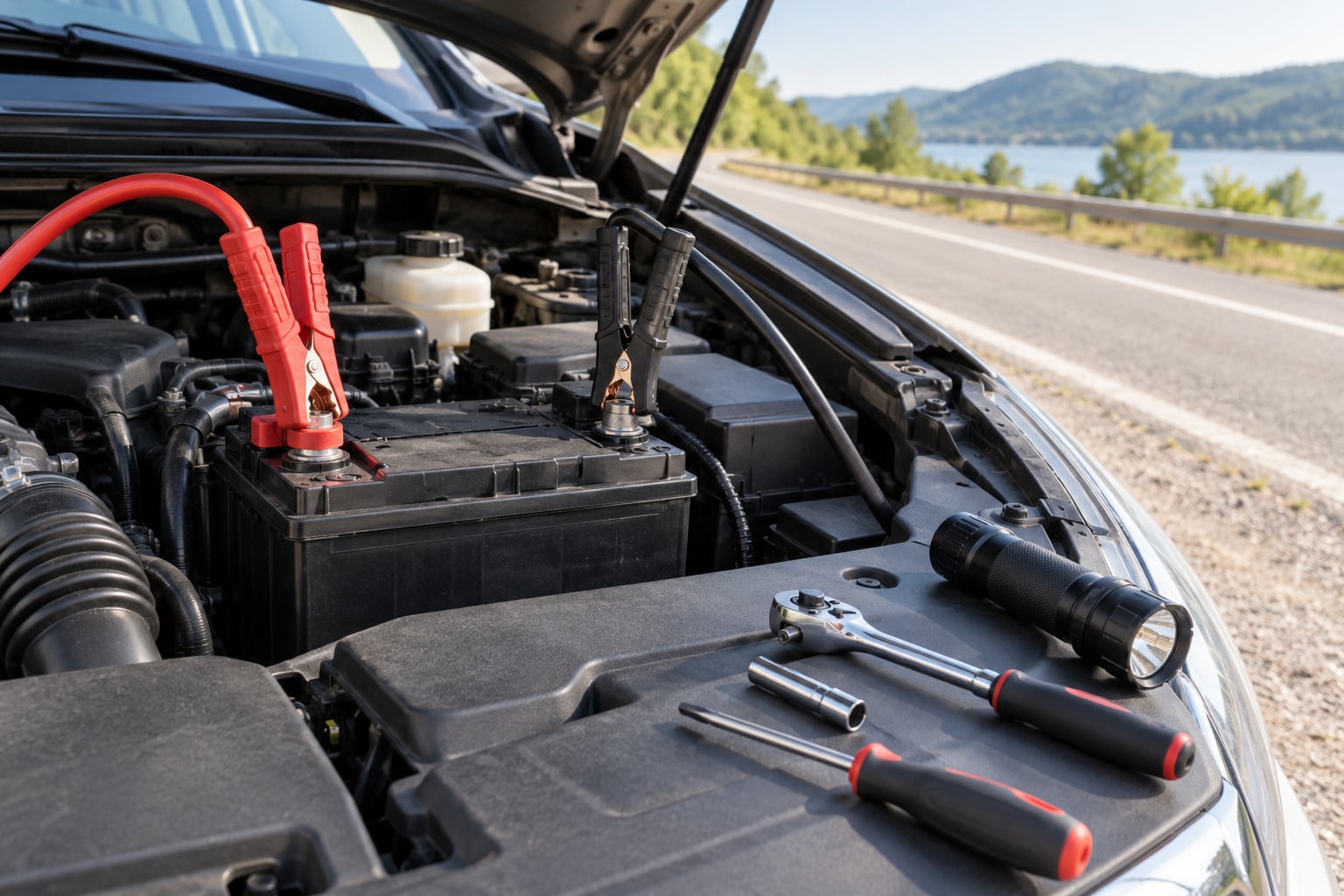
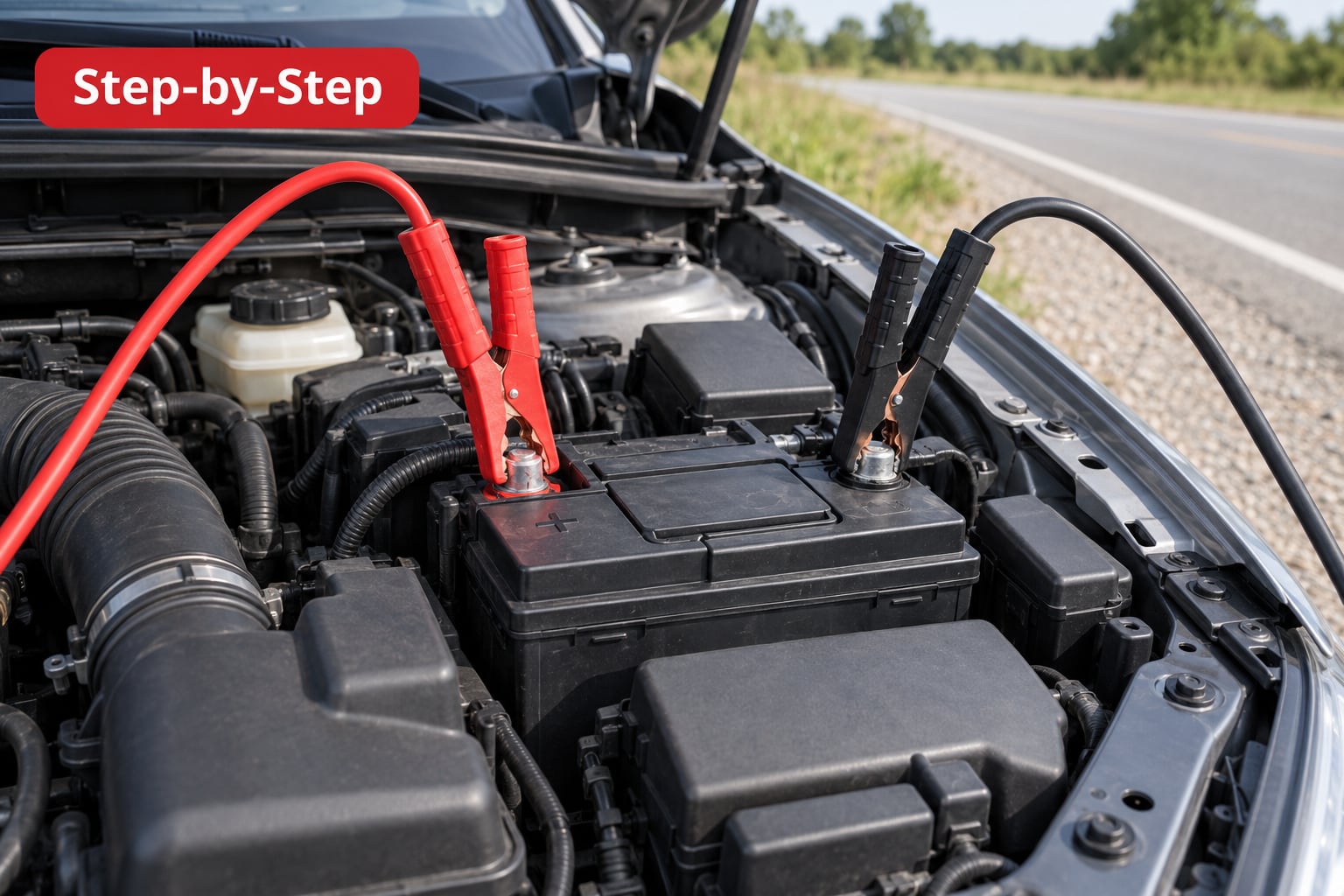
The order is the same every time, and it exists to keep the last connection away from the live battery on the dead car. Connect the red clamp to the positive terminal on the dead battery first. Then connect the other red clamp to the positive terminal on the donor battery.
Connect the black clamp to the negative terminal on the donor battery. Then, instead of attaching it to the negative post of the dead battery, clamp it to an unpainted metal ground point on the engine block or chassis away from the battery.
Grounding the last connection on bare metal is the safer practice, and it is the method most experienced drivers use. The current still completes the circuit, but any spark happens over a dirty metal surface instead of next to a battery that may be venting gas.
| Order | Clamp | Connect to | Note |
|---|---|---|---|
| 1 | Red | Positive terminal, dead battery | Never attach red to a negative post |
| 2 | Red | Positive terminal, donor battery | Dual-battery vehicles sometimes have a separate aux post |
| 3 | Black | Negative terminal, donor battery | Last connection that touches a battery, so it is the safest one |
| 4 | Black | Unpainted metal on the engine block, dead car | A bolt, bracket or strut mount works |
If your vehicle has no obvious ground point and the manual directs you to the negative post, use that instead. Keep the two clamps from touching each other or any metal while you work, and do not let them dangle where a moving belt or fan can reach them.
How to Jump Start a Car Safely: Start and Remove the Cables
Start the donor vehicle and let it idle. Leave the disabled car off until the donor is running, then turn the key and crank the dead car. If it catches, good. If it cranks slowly or not at all, rev the donor engine gently while you try again. A quick rev of the donor is often what tips a big engine over the line.
Once the disabled car runs, leave both engines idling for a couple of minutes with the cables still attached. That lets the alternator catch up before you break the circuit.
Remove the cables in the exact reverse order of connection: black from the engine block ground point on the disabled car, black from the donor negative, red from the donor positive, then red from the disabled car’s positive terminal.
You will see a spark when you take the last clamp off the donor positive. That is normal. Sparks on connection and disconnection are expected because current briefly flows as the clamp makes or breaks contact across a gap.
Now drive the car for 20 to 30 minutes rather than idling in the parking lot. You will see advice ranging from ten minutes to half an hour online, and the thirty-minute figure is the safer one: driving cycles the alternator and lets the battery take a real charge instead of a surface trickle.
Common Mistakes
Reversed polarity is the expensive one. Connecting red to negative on either battery sends current the wrong way through the donor alternator and through the disabled car’s electronics. A fried alternator is an expensive fix, and the engine control unit on a modern luxury vehicle can run into the thousands. Remember the rule: red first on the dead battery, black last on the ground, removal in reverse.
Starting the wrong vehicle first is the second most common error. The donor engine must be running before you crank the disabled car, otherwise there is not enough current to turn the starter motor.
Leaving the ignition on during the connection, or cranking the disabled engine repeatedly for more than about fifteen seconds at a time, overheats the starter motor. If it does not fire after two or three honest attempts, stop and reassess rather than leaning on it.
Working on a battery that is cracked, swollen, wet with acid or frosted is not a technique problem, it is a safety problem. Tow it.
When the Car Still Will Not Start
A dead battery makes a slow, lazy crank that fades, or a dull click and nothing else. If your car cranks at normal speed but will not fire, the battery is probably not the culprit. Listen for what the engine is telling you.
| Symptom | Likely cause | Check next |
|---|---|---|
| Slow crank, lights dim, no start | Battery discharged or worn out | Battery age and a load test at a shop |
| Single click, no crank | Low charge or failing starter relay | Try a jump; then test the starter current draw |
| Rapid crank but no fire | No fuel or a failed fuel pump relay | Fuel level, fuel pump fuse, listen at the filler neck |
| Crank, catch, then die | Spark plug, coil, fuel or immobilizer issue | Check that no accessory kill switch is engaged |
| Crank and run only for a few seconds | Alternator not charging | Voltage at the terminals with the engine running |
| Jump pack refuses, no output | Battery too deeply discharged to accept current | Charge the pack, then try a donor vehicle instead |
| Car will not crank at all after a jump | Dead main fuse or open jump post | Fuse box, then stop and call roadside help |
That jump pack limitation is real and rarely documented. Many lithium packs have a protection circuit that will not push current into a battery sitting near zero volts, because the pack is afraid of feeding itself. Charging the pack fully and trying again often works, and a donor vehicle with a healthy battery usually will.
Hybrids and electric vehicles need care. They have a 12-volt battery that powers the electronics, and the manufacturer specifies terminals and a procedure. Some manuals insist on the remote ground post rather than the battery itself. Check the manual, and never assume a hybrid uses the same layout as the car in front of you.
Stop troubleshooting and call roadside assistance if the battery shows damage, the engine cranks but will not fire after two attempts, a fuse has blown, or you are somewhere genuinely unsafe.
Safety and Battery-Care Tips
Sparks are normal and dangerous only in the wrong place. A small snap as a clamp connects is current finding a path across a gap. Standing in a fuel vapour cloud or over a venting battery is what turns that snap into an incident. Keep the red clamp away from the negative post and the black clamp away from the positive one until you are ready to connect them.
Lead-acid batteries off-gas hydrogen, which is why a dead battery that has been sitting unused for months can smell faintly of rotten eggs. Work in a ventilated space, keep flames and cigarettes well away, and do not drop a wrench across both posts.
Acidic residue on a battery post destroys paint and cable ends fast. Wipe it off, and if you touch it, wash your hands. Gloves are not fussiness here.
Cold is the biggest preventable cause of a dead morning on a road trip. Heat, then cold, and a battery parked overnight below freezing can lose enough capacity that a healthy battery will not turn the engine over. A battery tender on mains power during a long layover is cheap insurance, and a jump pack kept in the cabin rather than the trunk holds far more charge in winter.
After a successful jump, treat the battery as suspect. A battery that needed a jump once is usually near the end of its service life, often past three to five years. Most shops can load test it in a few minutes and tell you whether you need a new one or a charger, and if it will not hold a charge on a drive home, stop and charge it rather than running it down again.
Frequently Asked Questions
Which jumper cable do you connect first, red or black?
Attach the red clamp to the positive terminal on the dead battery first, then the other red clamp to the donor battery positive. Connect the black clamp to the donor negative last of the three battery connections, and finish on an unpainted metal ground point on the dead car. Removal happens in exactly the reverse order.
Is it normal to get sparks when jump-starting a car battery?
Yes, a small spark when the last clamp makes contact, or when you take it off, is normal. Current briefly arcs across the gap between the clamp and the terminal as the circuit closes. It is a reason to keep the clamps off painted bodywork and away from a battery that is venting gas, not a reason to panic.
Can jump-starting a car damage electronics or the alternator?
A correctly done jump is safe for the vehicles. Connecting red to a negative post on either battery reverses the current path, which can burn out an alternator diode and send a voltage spike through the engine control unit and other modules. On a modern luxury vehicle that module can cost thousands, which is why the order matters more than the speed.
How long should the car run after a jump start?
Drive the car for 20 to 30 minutes rather than idling. Driving cycles the alternator and puts a real charge into a battery that a stationary idle only trickles. Then get the battery load tested. If it will not hold that charge, or it needed the jump again within a few days, it is finished and needs replacing.
Why won’t my car jump start even with a good donor battery?
Common causes are corroded or loose terminals on the dead battery, a jump post that grips poorly, or cables that are too thin for a large engine. Lithium jump packs also refuse to deliver current to a battery sitting near zero volts. Clean the terminals, charge the pack fully, try a donor vehicle, and if it still cranks without firing, the battery is not your problem.
Can you jump start a car in the rain or in the cold?
A light drizzle is not a problem, and cold is routine rather than dangerous. What you avoid is standing water where a body could short to ground, a lightning storm, and an unlit shoulder with traffic coming past. In freezing conditions, a jump pack loses a large share of its rated output, so store it inside the vehicle and let it warm up before you rely on it.
Conclusion
To jump start a car safely, confirm the battery is really the problem, inspect it for cracks, leaks or swelling, and connect red to positive on both batteries before any black clamp goes on. Finish the last connection on a bare metal ground point, start the donor, then yours, and remove the cables in reverse.
If the battery looks damaged, if the engine cranks without firing, or if you are anywhere unsafe, skip the experiment and call roadside assistance. Five minutes with the right order beats a fried alternator and a long walk.