You can decline rental counter insurance safely, but only once you hold written proof that something else covers both the vehicle and the liability that comes with driving it. The whole point of knowing how to decline rental car insurance safely is that the decision is made at home, in daylight, where you can read a benefit guide without a tired agent watching the clock.
Travelers who get burned usually did their homework at the counter at ten at night, not the week before. A card that pays for vehicle damage says nothing about injury claims, damage to someone else’s property, or the fees a rental company adds after a fender scrape. Treat the counter offer as a menu of four separate products, not one bundle, and check each line before you say no to any of them.
Everything below is general information. Terms differ by country, state, card issuer, personal policy and rental company, and they change often enough that you should confirm the current wording yourself before relying on it.
Table of Contents
- What You Need Before You Reach the Rental Counter
- Step-by-Step: How to Decline Rental Car Insurance Safely
- 1. Compare the Counter Offer With the Full Rental Price
- 2. Confirm What Your Credit Card Actually Covers
- 3. Check Personal Auto, Home, Travel, and Health Policies
- 4. Check Whether Employer or Membership Benefits Apply
- 5. Review Liability and Exclusions Before You Decline Rental Car Insurance
- 6. Get the Decision in Writing
- 7. Verify the Coverage After the Car Is Assigned
- How to Decline at the Counter Without Sounding Unsure
- Common Mistakes That Can Create an Uncovered Loss
- Frequently Asked Questions
- Can I decline all rental car insurance if I have a credit card?
- Does a credit card cover liability when I rent a car?
- Can I decline the rental company’s collision waiver if I have auto insurance?
- What should I check before declining rental car coverage at the counter?
- Is travel insurance the same as rental car insurance?
- What if I cannot prove I have rental coverage when I pick up the car?
- Conclusion
What You Need Before You Reach the Rental Counter
You need evidence, not assumptions. Assurances you remember from a forum thread are worthless in a claim; a printed benefit guide, a declarations page and a written confirmation from your insurer are what a claims administrator will ask for later.
- Your reservation details — the confirmation number, the daily rate, the vehicle class you booked and the country of rental.
- Your card’s rental benefit guide — the issuer’s current terms, not the summary on the back of the card. Coverage caps, day limits and country exclusions live in the guide.
- Your personal auto declarations page — showing liability and collision limits, the deductible, and whether the policy extends to non-owned vehicles.
- Umbrella, home and renters policy evidence — excess liability and belongings cover, with limits noted.
- Your health insurer’s guidance — many health plans treat a rental car as ordinary travel, but the confirmation should come from the insurer.
- Your employer’s travel policy — for any business rental, including who pays for the counter coverage.
- The rental agreement terms — especially authorized driver rules, prohibited uses and reporting deadlines.
- A way to reach the rental company — a direct number, so you can sort a billing dispute without standing in a queue.
Screenshot the terms page on your phone and bring printed copies if you can. Offline access matters, because rental offices frequently have patchy guest Wi-Fi and a page that will not load at the desk is the same as no evidence at all.
Step-by-Step: How to Decline Rental Car Insurance Safely
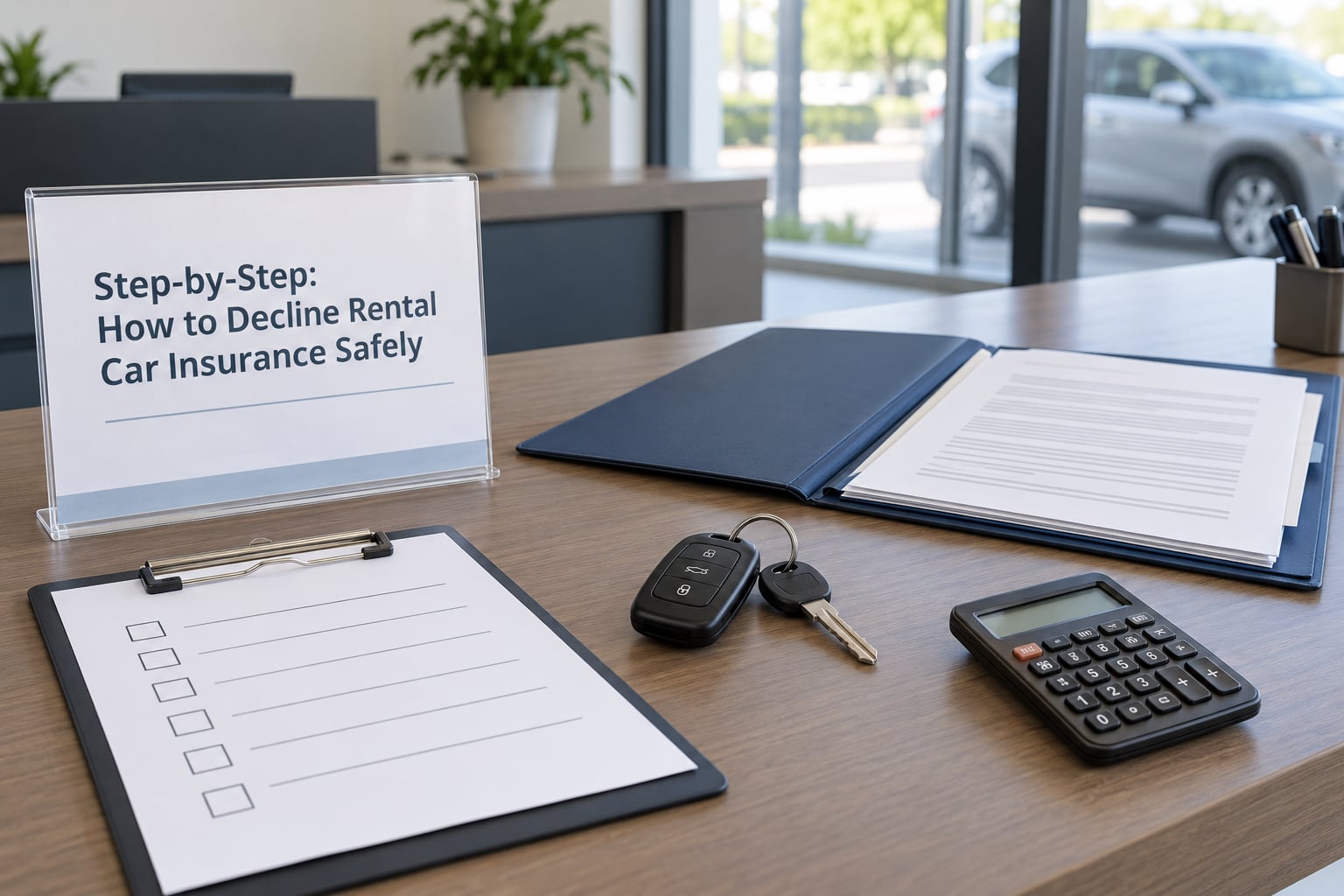
The process is straightforward once the paperwork is done in advance. Work through it in order, because each step either confirms a fact or tells you to buy the counter product instead.
1. Compare the Counter Offer With the Full Rental Price
Ask the agent to separate the base rental rate from every optional product and to show the per-day charge for each one on the agreement. You want the deductible you would be responsible for, the daily add-on, taxes and fees, the coverage cap on liability, how a claim is filed, the size of the authorization hold on your card, and any cancellation terms.
The cheapest bundle on the menu is often the one that quietly drops liability or personal accident cover. Price is a poor proxy for safety: a waiver that costs less but leaves you paying for injury claims from an uninsured driver is not the better deal.
2. Confirm What Your Credit Card Actually Covers
Read the issuer’s rental benefit terms for the specific card in your hand, this year, not a summary someone gave you years ago. Most benefits cover damage or theft of the rental vehicle only, and the fine print sets the boundaries that matter: vehicle classes excluded, rental length limits measured in consecutive days, country restrictions, and a requirement to decline the rental company’s collision damage waiver.
Payment rules cause more broken coverage than anything else. Typically the entire rental must be charged to that one card, so a deposit in cash, a split payment, a voucher, or a gift card can silently void the benefit. Secondary coverage, which most cards carry, means the rental company charges your card first and the issuer reimburses your deductible later. That reimbursement step is the reason primary card coverage is worth searching for, and the reason loss-of-use charges, diminished value, tires, glass and towing are worth checking individually, because those are commonly excluded.
3. Check Personal Auto, Home, Travel, and Health Policies
A personal auto policy usually extends collision and liability cover to a rental vehicle you drive, which is why most drivers with existing coverage can safely decline the damage waiver at home. Read your declarations page rather than your memory of it, and note whether the policy applies to non-owned vehicles and what the limits and deductible are.
Umbrella liability can raise your excess liability limit on top of the auto policy. Renters and homeowners policies often contain sublimits for off-premises belongings, so check them if you plan to travel with laptops or cameras. Travel medical and health plan cover varies widely; ask the insurer directly and get the answer in writing, with a reference number and a name.
4. Check Whether Employer or Membership Benefits Apply
Business travellers sometimes have a corporate rental agreement or an employer travel programme that already absorbs counter coverage, and auto club or travel membership benefits sometimes include rental damage cover. Ask the benefits desk for the certificate rather than a yes or no on the phone, because membership terms frequently require the rental to be booked and paid in a specific way.
An employer paying for your rental does not extend your personal liability cover. The company’s vehicle and the company’s rental agreement are one arrangement; you driving the car, and any claim following your own error, is another. If the answer is unclear, treat it as uncovered.
5. Review Liability and Exclusions Before You Decline Rental Car Insurance
Damage-to-the-rental protection and liability protection are different products, sold on different lines of the counter menu. The waiver covers damage to or theft of the rental company’s vehicle. Supplementary liability covers third-party injury and property damage. Personal accident insurance covers injuries to you and your passengers. Personal effects protection covers belongings. Each line can usually be declined on its own, which is why a blanket yes or no at the counter is a mistake.
- Decline safely when: you drive domestically, your card benefit covers the vehicle class, you pay the whole rental on that card, and your liability cover is confirmed in writing.
- Buy instead when: you rent abroad, you have no personal auto policy, the rental exceeds a card’s day limit, the vehicle is a luxury, exotic, van or truck, you carry passengers who are not listed drivers, or your travel crosses a border.
Check the exclusions while you are still at the desk: unauthorized drivers, unpaved roads, off-road driving, alcohol, prohibited uses, and countries your policy names as excluded. Alcohol and an unlisted driver are the two exclusions that void cover quietly and completely.
6. Get the Decision in Writing
Ask for the final agreement showing which products were accepted, which were declined, the amount charged and the amount authorized, the collision waiver status, the liability limits, and any condition where the rental company accepts no responsibility for damage. A verbal reassurance from an agent is not coverage, and that agent may not be working tomorrow.
If the agent cannot produce a document showing the declined products, you have not declined anything yet. Say so politely and give them a moment to bring the right form.
7. Verify the Coverage After the Car Is Assigned
Before you drive away, read the agreement against the folder you brought with you. Confirm the vehicle matches what you booked, the coverage selections match the quote, the deductible figure is the one you agreed, every driver is listed, and you have a roadside and emergency number that works where you are going.
Photograph each page, covering card numbers and addresses. If anything is wrong, fix it in the parking lot while the agent can still change it. Leaving the lot first and arguing afterwards costs more time and gets less done.
How to Decline at the Counter Without Sounding Unsure
You are not arguing a coverage decision, you are executing a plan you made earlier. That framing keeps the conversation short and calm.
I have confirmed collision coverage through my card and liability coverage through my policy, and I have the documents here.
I would like to decline the collision damage waiver, personal accident insurance, personal effects protection and supplementary liability.
Please show the final agreement with those items marked as declined and everything else itemized.
Please confirm in writing that no loss-of-use or diminished-value charges would apply.
Ask questions rather than making claims, and let silence do the work. An agent who cannot answer a direct question about the agreement is giving you a reason to slow down.
Common Mistakes That Can Create an Uncovered Loss
Every serious post-rental dispute I have read traces back to one of these, and none of them were caused by a traveller who asked too many questions.
- Assuming a credit card covers liability. Card benefits cover the rental vehicle. Liability to other people is a separate exposure and needs your auto policy, umbrella cover or supplementary liability.
- Treating a policy as active without documentation. If you cannot produce the declarations page or written confirmation, assume you have no cover until you do.
- Declining only part of the offer by accident. Declining the waiver is fine. Declining everything, including liability, on a tired afternoon is not.
- Paying with the wrong method. A cash deposit, a split payment or a voucher can void card cover even when the same card paid most of the rental.
- Skipping additional drivers. Cover is tied to named drivers. A spouse or friend behind the wheel can leave the whole claim on you personally.
- Missing exclusions. Off-road, unpaved roads, intoxication, and unlisted countries quietly void most policies.
- Leaving before reading the agreement. A car returned at the wrong time or the wrong place generates its own fees, and the agreement is where they live.
- Relying on another renter’s card. A spouse’s or colleague’s card benefit does not follow you onto a rental in your name.
Keep your evidence with the reservation record for the length of the trip, not in an inbox you will lose. If you cannot confirm coverage while you are still in the parking lot, buy the counter protection before you drive. That per-day add-on is cheap compared with an uncovered repair, a vehicle off the road for weeks, and the administrative fee on top.
Frequently Asked Questions
Can I decline all rental car insurance if I have a credit card?
Usually not. Most card rental benefits cover damage or theft of the rental vehicle only, and they usually require you to decline the rental company waiver and pay the entire rental on that card. Liability to other drivers, injuries to you, towing, glass and loss-of-use charges commonly sit outside the benefit. Check your issuer’s current terms and confirm liability cover separately before declining the whole menu.
Does a credit card cover liability when I rent a car?
Rarely. Card rental benefits are designed for damage to the vehicle you rent, not claims against you from injury or property damage you cause. Those exposures normally come from your personal auto policy, an umbrella policy, or the rental company’s supplementary liability product. Some issuers offer limited third-party liability as an add-on you must enroll in before the trip, so ask the issuer directly rather than assuming.
Can I decline the rental company’s collision waiver if I have auto insurance?
In most domestic cases yes, because a personal auto policy commonly extends collision and liability cover to a rental vehicle. Verify it first: read the declarations page, check that non-owned vehicles are included, and confirm the deductible. International rentals are different, since many policies stop applying outside the country of issue. Bring written proof and do not drive until the coverage is confirmed.
What should I check before declining rental car coverage at the counter?
Check four things: that your card or policy covers the vehicle class and length of rental, that liability is covered somewhere, that the country is not excluded, and that the entire rental is paid on the correct card with the counter waiver declined. Then confirm on the final agreement which products were accepted and declined, and photograph the pages before you drive away.
Is travel insurance the same as rental car insurance?
No. Travel insurance policies vary widely and many only cover specific rental car excesses you declare in advance, or offer a rental vehicle add-on you purchase separately. Some trip cancellation policies treat the rental as part of the trip and reimburse only when the trip itself is cancelled. Read the wording for rental car cover, excess amounts, day limits and country exclusions, and ask the insurer in writing.
What if I cannot prove I have rental coverage when I pick up the car?
Buy the counter protection before you leave the lot, at minimum the collision damage waiver, and add liability cover if nothing else provides it. Do not argue with the agent or drive on the hope that your insurer agrees later. Once the vehicle is back and something has happened, proof becomes far harder to produce and insurers regularly decline claims where the evidence was not gathered at the time.
Conclusion
Do one thing first: get written confirmation of every piece of cover that applies to your trip, then have the rental company show that cover on the final agreement before you decline anything. That single habit is most of what makes it possible to decline rental car insurance safely, and it costs nothing but an evening with your own documents.
The cheapest option at the counter is rarely the cheapest option overall. One scratch, one week off the road, and a diminished-value charge on top can undo years of savings, and none of it is recoverable without the evidence you gathered before you said no.