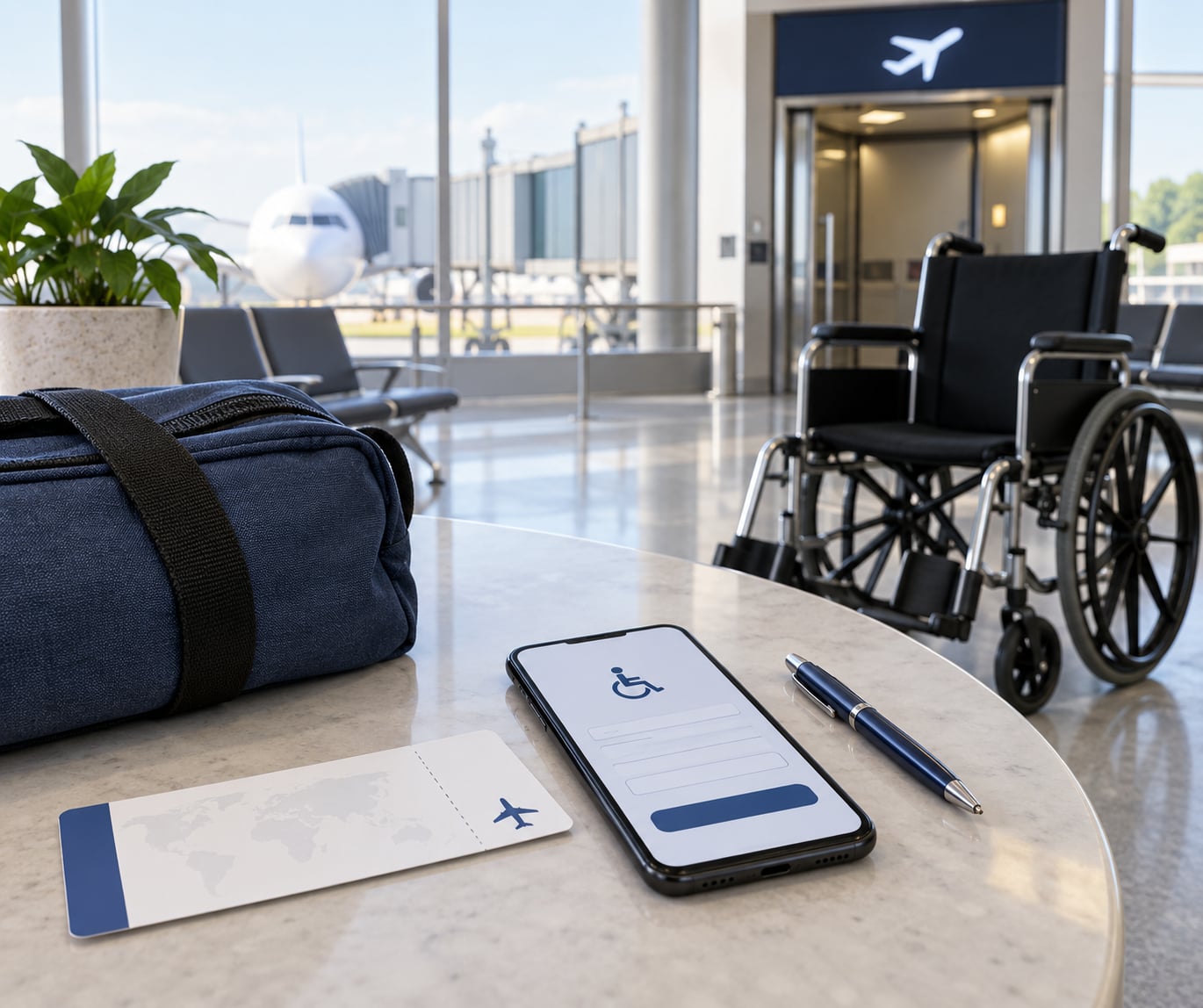
How to request airport wheelchair assistance takes one phone call or a few clicks inside your booking, and it costs you nothing. Contact the operating airline’s accessibility line, or add a special assistance request to your reservation, at least 48 hours before departure and confirm it again the day before you fly.
That is the whole mechanism. Airlines and airports run wheelchair services as part of everyday passenger handling, so there is no application form, no doctor to call, and no fee. In the United States the Air Carrier Access Act of 1986 makes it a right rather than a favor, which also means no airline can ask you to prove you have a disability.
If your need is temporary, like a broken ankle or a recovery from surgery, request it anyway. You are not claiming a permanent disability, you are asking for help covering the length of a terminal, and staff see requests like this every single day.
Below is the order that works most often: get your paperwork together, make the request with every carrier in your itinerary, describe the help you need precisely, then check in and speak to a person. The steps after that explain each part in detail.
Table of Contents
- What You Need to Request Airport Wheelchair Assistance
- Step-by-Step
- How to Request Airport Wheelchair Assistance Online or by Phone
- Describe the Assistance You Need
- Confirm Every Flight in the Itinerary
- Reconfirm and Check In Responsibly
- Know What Happens at the Airport
- What to Do When More Help Is Needed
- Common Mistakes
- Frequently Asked Questions
- How far in advance should I request airport wheelchair assistance?
- Is airport wheelchair assistance free, and is my own wheelchair transported too?
- What is the difference between WCHR, WCHS, and WCHC assistance?
- Do I need to contact every airline and airport in my itinerary?
- Can I request wheelchair assistance after checking in at the airport?
- What should I do if my assistance request is not shown in the system?
- Conclusion: What to Do First
What You Need to Request Airport Wheelchair Assistance
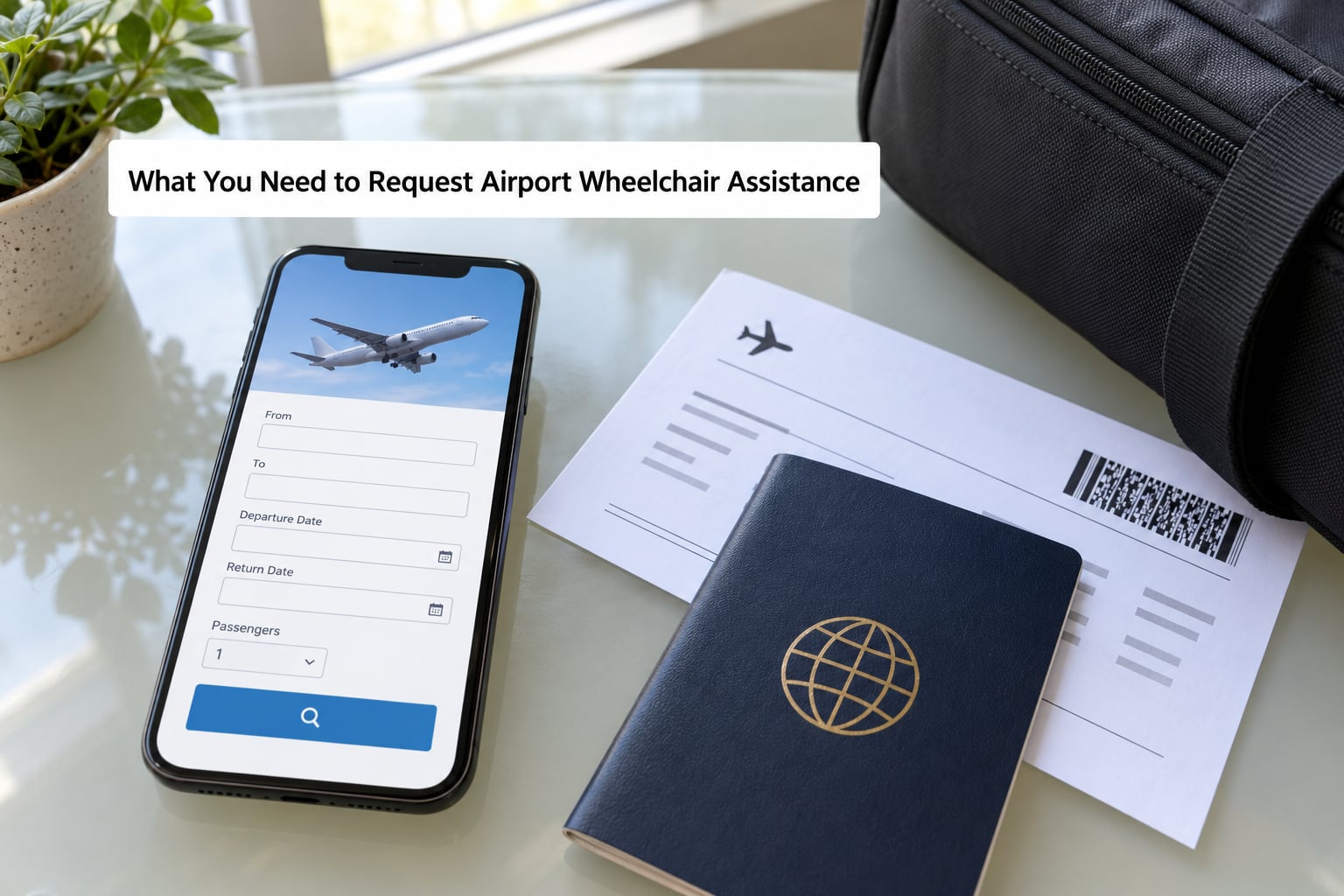
You need very little to make the request, and none of it involves a medical form. Having these items in front of you turns a five-minute call into a two-minute call.
- Your flight confirmation. The six-character booking reference, and the full itinerary including every connection.
- The name of the operating airline on each segment. The airline that actually flies the plane, which is not always the airline you booked with.
- A clear idea of what you can manage. How far you can walk comfortably, whether stairs are a problem, and how long standing tires you out.
- Details of any mobility equipment. Manual chair, power chair or scooter, plus weight, folded dimensions, and the battery type and watt-hours.
- Companion and service animal details. Who is travelling with you, and whether a service animal is flying.
- The airline’s accessibility contact. The accessibility page and the dedicated assistance phone line, found on the carrier’s own website.
Three service levels get attached to your booking, and you will see the codes in confirmations, so it helps to know them now. WCHR means a wheelchair from the curb to the gate, where you can walk the last stretch on your own. WCHS covers the gate all the way to your seat, including stairs. WCHC is full assistance the whole way, using an aisle chair inside the aircraft.
Pick the level that matches your trip rather than the level that seems most generous. Asking for WCHC when you only need WCHR means more people are scheduled to help you, which on a busy bank holiday weekend can be a longer wait.
Step-by-Step
How to Request Airport Wheelchair Assistance Online or by Phone
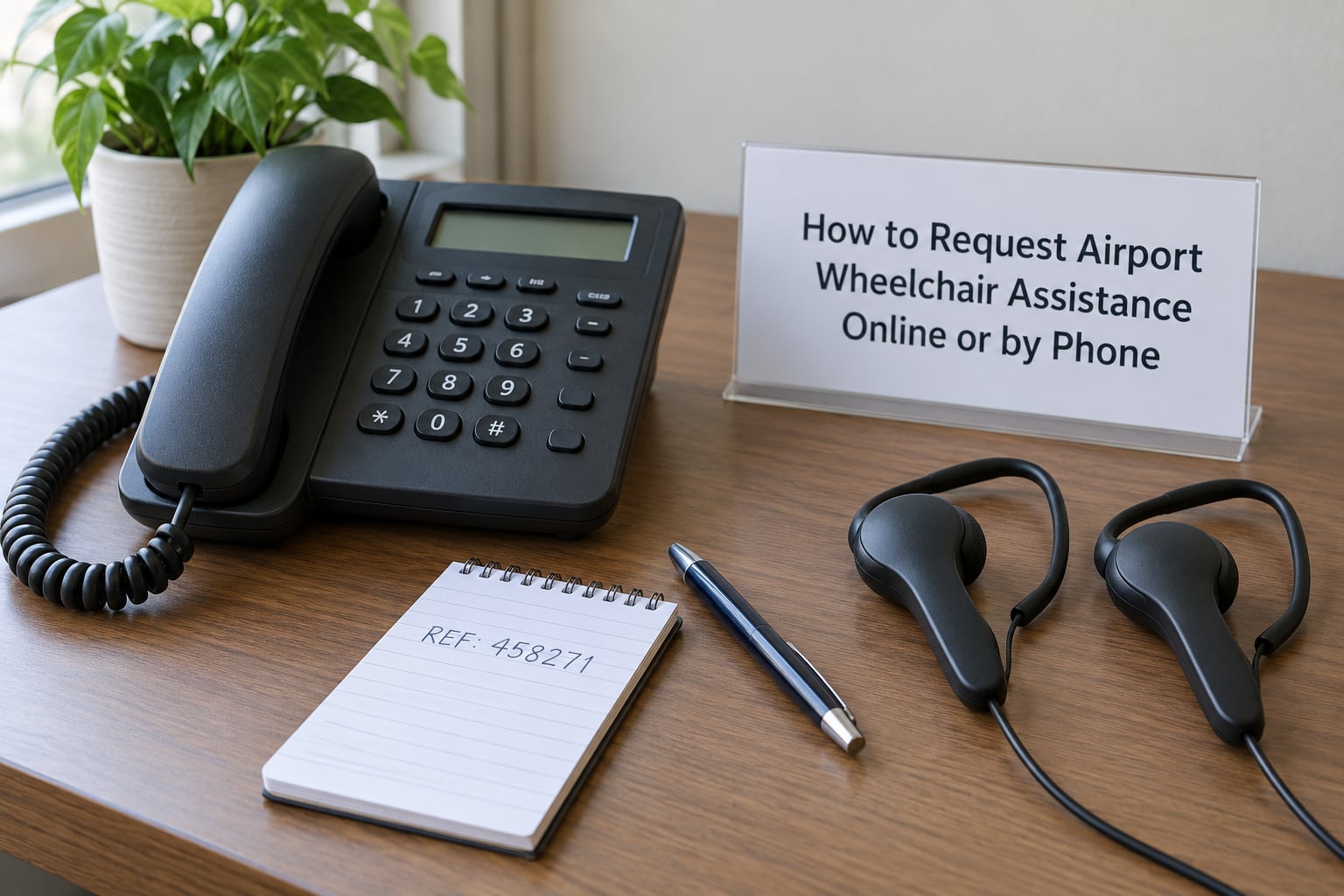
The fastest route is the airline’s accessibility page or its dedicated assistance line, not the general reservations number. Both let you attach a special service request to an existing booking without rebooking anything.
Online, open the airline’s accessibility page and look for the special assistance request form, or sign in to manage your trip and find the assistance section beside your itinerary. Airlines that book through third-party sites still keep your special service requests in the same reservation record, so an agent can add them for you and then you confirm with the airline directly.
By phone, call the accessibility line rather than the reservations queue. Explain that you want wheelchair or mobility assistance added, give your booking reference and flight details, and state which service level you need. If you are hard of hearing, ask whether relay or text relay is available in that country, since most carriers offer one.
Before you hang up, three things matter:
- Ask for a confirmation reference or case number and write it down.
- Ask which airports and which flights on the itinerary the request now covers.
- Ask when the airline wants you to call back to reconfirm.
Keep whatever you receive in writing, an email is ideal, because it settles arguments later. Forum travelers report the pattern that works best: call about two weeks out, then call again the night before the flight to confirm. That habit catches requests that silently dropped out of the system.
Describe the Assistance You Need
Describing the help precisely is what separates a smooth trip from a day of improvising. Airports offer several different services, and they are easy to confuse.
Gate assistance is a meet-and-assist at the aircraft door, where a staff member helps you across the bridge and onto the plane. Wheelchair assistance means a chair and a trained attendant escort you through the terminal. Electric cart service is a ride on a small cart around concourses, offered at many large hubs and worth asking about if a chair feels like more than you need.
Say plainly how you will be moved. If you can do a standing transfer with one person assisting, say that. If you need an aisle chair on board, request WCHC. If you use a power chair, give the battery type and watt-hours, the folded dimensions and the weight, because those numbers decide whether the chair travels in the cabin or is gate-checked in the cargo hold.
Mention service animals too. They are not treated as baggage and are not counted in your allowance, but the airline still has to be told in advance so the cabin crew knows before you board.
One question comes up more than any other, so ask it directly: do I have to use an attendant, or can my companion push the chair? The answer is that you stay in control of the transfer. You tell the attendant how to handle you, and a companion can usually assist in the terminal and at the aircraft door, though boarding inside the cabin always uses the aisle chair and the crew.
Confirm Every Flight in the Itinerary
One booking does not automatically cover the whole trip. Each operating airline handles its own passengers, so a request filed with the first carrier does nothing for a connection flown by someone else.
Work through the itinerary segment by segment and note three things: who operates the flight, who controls the airport, and whether the two tickets are linked. A codeshare operated by a partner airline means the operating carrier’s accessibility desk holds the request. Separate tickets on a self-transfer connection mean you may need to collect your own bags and re-request at the next airport.
Connection airports deserve extra attention. At a hub where your airline runs its own operation, the attendants and equipment are in place. At an airport where the airline does not control the terminal, the request still needs to be in the arrival airline’s system, and asking the airport’s accessibility desk for confirmation is worth doing.
Overnight connections and long layovers change things too. If you are twelve hours between flights, you are likely asking for terminal-to-terminal and gate-to-gate help rather than a quick escort, and you should say so when you request it.
Reconfirm and Check In Responsibly
Requests do get lost in airline systems, so treat reconfirmation as part of the process rather than an extra. Call again within 24 to 48 hours of departure, repeat your flight details and service level, and confirm the request is attached to every segment.
Arrive earlier than the airline’s normal recommended check-in time. Assistance adds steps rather than removing them, because you are escorted separately through security and to the gate. As a baseline, add at least an hour to the airline’s stated arrival time, and more if you are travelling with a powered chair that needs to be loaded or unloaded.
At the counter or the dedicated assistance desk, give your name and booking reference and state that you have a wheelchair request on file. Then ask the agent to see it on screen. This is the moment where a lost request shows up, and it is much easier to fix at the counter than at the gate.
Security deserves a short note. A disability does not let you skip the line. What you can request is an accommodation: more time, help with removing shoes or a jacket, a private screening room where one is available, or pre-check enrollment through the screening authority’s own program. Ask early, because private screening depends on staffing at that checkpoint.
Know What Happens at the Airport
The sequence is usually the same, and knowing it in advance makes the day feel much calmer.
- Curbside or counter. If you cannot unload from a vehicle, ask for curbside assistance when you arrive. Otherwise go to the counter or assistance desk and check in as described above.
- Bag drop. Checked bags are tagged at the same counter. Note whether your mobility device is traveling with you to the gate or being gate-checked, and keep the tag number.
- Security. You are escorted through the checkpoint, usually ahead of the main queue.
- Gate. An attendant meets you near the gate, confirms your destination, and stays with you until boarding.
- Preboarding. You board first, before the general boarding queue.
- Aisle chair. If you booked WCHC, crew bring an aisle chair to the door and move you along the cabin to your seat.
- Arrival. Assistance on arrival is preboarded too, so you are often among the first off. You are met at the aircraft door and escorted to baggage claim and then to the pickup area.
If you brought your own chair and it was gate-checked, it is normally returned to you at the aircraft door or the jet bridge, with a gate-claim baggage tag to match.
Two things regularly go wrong on the ground. Delays and gate changes move your escort around, so keep the attendant’s contact point with you. And a separate aircraft or ground connection at a large hub can add an hour of walking, so ask for a cart or terminal transfer rather than assuming it is included.
What to Do When More Help Is Needed
If a request was missed or handled badly, work up the ladder in order and keep a record as you go.
First, stay at the counter or gate and ask calmly for the supervisor or the accessibility manager, quoting your confirmation reference. Most problems are a missing note in the system, and staff can often fix it in a few minutes once they see it.
Second, write everything down while it is fresh: flight numbers, times, names of staff, what was requested, what was actually provided, and whether a mobility device was damaged. Photographs of damage matter, so take them before leaving the airport where possible.
Third, file a written complaint with the airline’s customer service or accessibility team once you are home, attaching your notes. Include what you wanted, what happened, and what resolution you are asking for.
Fourth, escalate outside the airline if it stalls. In the United States, a domestic air travel accessibility complaint can go to the Department of Transportation’s consumer complaint process, and screening problems go to the TSA’s accessibility channel. For EU departures, the national enforcement body for passenger rights handles complaints against the airline. Outside those systems, an airport authority or consumer protection body is the next step.
Be realistic about outcomes. You can ask for a review, a written response, or reimbursement for costs you can evidence, but nobody can promise what any authority will decide.
Common Mistakes
Most bad airport wheelchair experiences trace back to one of these, and all of them are avoidable.
- Assuming the booking covers every carrier. A codeshare or a separate ticket needs its own request. Correction: check which airline operates each segment and contact each one.
- Confusing gate help with wheelchair check-in. Gate assistance starts at the aircraft door and gets you nothing across the terminal. Correction: ask explicitly for a chair and an attendant from the counter to the gate.
- Forgetting the equipment details. Missing battery type, watt-hours, weight or folded dimensions can force a gate-check at the last minute. Correction: fill in the mobility device information form with the request, not at the gate.
- Never reconfirming. Requests disappear during schedule changes and rebookings. Correction: call again 24 to 48 hours out and after any schedule change.
- Requesting the highest service level out of caution. Over-requesting can mean a longer wait for a chair. Correction: describe your actual walking ability and choose the code to match.
- Arriving at the normal time. Assistance adds time at the counter and at security. Correction: add at least an hour, and more with a powered chair.
- Forgetting the arrival airport. A request filed for departure usually says nothing about assistance on arrival or at a connection. Correction: ask for every segment, including the final one, when you file.
Frequently Asked Questions
How far in advance should I request airport wheelchair assistance?
Most US airlines ask for at least 48 hours of notice, and 72 hours is the safer number, especially on multi-leg trips, overnight connections, or flights to smaller airports. In practice the reliable pattern travelers report is a first call about two weeks out and a second confirmation call the night before. Same-day requests are often still honoured, but equipment and attendants are only staffed against confirmed requests, so a late request usually means waiting.
Is airport wheelchair assistance free, and is my own wheelchair transported too?
The assistance itself is free. Under the Air Carrier Access Act and equivalent rules elsewhere, a carrier cannot charge you for a disability accommodation, which covers the airport wheelchair, the escort through the terminal, and the aisle chair used on board. Your own mobility device is also carried free, either in the cabin or gate-checked in the cargo hold. Tipping attendants is not expected anywhere in the world.
What is the difference between WCHR, WCHS, and WCHC assistance?
WCHR gives you a wheelchair from the curb or check-in counter to the gate, where you walk the last stretch yourself. WCHS covers the gate to your seat and includes stairs and escalators. WCHC is full assistance the whole way, including transfer into the aisle chair inside the aircraft. Choose based on your actual walking ability rather than the most generous level.
Do I need to contact every airline and airport in my itinerary?
Contact every operating airline, yes. A request filed with the carrier you booked does not reach a partner airline flying a codeshare, and each airline controls its own service at each airport. Work through the itinerary segment by segment and note which carrier operates the flight. At connection airports where the airline does not run its own operation, ask the arriving airline to confirm the request with the airport desk.
Can I request wheelchair assistance after checking in at the airport?
Yes, you can ask at the counter or the dedicated assistance desk on the day, and staff will try to help. Be aware that chairs and attendants are staffed against requests made in advance, so a same-day request can mean a wait at the counter rather than someone meeting you at the kerb. This is also the moment to check whether an earlier request was actually saved to your booking.
What should I do if my assistance request is not shown in the system?
Ask for the supervisor or accessibility manager at the counter and quote your confirmation reference, because a missing note is usually the whole problem and can often be fixed on the spot. If it cannot be resolved there, ask for it to be recorded before you move to security. Afterward, send a written complaint to the airline with dates, flight details and what you were told.
Conclusion: What to Do First
Open the airline’s accessibility page or call the accessibility line today, and give them your booking reference, each flight number, and the service level that matches how far you can walk. Ask for a confirmation reference and save it. Then repeat the request with every other airline operating your itinerary, and call back 24 to 48 hours before departure to confirm it is still attached to each flight.