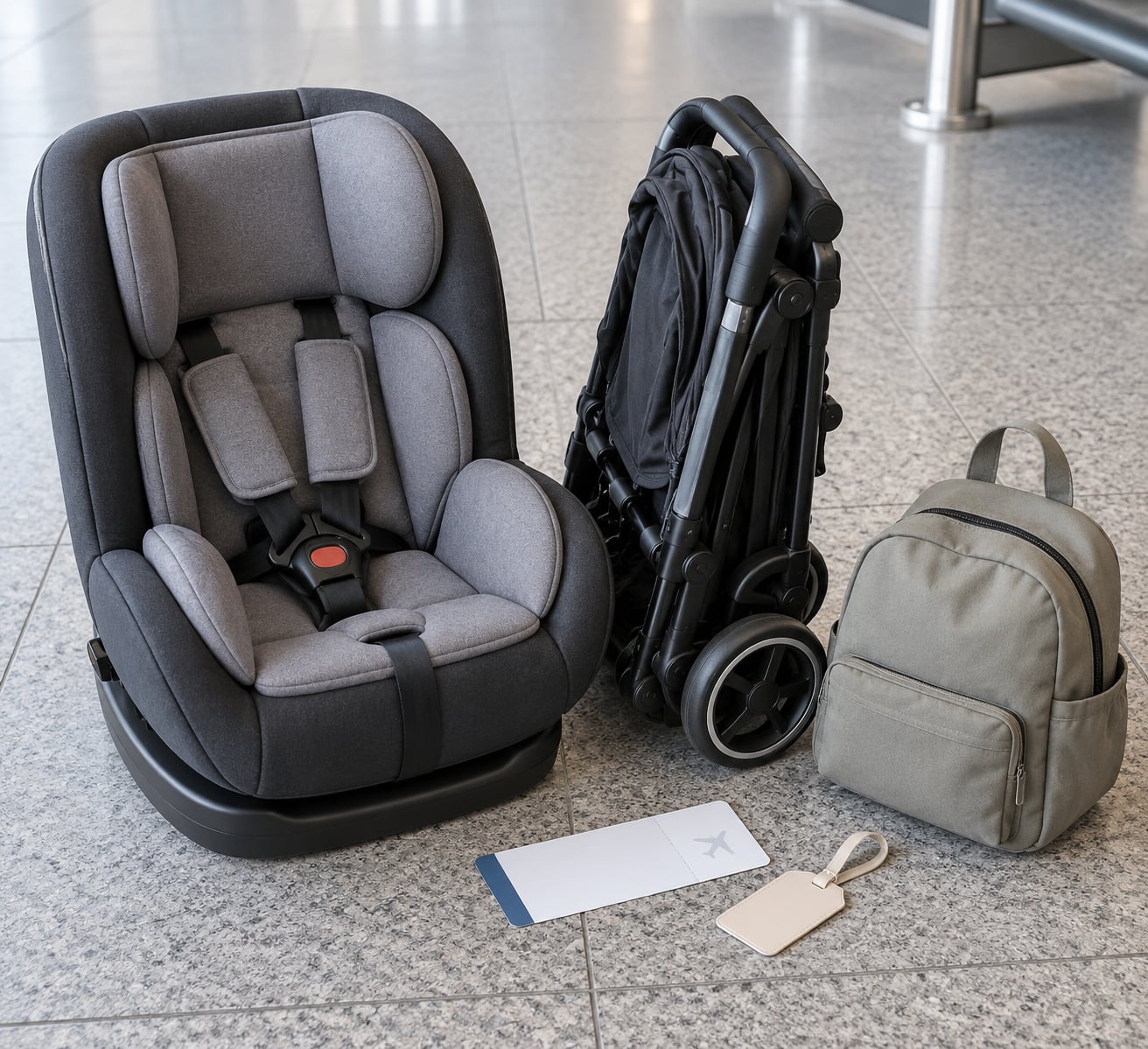
If you are working out how to fly with a car seat and stroller, the short version is this: on US domestic flights both items travel free of charge, and neither one counts toward your checked baggage allowance. You keep them with you through the terminal, hand them to a jet-bridge agent at boarding, and collect them at the gate or on the belt when you land.
The only decision you really have to make is whether the car seat flies in the cabin with your child or gets tagged at the gate. Budget about 45 extra minutes at the airport, and the rest is routine.
Table of Contents
- What You Need
- Step-by-Step: How to Fly With a Car Seat and Stroller
- 1. Check the airline’s rules before you book
- 2. Decide whether the car seat can fly in the cabin
- 3. Choose cabin carriage or gate-checking for the stroller
- 4. Prepare and label both items
- 5. Arrive early and document everything
- 6. Board, secure, and troubleshoot on arrival
- Common Mistakes
- Frequently Asked Questions
- Do I need to buy a separate airplane seat for my child’s car seat?
- Can I use a car seat as checked baggage instead of buying a seat?
- Is a stroller free on a flight, and can I gate-check it?
- Can I fly internationally with my child’s car seat and stroller?
- What should I do if my stroller or car seat is lost or damaged?
What You Need
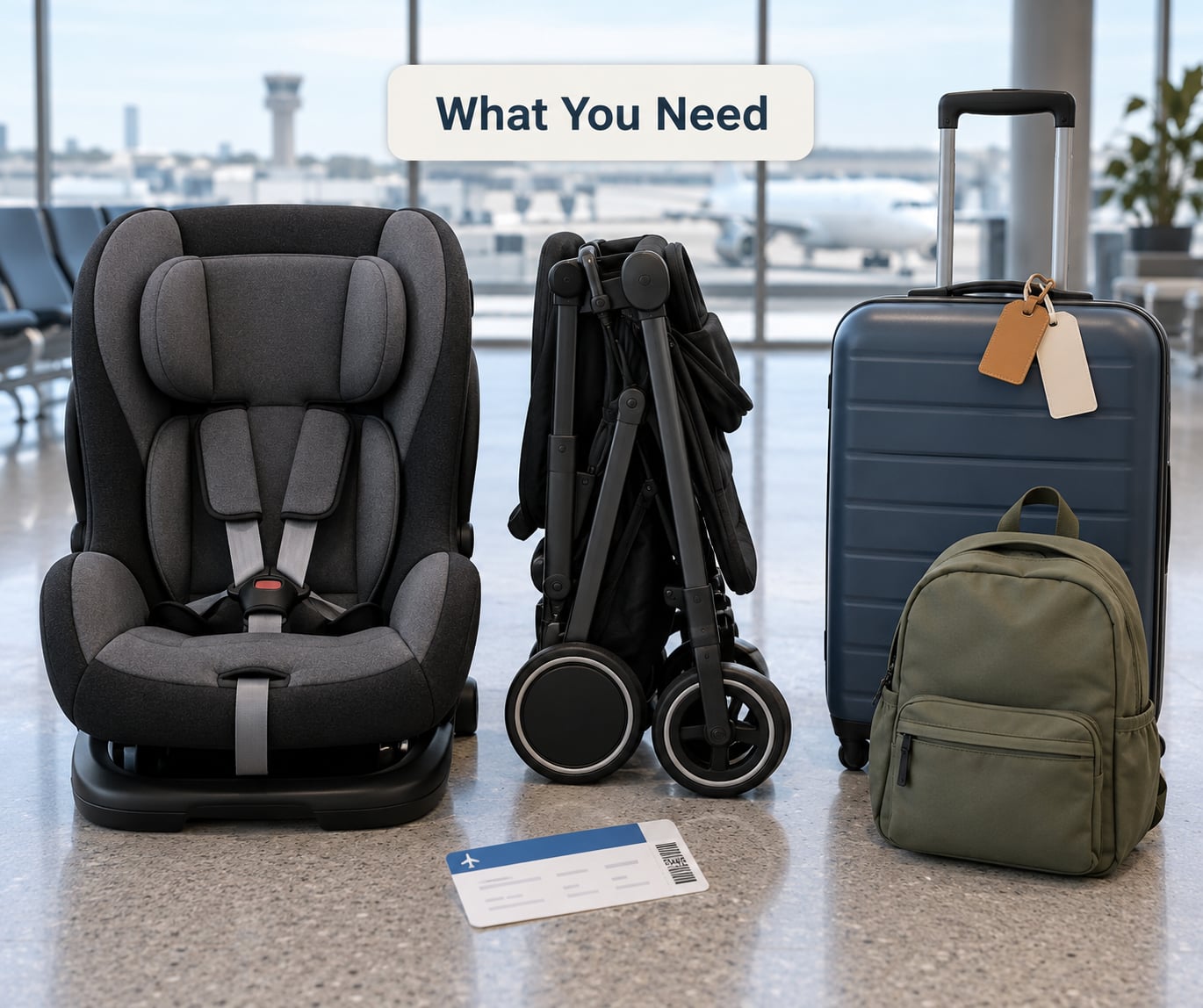
Here is the kit list. It is shorter than most families expect, because both big items travel as airline gear rather than as ordinary luggage.
- A car seat with an FAA aircraft certification label. The sticker on the shell is what makes the seat legal to install in a cabin. Without it, the seat is checked like any other box.
- A travel-approved stroller. A compact folding frame is far easier at the jet bridge than a full-size travel system that clicks apart in a crowded line.
- A ticket for your child. Every passenger, including an infant, needs an eligible ticket on a flight.
- Identification for the child. Airlines match the name on the ticket, and some require an additional document depending on age and route.
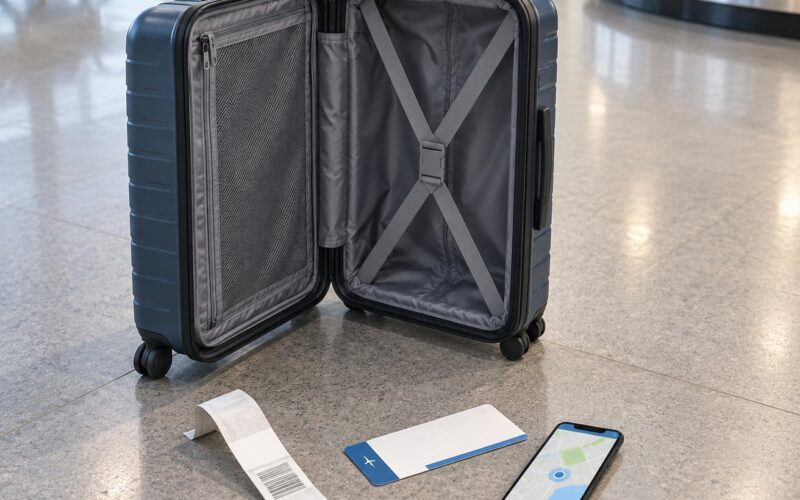
- Your boarding pass and the gate-check tag. The tag is issued by the airline at the jet bridge, so leave room to write on it or to ask for a receipt.
- A removable tracking device for either item, if you gate-check it.
- Destination documents. Passports and visas for international trips, plus a reservation for a rental car, since not every destination has car seats on hand.
If you have TSA PreCheck, put everyone on the same reservation so you land in the family lane with a baby and a bag of gear. It is the difference between a ten-minute wait and a forty-minute one.
Step-by-Step: How to Fly With a Car Seat and Stroller
1. Check the airline’s rules before you book
Read the operating carrier’s policy, not just the booking website. Codeshares and partner-operated international legs can follow different rules from the marketing airline on your ticket, so confirm both the stroller allowance and the seat eligibility with whoever actually flies the aircraft.
Also confirm the connection points. A tight connection with a stroller, a car seat and a toddler is a different journey from the same trip with an overnight layover, and the gear-in-the-cabin option disappears quickly on a small regional aircraft.
2. Decide whether the car seat can fly in the cabin
A car seat can only be installed on board if it carries the FAA aircraft certification label and your child has a purchased seat. Carrying a seat through the cabin to store in an overhead bin is a different act from using it as the child’s restraint, and airlines treat them differently.
Where a seat is permitted, expect restrictions: a window or middle seat, never an emergency exit row, and enough width between the armrests for the seat to sit without wedging. Cabin bags have weight and size limits that vary by airline and fare, so measure rather than assume.
Boosters are a special case. A booster positions a child for a lap-and-shoulder belt, and aircraft seats do not have one, so boosters are not usable in flight. Parents often carry one anyway for the arrival leg in a rental car, which is a reasonable reason, but it is not a restraint on the plane.
Rear-facing is fine for a toddler within the seat’s height and weight limits. The FAA’s guidance is that a properly installed child restraint is the safest option for every child who can use one, including infants who are legally allowed to fly on a lap.
3. Choose cabin carriage or gate-checking for the stroller
Most parents end up gate-checking the stroller, and the reasoning in parent forums is consistent: keep it until the jet bridge, hand it over with a tag, and pick it up first on the other end. A lightweight frame that folds with one hand is the piece of gear people describe as a lifesaver in an airport.
The alternative is taking an empty stroller as a cabin carry-on where the airline permits it. That works best on wide-body aircraft with larger overhead bins, and it fails often enough on small planes that many families treat it as a backup plan rather than a plan.
Checking at the ticket counter is the third option. It is free on US carriers and it does not count toward your allowance, but you hand over the gear at the start of the trip. Gate-checking keeps the stroller useful through the terminal and moves the handover to the last possible moment.
Two things to know about gate-checking. Fees vary by carrier and route, and the return is not guaranteed to the jet bridge: after a delay or a diversion, gate-checked gear is often delivered to the baggage belt instead. Plan for both.
4. Prepare and label both items
Strip everything removable first. Cup holders, snack trays, stroller adapters and any insert that is not part of the seat structure come off and go in your cabin bag, because these are the parts that snap off in conveyor machinery.
Clean the seat shell, tighten the harness straps and buckle loose webbing into the shell so nothing catches on a belt or a jet-bridge edge. Then fold the stroller and put both items in a padded travel bag. Forum consensus is clear on what a flight check bag does: it stops grease, dirt and scuffs. It does not stop crushing, so treat the structure as the fragile part.
Now label. Use a durable tag with your full name, the phone number you will answer, and your flight number on the car seat shell and on the stroller frame itself, not just the bag. Identity labels are for finding your gear; routing tags are for the airline’s system. Write both, and skip the fragile paper tag that rips off in rain.
5. Arrive early and document everything
Aim for 45 to 60 extra minutes on a domestic trip with an infant and gear. Check in at the counter or the app if the airline needs to verify the child’s boarding documents before you are at the airport, and ask at the desk whether your fare allows an empty stroller in the cabin.
At security, the stroller goes through the x-ray machine unfolded, and the car seat goes through with the child still in it whenever the checkpoint can accommodate that. Carry the child through the detector in your arms, so you are not trying to lift a seat and a toddler at the same moment.
Photograph the stroller folded, the car seat shell, and any existing wear before you hand anything over. Those pictures are the only evidence you will have if a claim needs support later. Keep the gate-check tag, and note what the agent tells you about where the gear will be on arrival.
6. Board, secure, and troubleshoot on arrival
Talk to the gate agent before the line moves. Tell them early that you have a car seat and a stroller, so the gate check happens on your terms rather than during boarding when the ramp is busy. Keep wipes, a change of clothes, feeding supplies and any documents in your cabin bag rather than in a checked item.
If you are installing the seat on board, follow the seat’s own instructions rather than muscle memory: belt through the correct belt path, harness height set to the manufacturer’s mark, child seated for the flight in the position the seat was tested in. If the seat cannot be installed securely, use it as checked gear.
On arrival, check the jet-bridge area first for gate-checked gear, then the belt. If something is missing or damaged, go to the airline’s baggage office inside the airport and file before you leave the building, with your tag and your photographs in hand. Entitlement and compensation are the airline’s to decide, and almost every claim gets harder after you have gone home.
If the car seat never arrives, you are without a safe way to travel onward. Buy or borrow one at your destination, keep the claim open, and ask the airline to deliver the seat when it is located. Never reinstall a seat with visible structural damage after a rough handling.
Common Mistakes
- Booking a lap infant and then expecting a car seat on board. Children under two may fly free on a lap on most domestic US routes, but a lap infant is not a restraint, and many international flights do not accept lap infants at all. Book the seat if you want the car seat installed.
- Assuming a stroller is automatically free in the cabin. Cabin carriage depends on the airline, the aircraft type and your fare’s baggage allowance. Check the policy rather than counting on the overhead bin.
- Forgetting to fill in the gate-check tag. An unlabelled stroller on the carousel is how gear ends up in the wrong country. Write your name and phone number on the tag and on the frame.
- Leaving removable parts attached. Cup holders, trays and adapters snap off in handling and rarely travel with the seat. Take them off and carry them.
- Packing supplies in a checked item. Diapers, formula, medication and the change of clothes go in your cabin bag. Gate-checked gear is not a place to keep a feeding kit.
- Running an unfolded stroller through security. It gets inspected, it slows the line, and it is a reason to get pulled aside. Fold it before you reach the belt.
- Using the car seat without reading its instructions. Belt path, harness height and the expiration date all matter. Follow the manual, and check it is still in date before you pack.
Frequently Asked Questions
Do I need to buy a separate airplane seat for my child’s car seat?
Yes, if the car seat will be used as your child’s restraint. An FAA-approved car seat can only be installed in the cabin for a child who has their own purchased seat, usually on a window or middle seat and never in an emergency exit row. A child travelling as a lap infant under two cannot use a car seat as a restraint on most flights, and international routes frequently require a purchased seat regardless of age.
Can I use a car seat as checked baggage instead of buying a seat?
You can, and most US airlines take a car seat free of charge whether you check it at the counter or gate-check it at the jet bridge. Gate-checking keeps the seat with you until the last possible moment, which parents prefer, but it exposes the shell and base to cargo handling. Put it in a padded travel bag, remove loose parts, label it, and photograph it before handover.
Is a stroller free on a flight, and can I gate-check it?
On major US carriers an empty stroller is generally accepted free of charge and does not count toward your checked baggage allowance, whether you gate-check it or hand it over at the counter. Gate-checking means keeping it until the jet bridge and collecting it at the gate or the belt on arrival. Cabin carriage depends on the airline and the aircraft, so check before you rely on it.
Can I fly internationally with my child’s car seat and stroller?
Yes, and the gear itself is rarely the problem. The complications are tickets and documents: lap infants are not accepted on many international flights, so a child under two usually needs a purchased seat and an approved restraint. Check the operating carrier and any partner-operated leg for stroller limits, carry a tracker for anything gate-checked, and confirm your destination rental car can supply a seat.
What should I do if my stroller or car seat is lost or damaged?
Before you leave the airport, go to the airline’s baggage office with your gate-check tag and your photographs of the gear before handover. File the report on the spot and get a reference number, because claims get harder once you are home. Ask how the gear will be returned, keep tracking information, and never reinstall a car seat that has visible structural damage. If you fly again soon, source a replacement at your destination.
Do one thing before anything else: open your airline’s policy page and confirm whether your fare lets you carry an empty stroller on board. That single answer decides whether you pack for the cabin or for the belt.
Then gate-check, label, photograph, and keep your essentials in your own bag. Everything else on this page is a variation on those four habits.