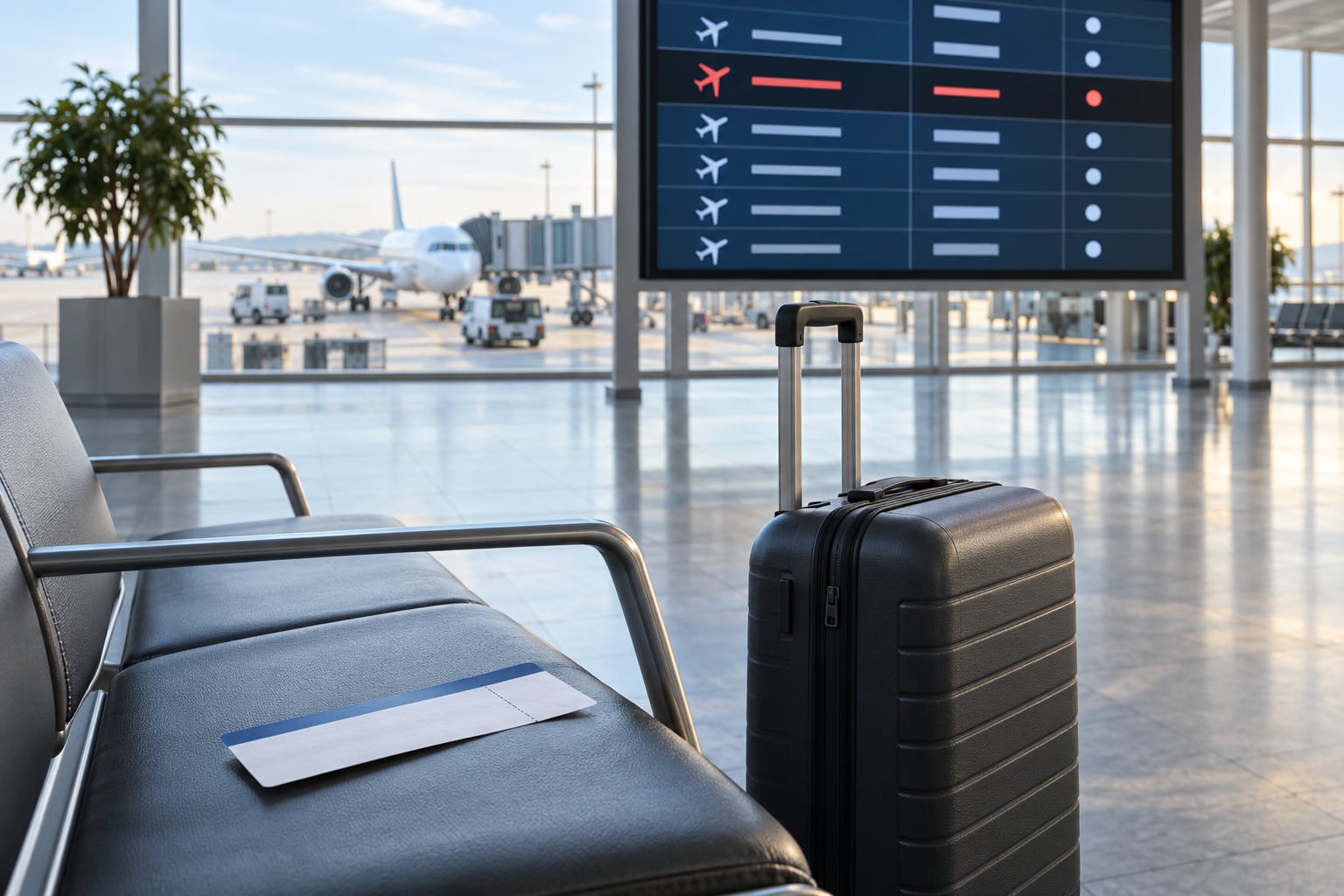
If you miss your connecting flight, the airline will usually rebook you on the next available departure, and often for free. Whether you pay, whether you get a meal or a hotel, and whether you can claim compensation all come down to two things: whether both flights were on a single ticket, and what caused the delay.
Table of Contents
- What Happens If You Miss Your Connecting Flight?
- What Is the Difference Between a Protected and Unprotected Connection?
- Why Did You Miss the Connection?
- What Should You Do Immediately at the Airport?
- Can You Still Make the Next Flight After Missing Your Connection?
- Will the Airline Rebook or Refund Me?
- What Happens If You Miss an International Connection?
- How Long Must You Wait to Make a Connection?
- Can You Claim Compensation for a Missed Connection?
- Frequently Asked Questions
- Will a connecting flight wait for me?
- Who is responsible if I miss a connecting flight?
- What happens if you miss a connecting flight due to not enough time?
- What happens if your flight is delayed and then you miss your connecting flight?
- What happens if I no-show for a connecting flight?
- What happens if I miss your connection due to passport control?
- Conclusion
What Happens If You Miss Your Connecting Flight?
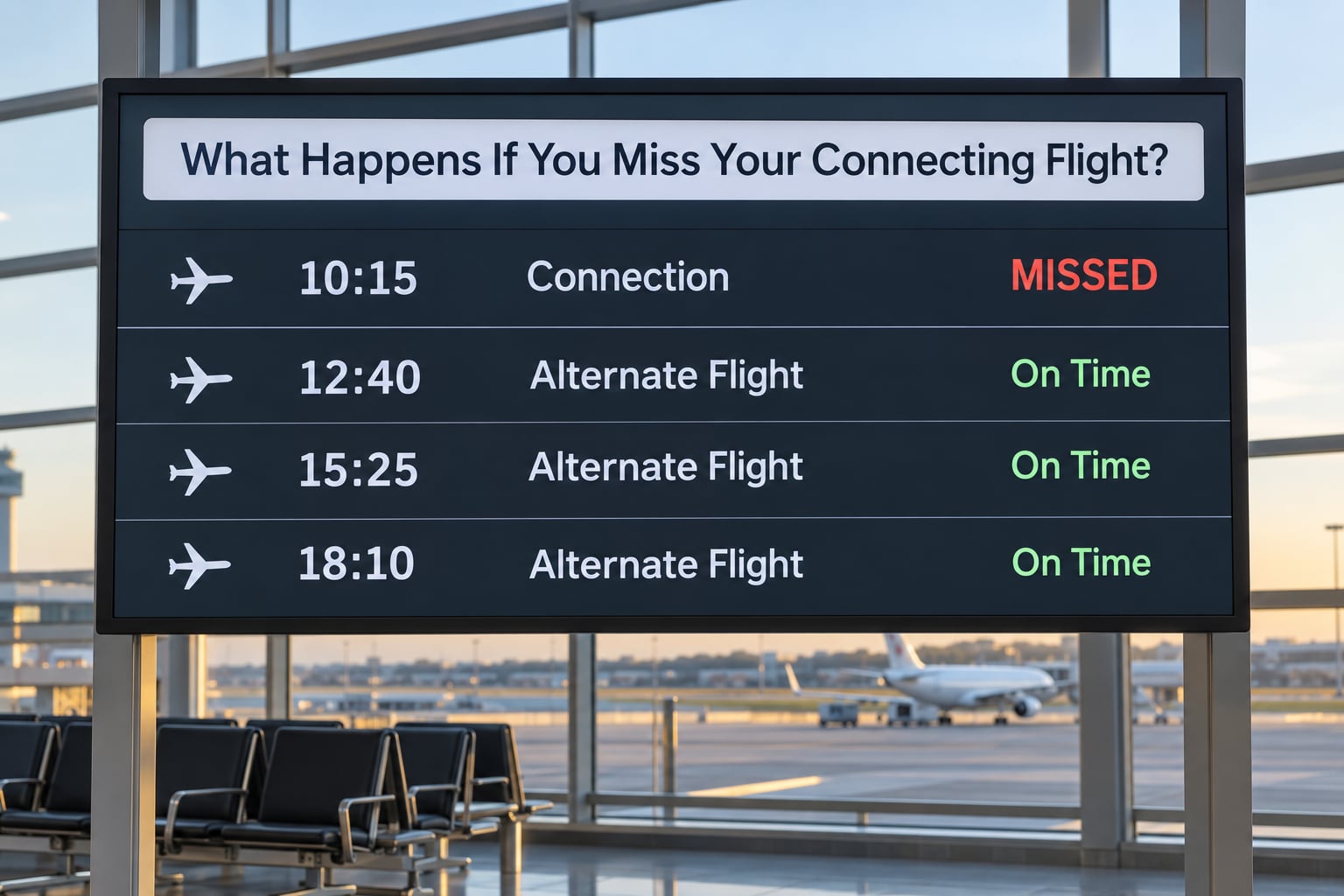
Missing your connection means the onward flight left without you. The flight crew cannot bring it back, and the gate will not reopen it, so the practical outcome is a rebooking decision made in the next few minutes.
Four things decide how that decision goes, and they are worth sorting out before you reach the desk:
- One ticket or two. Both legs on a single reservation with one confirmation code means the airline owns the whole journey. Two separately purchased tickets means the airline only owns the leg that failed.
- Whose fault the delay was. An inbound delay, a cancelled flight, a mechanical problem or an overbooking are the airline’s problem. Your own late arrival, a long security queue or a booking that was too tight to begin with are not.
- Domestic or international routing. International connections add immigration, transit visa checks, customs and baggage reclaim on top of the rebooking itself.
- Whether you have a checked bag. A bag on the original routing is a second problem to solve, and it changes which flights you can actually take.
Travelers report that outcome quality varies sharply by airline, hub and the individual agent. The same delay produces a free hotel at one airport and a shrug at another, so treat the categories below as rules of thumb rather than promises.
What Is the Difference Between a Protected and Unprotected Connection?
A protected connection means both flights sit on one ticket, so the airline that sold you the itinerary is responsible for delivering you to the final destination. An unprotected connection, sometimes called a self-transfer, means you bought two tickets independently and the second airline never has an obligation to help you catch the first one.
| Booking situation | What rebooking looks like | Who pays | Meals and hotel |
|---|---|---|---|
| One ticket, same airline, airline-caused delay | Rebooked free on the next available flight, often on a partner carrier if needed | Airline, including any fare difference | Usually provided if the wait runs long |
| One ticket, codeshare or interline | Handled through the ticketing carrier, but often on the operating carrier’s plane | Airline | Varies by carrier; ask at the first desk you reach |
| One ticket, you were the cause | Rebooked on a good-faith effort, usually on the next available flight | You pay the fare difference and any change fee | Yours to cover |
| Two separate tickets, one airline | No automatic help; you buy a new seat like any other walk-up passenger | You, at the current fare | Yours to cover |
| Two separate tickets, different airlines | No obligation at all; the second airline sells to whoever is buying | You, at the current fare | Yours to cover |
One detail catches people out even on a single ticket: a protected connection does not mean you are guaranteed the same aircraft, the same seat or a specific replacement time. It means you get moved forward and the airline absorbs the cost of getting you there.
Why Did You Miss the Connection?
The airline controls most of the reasons. An inbound flight lands late, weather closes a runway, a technical fault delays departure, air traffic control imposes a hold, or the first flight was overbooked and you were bumped off it. Add crew shortages and aircraft arriving out of sequence, and plenty of connections break through no fault of yours.
Passenger-side causes sit on the other side of the line. A security queue that overran, a slow immigration hall, a terminal change that added a shuttle ride, or a layover booked at 45 minutes on a busy hub. A boarding cutoff works the same way: gates typically close 15 to 20 minutes before a domestic departure and closer to 30 for many international flights, and after that the seat is released to standby.
Why it matters is the follow-up, not the blame. Airline-caused delays usually mean free rebooking plus incidentals, and in the European Union they may also mean cash compensation. Your own lateness usually means a free seat if one exists and a fare difference if it does not.
On r/delta, experienced flyers note that hub-based carriers will often hold a plane briefly or rebook you around a storm, barring a full airport shutdown. On r/unitedairlines, the common report is that rebooking is still free if everything ran on time and you simply did not make the gate, but incidentals become your responsibility. Treat both as tendencies, not policy.
What Should You Do Immediately at the Airport?
Speed matters more than politeness, though you need both. Work through this in order rather than joining the queue and hoping.
- Get to a staffed position fast. The airline’s service desk, a gate agent handling the disruption, or the transfer desk for self-transfers. If the departure board shows mass delays, head for the airline’s own disruption counter rather than the general queue.
- Show the full itinerary on your phone. Both flight numbers, the confirmation code, and the original scheduled connection time. Screenshots taken at the gate help later.
- Ask the gate agent before you walk away. If you are still airborne or the delay is being called on board, the crew may be able to move you forward on a later leg or flag your record before arrival. It costs nothing to ask.
- Open the airline app while you wait in line. Self-service rebooking often shows options the desk does not, including flights on partner carriers. Screenshots of what you were offered are useful evidence.
- Name a specific flight. Travelers on r/Flights report better results asking for a particular rebooking rather than leaving the conversation open. “Put me on the 6:40 to Denver” beats “what can you do for me.”
- Ask for vouchers explicitly. Meal vouchers, hotel, and ground transport are owed in most airline-caused long delays. Request them by name at the desk; a vague request often produces a no.
- Keep every receipt and every document. Hotel folio, meals, taxis, the new boarding pass, and written notes of what the agent said. Claims months later are won on paperwork.
Do not run across a taxiway, a ramp, or between terminals on foot. Gate agents can and will rebook you; being struck by equipment ends the trip in a much worse way.
Can You Still Make the Next Flight After Missing Your Connection?
Sometimes yes, and the gate is what decides. Ask to be added to the standby or waitlist for the next departure rather than accepting a seat hours later. Standby is first offered to passengers on that flight who bumped, then to those rebooked earlier, then to anyone the agent clears.
Getting on is not automatic. It depends on whether a seat remains at boarding time, whether your bag can be transferred in time, and whether a minimum connection time applies at that airport for your particular itinerary. A short-haul aircraft with a full premium cabin and a list of no-shows is a poor bet; a widebody with empty rows is a good one.
Airport changes make this harder. A connection that moves you to another terminal or another airport may need a new boarding pass and sometimes a new security screening, which adds real time.
Will the Airline Rebook or Refund Me?
On a single ticket with an airline-caused disruption, expect free rebooking onto the next available flight at no cost to you. If the replacement flight costs more, the airline normally absorbs the fare difference. The agent will usually rebook you rather than offer a refund, because getting you to the destination is cheaper than paying you back.
A refund becomes relevant in three situations: you decide not to travel at all, you are more than a few hours late and the airline offers you the option, or the whole journey is cancelled and you cannot be rebooked reasonably. Refunds normally go back to the original payment method, which means a credit card gets its money back while a voucher leaves you holding airline credit.
On separate tickets, none of this applies to the second airline. You are a walk-up passenger paying the going rate, which on a short notice domestic fare can be several times what you paid originally. That gap is the real cost of a cheap self-transfer, and it is the number to weigh before booking two tickets over one.
What Happens If You Miss an International Connection?
International connections are harder for a mechanical reason: clearing the border. If your connection was domestic and you miss it, you stay in the same country. If it was international, you may already be committed to an entry or transit process that takes time you no longer have.
On a typical long-haul connection you land, clear immigration, reclaim checked baggage, pass customs, then find your gate. Transit visa rules decide whether you are allowed through that process at all, and some countries require you to collect and re-check bags even when staying in the transit area, which adds a queue to the front of the clock. If you arrive after the connection has closed, you may also lose the right to board an independent replacement flight that arrives in time.
Talk to the airline before you buy anything. Buying your own ticket and then claiming reimbursement is a much harder case than asking the airline to authorize the replacement, because a self-bought fare is treated as a separate purchase.
How Long Must You Wait to Make a Connection?
There is no universal safe number, and anyone quoting one universal figure is simplifying. A workable connection depends on the airport, the terminals involved, whether you are staying airside, whether you have checked baggage, whether you clear immigration, and how often that particular hub runs late.
The practical tiers look like this. Domestic to domestic in the same terminal at a well-run airport can work in around an hour. Domestic to domestic across terminals, or a first flight that routinely arrives late, wants closer to two. International arrivals with immigration, baggage reclaim and customs routinely need three or more, and five is the sensible buffer when a connection is the whole point of the trip.
Check the itinerary for the specific minimum connection time printed for your flight pair, and treat anything at or near that minimum as risky. Booking through one airline on one ticket at least gives you a fallback when the first leg runs late. If you are booking separate tickets, add at least an hour of buffer on top of these tiers, because nothing protects you.
Can You Claim Compensation for a Missed Connection?
Compensation is possible but never automatic. Three things have to line up: the operating carrier’s rules, the reason for the delay, and the consumer protection rules that apply on that route.
In the European Union, Regulation 261/2004 sets cash amounts of 250, 400 or 600 euros depending on flight distance when the delay or cancellation falls inside the regulation’s scope. Arrivals of three hours or more late, and cancellations, are the usual triggers. Cases involving extraordinary circumstances, such as weather and air traffic control decisions, are typically excluded, which is why a storm-caused misconnection and a mechanical one can end very differently.
The reach of the rule has also been tested in court. In 2018 the UK Supreme Court found that EU261 can apply to a missed connection where the onward flight departed from outside the EU, which widened the pool of claimable itineraries beyond intra-EU travel. In the United States there is no equivalent automatic cash compensation for delays. The Department of Transportation sets rules on refunds and requires airlines to give prompt updates, and a claim is usually built on the refund of the unused portion plus any documented expenses.
Insurance sits alongside this rather than instead of it. Trip interruption coverage and credit card trip-delay protection typically reimburse hotel, meals and ground transport, and some reimburse a replacement ticket. Every version wants the same evidence: itemized receipts, the written record of the delay, the new boarding pass, and a claim form submitted inside the policy window. Check the deadline, because it is the most common reason a valid claim fails.
Frequently Asked Questions
Will a connecting flight wait for me?
Usually not for long. Aircraft have their own rotation and crew duty limits, so a gate will hold a departure for a few minutes at most, and often not at all. On a single ticket, the airline will normally rebook you rather than wait. Hub-based carriers are somewhat more willing to try to protect a connection when weather is the cause, but that is a tendency, not a rule.
Who is responsible if I miss a connecting flight?
It depends on two things. If both flights are on one ticket and the airline caused the delay, the airline is responsible and should get you to your destination without extra charge. If you arrived late on your own, or you bought two separate tickets, the second airline has no obligation and you buy a new seat. The airline that sold the ticket, not necessarily the one that operates it, is the one to approach.
What happens if you miss a connecting flight due to not enough time?
If both flights were booked together and the first one ran on time, the airline will usually still rebook you free of charge on a good-faith effort, because the tight layover was created by its own schedule. Meals and a hotel usually are not provided. On separate tickets, an unrealistic connection is your booking decision, so you are simply a walk-up passenger and you pay the current fare.
What happens if your flight is delayed and then you miss your connecting flight?
On a single ticket, the airline rebooks you on the next available flight at no cost, covering any fare difference, and provides meals or a hotel when the wait runs long. Whether you can claim cash compensation depends on the route and the cause. In the European Union, arrivals three hours or more late can qualify under Regulation 261/2004, though weather and air traffic control delays are usually excluded.
What happens if I no-show for a connecting flight?
The airline records a no-show and releases your seat, and any onward bookings on that ticket may be cancelled. The remainder of your itinerary is normally cancelled, though you can often rebook it later as a new request. If the no-show was caused by the airline’s own delay, contact them immediately with the delay record, because an involuntary no-show caused by the carrier is treated very differently from a voluntary one.
What happens if I miss your connection due to passport control?
It depends on whether the long queue was the airline’s doing, which it usually is not. On a single ticket, ask the airline rebooking desk to note the immigration or customs delay, because that record supports a claim for meals, a hotel, and possibly compensation. Speak to the airline rather than the border agency, and keep the evidence, since the amount you can recover is far smaller than the cost of buying an unapproved replacement ticket yourself.
Conclusion
What happens if you miss your connecting flight comes down to one call and one question. Contact the airline or rebook in its app the moment you land, and before you accept any seat, confirm out loud whether your two flights are on one ticket and what delay reason the airline is recording. That single confirmation decides whether the airline carries the cost or you do, and it shapes every claim you make later. Ask for vouchers by name, keep every receipt, and hold off on buying your own replacement flight until the airline has said no in writing.