Pick a cruise if you want several destinations in one trip and don’t mind living out of a suitcase for a week. Pick a resort if you want one place to settle into, unpack once, and shape each day yourself. Most people who regret their choice chose the opposite of what they actually wanted from a holiday.
The two trips get compared constantly, usually on price, and price is the worst place to start. A cruise fare and an all-inclusive resort rate cover very different things, and neither number tells you how you’ll spend your days. Work through the trade-offs below and the answer usually becomes obvious within ten minutes.
Table of Contents
- How to Choose Between a Cruise and a Resort Vacation at a Glance
- Cruise or Resort: What Each Vacation Actually Involves
- Cost: What You Pay Beyond the Advertised Price
- What a cruise fare usually leaves out
- What an all-inclusive resort usually leaves out
- Two costs people forget
- Trip Length and Scheduling: Which Fits Your Time
- Destinations and Flexibility: Where You Can Go
- Food, Accommodation, and Everyday Comfort
- Activities and Independent Time
- Planning Effort and Logistics
- How to Choose Between a Cruise and a Resort Vacation by Budget
- How to Choose Between a Cruise and a Resort Vacation by Travel Style
- For first-time vacationers who want an easy win
- For travelers who want scenery and new places
- For travelers who care about food
- For couples and honeymooners
- For families with young children
- For travelers with limited mobility
- For people who like structure versus people who like free time
- For repeat cruisers deciding what to do next
- Which Should You Choose?
- How to choose between a cruise and a resort vacation in 30 seconds
- Frequently Asked Questions
- Is a cruise cheaper than a resort vacation?
- Which is better for a first trip to Hawaii?
- Is a cruise better for families with children?
- Can you explore more on a cruise or at a resort?
- Which option is better for travelers with limited mobility?
- How far in advance should I book a cruise or resort vacation?
- Conclusion
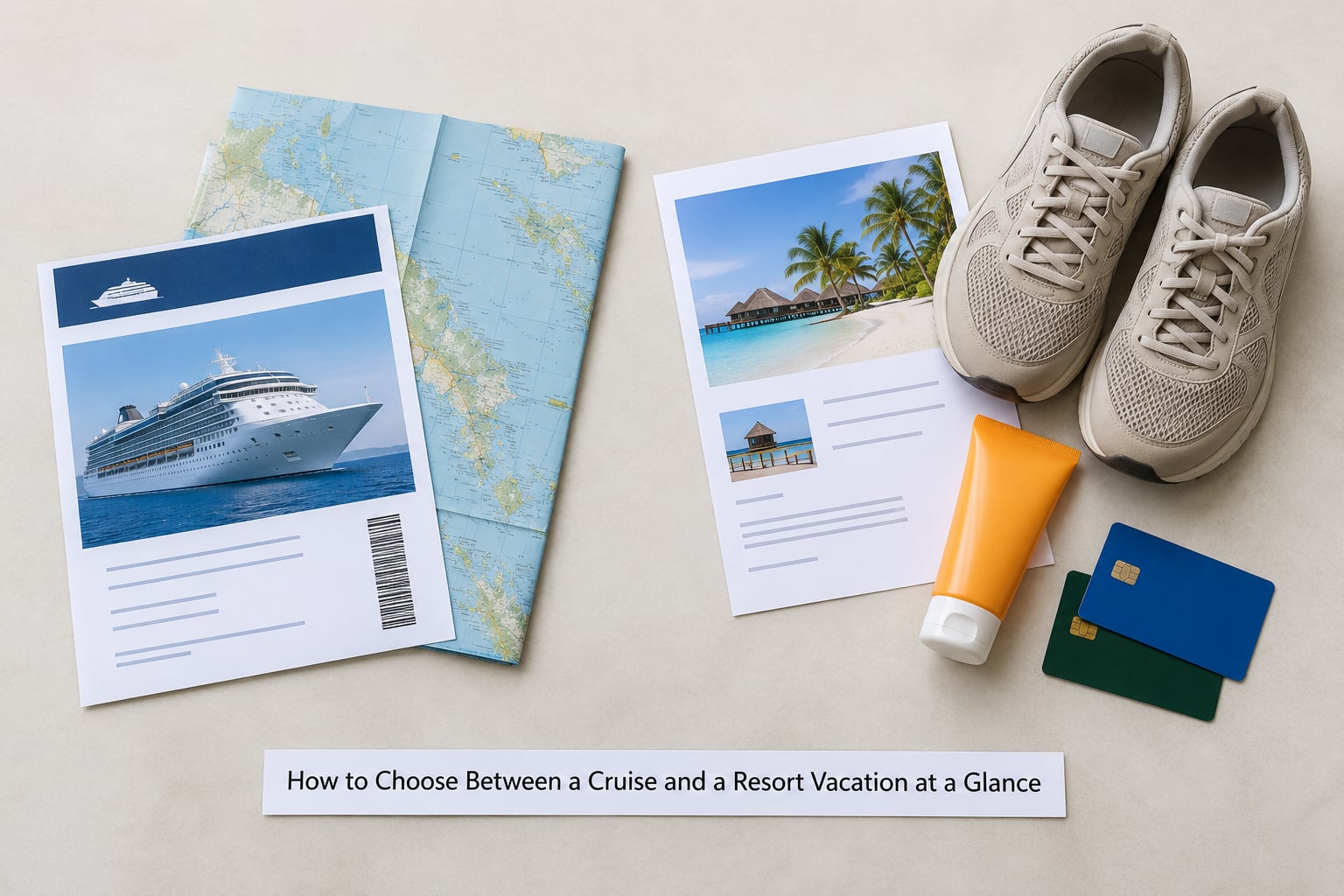
How to Choose Between a Cruise and a Resort Vacation at a Glance
| What matters | Cruise | Resort vacation |
|---|---|---|
| Typical trip length | Fixed, usually three to fourteen nights | Flexible, anything from a long weekend to two weeks |
| Places you see | Several ports on one route | One resort area and its surroundings |
| Daily structure | Ship schedule: port calls, sea days, showtimes | Your schedule, with programmed evening options |
| Room size | Compact, especially in lower categories | Generous, often with a balcony or terrace |
| Food | Main dining and buffet included, specialty venues extra | Most meals included, quality varies by property |
| Drinks | Paid packages or a la carte | Usually included at all-inclusive properties |
| Activities | Pools, kids clubs, shows, port excursions | Pools, kids clubs, spa, off-property excursions |
| Packing | One bag per trip, plus a day bag | Everything for the length of stay |
| Planning effort | Heavy before the trip, light once aboard | Lighter before, more decisions each day |
| Suits best | Scenery seekers, first-timers, tight holiday windows | Longer stays, couples, anyone wanting depth in one place |
Read that table with one question in mind: do you want change, or depth? Everything else follows from the answer.
Cruise or Resort: What Each Vacation Actually Involves
A cruise is a voyage. Your stateroom, most meals and the entertainment travel with you, and the ship follows a published route. You wake in one country and go ashore in another, then unpack again in a new place. Most of the planning happens weeks before you board, once the itinerary is fixed.
A resort vacation is a land-based stay at one property. You check in once, the room stays yours, and the nearest beach, pool and restaurant are a short walk away. Days are wide open, which is exactly what some people want and exactly what makes other people restless by day three.
Travelers who have done both tend to describe it the same way: the cruise is a change of scenery, the resort is depth in one place. Choose based on which of those two sentences describes the holiday you actually want.
Cost: What You Pay Beyond the Advertised Price
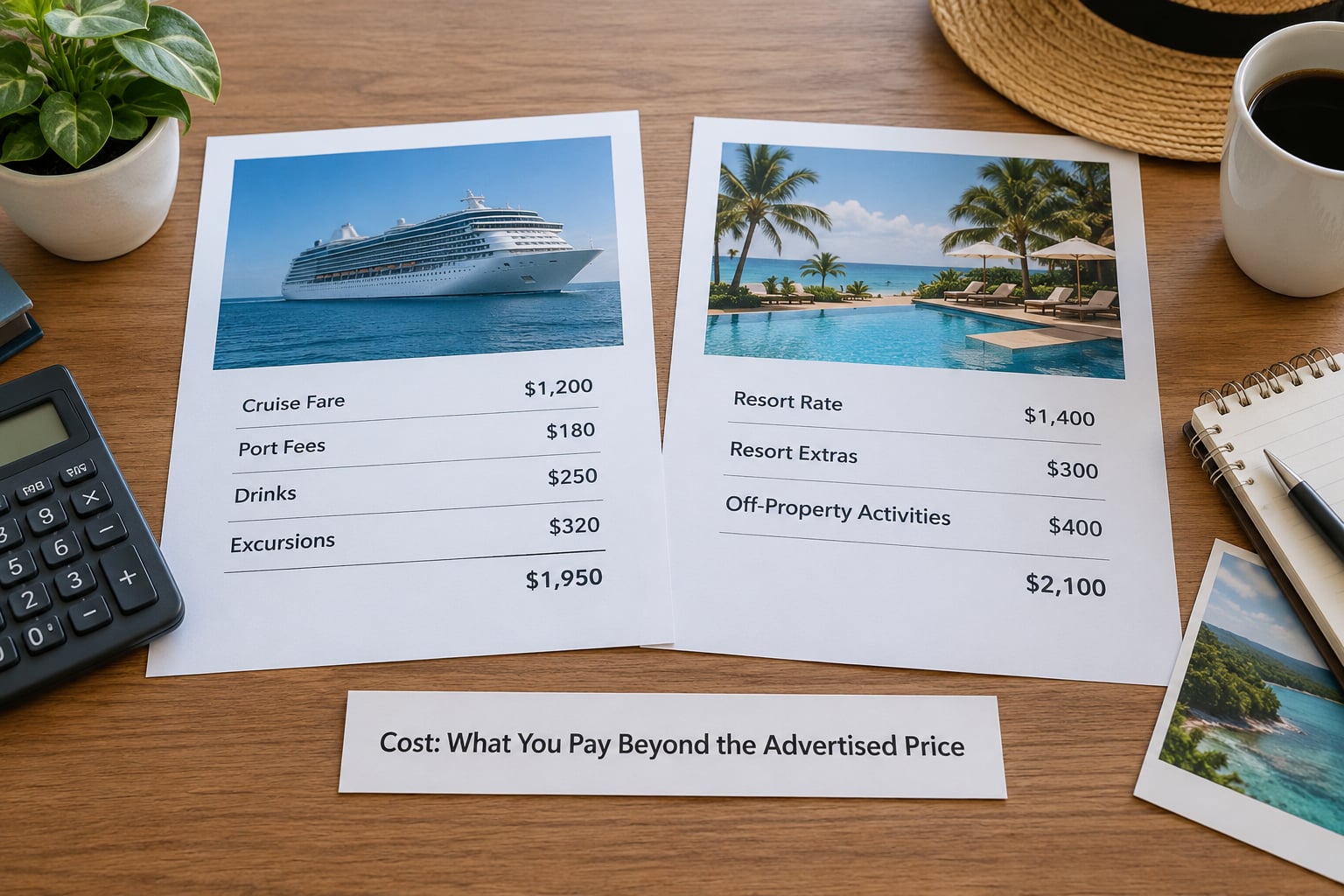
Neither style is automatically cheaper. They just hide their cost differently. A cruise publishes a base fare and lists the extras separately. An all-inclusive resort publishes one rate and buries the boundary of what’s inside it, usually on a separate page.
What a cruise fare usually leaves out
On a cruise, expect to pay separately for drink packages, specialty dining, shore excursions, Wi-Fi packages, gratuities, and often a third-party convenience fee. Excursions are the line item that surprises people most, because several optional shore stops can each cost as much as a day’s budget for the whole trip.
What an all-inclusive resort usually leaves out
At a resort, meals, local drinks and standard activities sit inside the rate. Outside that boundary sit the spa, cabanas, premium spirits, off-property excursions, and any special event. The word “all-inclusive” describes a boundary, not an unlimited budget.
Two costs people forget
Getting there counts on both sides. Many US cruise ports are a drive away, which can beat four airfare seats for a family, while a Caribbean or Mexican resort almost always means international flights plus a transfer.
Rounding up matters too. Cruise lines increasingly add automatic gratuities to the final bill, and some resort groups run a strict no-tipping policy while others expect staff to be tipped. Know the rule before you arrive so a gesture never turns into a scene.
The fix is simple: build both quotes the same way. Add transport, the mandatory fees, one realistic daily drinks allowance, and two or three excursions or activities. Compare those totals, not the headline numbers.
Trip Length and Scheduling: Which Fits Your Time
A cruise has a duration. Seven nights is seven nights, you board on the scheduled day, and the ship leaves whether or not you’re finished exploring. That rigidity is genuinely useful when your holiday window is fixed and you want to know the exact dates before committing.
A resort stay can be as short as a long weekend or as long as you can afford. If your employer is rigid, if your kids’ school calendar sets the window, or if you want to extend by three days on impulse, that flexibility is worth real money.
Add the in-transit days. Cruise trips usually consume an embarkation day and a disembarkation day, plus travel to the port. For a seven-night sailing you’re often away for nine or ten days. A seven-night resort stay costs you the same seven days plus arrival, which is one reason cruisers call a short resort trip “only five real days.”
Destinations and Flexibility: Where You Can Go
The clearest cruise advantage is the itinerary. Several ports in one trip, no airport transfers between them, no repeated packing. For a traveler who wants to see three countries in a week, no land-based stay replicates that.
The catch is that the route is chosen for you. You can only go ashore in the window the ship allows, and you may spend an entire day at sea with nothing to do but use the ship. Review the number of sea days before you book; more than two changes the feel of a sailing.
A resort wins on spontaneity. You can take a taxi into town, try a different beach, join a cooking class or do absolutely nothing after breakfast without rearranging anything. Couples who like privacy and travelers with a specific hobby usually value that more than the destination count.
Food, Accommodation, and Everyday Comfort
Food is the one category where the forum consensus leans resort, though the reasoning matters. Resort kitchens at good all-inclusive properties serve fresh, well-sourced food in generous quantities. On a ship, the main dining room and buffet are genuinely included and there are usually many more venues to choose from, but quality swings harder and the specialty restaurants carry an extra charge.
Rooms are where cruise ships lose ground. An interior or ocean-view stateroom is compact by resort standards, and only the higher categories approach a typical resort room in size. A resort room at the same budget is commonly double the space, often with a private balcony and a separate sitting area.
Service patterns differ too. On a ship, service is constant and informal; you rarely tip for a drink carried to your chair. At a resort, service is attentive and structured around your room, your pool chair and your assigned server. Travelers with limited stamina usually prefer the resort. Travelers who hate asking for anything prefer the ship.
Noise is the quiet decider. A megaship is a busy building, and cabins near the main dining room, the theater or the engine rooms carry more vibration than the marketing photos suggest. Check the deck plan before booking a cabin rather than after.
Activities and Independent Time
A cruise gives you programming you didn’t have to organize: shows, trivia, cooking demos, guided classes, kids clubs that run in shifts, and a crew that keeps the day moving. Sea days are the weak point, since the ship is a closed world when it cannot go anywhere.
A resort offers pools, a kids club, tennis, spa treatments and excursions as menu options, with no schedule running over you. The freedom cuts both ways. Travelers who dislike unstructured time often report the same thing: a resort gets boring after two days because there is nowhere you have to be.
Childcare is the factor families weigh most. Resort kids clubs frequently run age-banded sessions, cap enrollment, and often require a child to be potty trained, so ask for the age minimum before you book. Ship clubs split into similar bands and often cover a wider age range, which helps with mixed-age groups. Neither option hands you a genuinely free evening on its own.
Planning Effort and Logistics
The cruise takes more work before departure. Choosing a line, ship size and cabin category matters more than most first-timers expect, and a travel agent who specializes in cruising is worth the small fee on a first booking. Book excursions ahead, arrive a day early, pack one bag plus a day bag, and download what you need onto a tablet before you lose signal.
The resort takes less effort up front and more attention daily. Reservations for specialty restaurants, excursions and spa appointments fill quickly in peak season, so a few minutes of planning keeps the days from sliding into nothing.
Contingency planning tells the two apart. A ship leaves on schedule no matter the weather, so a missed excursion is a lost day with no alternative. At a resort, a cancelled boat trip can often be replaced the next morning. For travelers who find fixed deadlines stressful, that flexibility is worth more than it sounds.
How to Choose Between a Cruise and a Resort Vacation by Budget
Budget-driven travelers usually focus on the headline number, and that’s where they get it wrong. Compare the full trip on both sides using the same four columns: transport, the base rate, expected extras, and the final bill.
- Transport. A drive-to port on the US east or Gulf coast can cost less than airfare for four. An international resort almost always adds flights and a transfer.
- Base rate. A cruise fare looks modest because the fees are excluded. An all-inclusive rate bundles more, so the gap narrows fast once you total it.
- Extras. Drinks matter most. If you average several alcoholic drinks a day, a cruise drink package can be sensible; if you don’t drink, buying one is pure waste and the resort or à la carte is cheaper.
- Final bill. Add gratuities, specialty dining, and Wi-Fi on the cruise side. Add the spa, cabanas and off-property tours on the resort side.
One more trap: resort rates shift with the exact number of adults and children entered into the booking. A quote that looked comfortable can move substantially when the family count changes, so get the rate re-confirmed for your actual party before comparing anything.
How to Choose Between a Cruise and a Resort Vacation by Travel Style
For first-time vacationers who want an easy win
The cruise. One booking, one bill, no airport transfers, and a destination list that feels impressive without effort. The trade-off is a smaller room.
For travelers who want scenery and new places
The cruise. Several countries in one week without repacking is the thing it does better than anything else.
For travelers who care about food
The resort, unless you enjoy variety more than consistency. Good all-inclusive kitchens usually win on quality; the ship wins on the number of places to eat.
For couples and honeymooners
Depends on the couple. Choose the resort for privacy, quiet and a terrace; choose the cruise for romance with less planning and no driving.
For families with young children
The cruise for logistics, the resort for space and beach time. Check kids club age minimums and enrollment caps before booking either.
For travelers with limited mobility
Neither is automatic. Ships often have elevators and accessible staterooms, but port days involve gangways and uneven ground. A resort lets you stay poolside and skip the excursions entirely. Ask each property specifically about accessible rooms and transfers rather than assuming.
For people who like structure versus people who like free time
The ship runs on a clock and gives you something to do when you don’t feel like deciding. A resort gives you an empty afternoon and the responsibility to fill it. Know which one annoys you more.
For repeat cruisers deciding what to do next
Many experienced travelers switch to land after a dozen sailings, describing repeated cruises as a floating resort with better food. If you’ve lost interest in the itinerary itself, a resort is the natural change. Some people are the reverse and want their shore time.
Which Should You Choose?
How to choose between a cruise and a resort vacation in 30 seconds
Choose the cruise when you want several destinations, a fixed schedule you don’t have to build, and as little planning as possible. Choose the resort when you want a longer stay, a bigger room, freedom to improvise each day, and real time in one place.
A short checklist before you book anything:
- Count the ports or the days you’d actually spend at the resort. Whichever number feels short, pick the other option.
- Write your realistic daily drinks and excursion habits, then price them on both sides.
- Decide whether you want to be entertained or left alone. Both options deliver one well and the other badly.
- Check the cabin or room size in square footage, not in photographs.
- Ask the resort for the kids club age minimum or the ship for its club bands, if children are coming.
- Confirm the tip policy on whichever side leans more on tipping.
If both options still look equal after that, take the resort. A room you can spread out in, a beach you can reach in sandals, and a week without a departure board tend to age better than an itinerary.
Frequently Asked Questions
Is a cruise cheaper than a resort vacation?
Only after you total both sides the same way. A cruise fare looks cheaper because drink packages, shore excursions, specialty dining, Wi-Fi and gratuities sit outside it. An all-inclusive rate bundles more, but the spa, cabanas and off-property tours sit outside that. Add transport to both, then compare complete trip totals.
Which is better for a first trip to Hawaii?
A resort usually wins for Hawaii, because the islands are spread out and a ship calls at only a few ports per itinerary. A cruise is a good second option if you want a shorter trip or want to combine Hawaii with Alaska or Canada on one route. If you want deep time on Oahu and Maui, stay put.
Is a cruise better for families with children?
A cruise is easier on logistics: one room, one booking, one bill, and no airport transfer. Kids clubs run in age bands on both sides, so check minimum ages and enrollment caps before booking. A resort gives you more space and beach time but requires daily childcare arrangements and more driving.
Can you explore more on a cruise or at a resort?
A cruise gives you more places in a week, but each stop is limited to the ship’s port window and many are optional shore excursions. A resort gives you fewer destinations and unlimited time in one area, so spontaneous trips to town, a beach or a tour are easy. Breadth favors the cruise, depth favors the resort.
Which option is better for travelers with limited mobility?
It depends on the specific ship and property, so ask both directly about accessible staterooms, elevators, transfers and shore excursions. Cruise ships often have elevators and accessible rooms, but gangways and port surfaces can be difficult. A resort lets you skip excursions and stay poolside, which many travelers with limited mobility prefer.
How far in advance should I book a cruise or resort vacation?
Earlier is better for both, and cruises usually demand more notice because cabins and categories sell down. Book a cruise as soon as your dates and budget are firm, and reserve specialty dining and excursions ahead once you are aboard. For resorts, book earlier for peak holidays and flexible room types, later for off-season travel.
Conclusion
Deciding how to choose between a cruise and a resort vacation comes down to one question: do you want change of scenery or depth in one place? Everything else is arithmetic around that answer.
Before you book, compare the complete trip total rather than the advertised fare, count how many real days you lose to travel, name the activities you would regret missing, and check the room size in numbers. Whichever option wins those four checks is the one to book.