
To choose a hotel neighborhood in a new city, start from your itinerary rather than the hotel list: pick the two or three places you will actually spend your time, find the neighborhoods within an easy reach of them, then check each one for transit, safety at your hours, noise and total cost including transport. The whole process takes about an hour of desk research, and it is the difference between a trip that runs smoothly and one you spend fighting the map.
Most people get this backwards. They filter by price and star rating first, open the map, and then try to squeeze a city around whatever neighborhood turned out cheap. The room is usually the least consequential decision on the page.
Here is the process I use, roughly in order, whenever I book somewhere I have never been.
Table of Contents
- What You Need
- Step-by-Step: How to Choose a Hotel Neighborhood in a New City
- 1. Define the trip you actually want
- 2. Map the places you will visit most often
- 3. Compare transport and arrival logistics
- 4. Check the neighborhood at different times
- 5. Set a realistic budget beyond the room price
- 6. Shortlist neighborhoods, then shortlist hotels
- 7. Test the choice against your itinerary
- Common Mistakes Travelers Make With Hotel Locations
- Frequently Asked Questions
- How far from the center is too far to stay?
- Is it better to stay near a train or metro station?
- How do I check if a neighborhood is safe before booking?
- What matters most for families and travelers with limited mobility?
- Should I stay in the tourist district or a residential area?
- Do hotel prices get cheaper the closer you get to travel?
What You Need

You need very little to run this comparison: a rough sense of what the trip is for, a place to write things down, and a map tool open on a second screen. That is it. The work is thinking, not gear.
- A trip purpose in one sentence. A conference with two free evenings, a week of museums, a birthday, a month of work, a family visit with a toddler. Write it down.
- Two or three must-do anchors. The specific places your days will revolve around, not the whole wish list.
- Your arrival and departure points. Which airport, which station, and what time you land. A 6 a.m. arrival and a 1 p.m. arrival favor very different areas.
- A rough transport tolerance. Are you a person who enjoys a 25-minute ride on a metro, or do you want everything within a 15-minute walk?
- A budget ceiling that is more than the room. Decide what you can spend per day all-in, then work backwards.
- Any accessibility requirements. Step-free routes, short walks, elevators, a room away from street noise. These narrow the field faster than any other input.
- A short list of non-negotiable hotel features. Air conditioning, a bathtub, kitchenette, late check-in, laundry on site. Keep it under five items.
Get these seven things straight and the neighborhood question answers itself in far fewer tabs. Skip them and you will spend the evening reverse-engineering reviews that were written about the wrong area.
Step-by-Step: How to Choose a Hotel Neighborhood in a New City
Seven steps, in this order, each one narrowing the field. Do them roughly in sequence, because each depends on the last.
1. Define the trip you actually want
Turn vague plans into a ranked list of priorities, because the right neighborhood for four days of museums is wrong for a week of cafés and long walks.
Ask yourself what the trip is really for: relaxation, food, culture, nightlife, family time, or a short stopover between two other journeys. Then decide your pace. Slow trip means fewer anchors and a base you are happy to leave rarely; fast trip means a base you leave early and a long commute is tolerable because you are only there in daylight.
Write your priorities in order and mark the top two as non-negotiable. That ranking is the tiebreaker you will need later, and it stops you from talking yourself into a trendy area because it looked good in a photo.
2. Map the places you will visit most often
Plot your anchors on a map, then draw the areas from which all of them are reachable in under half an hour. That overlap is your shortlist.
Include the unglamorous places, not only the landmarks: the restaurant you have a reservation at, the market you want to buy fruit from, the meeting point where a friend lives, the gym, the beach. Travelers who anchor on a single museum end up in a quiet district with nothing to do after it closes.
Then cluster the pins. A tight cluster means you can live on its edge and walk to most of it. Three pins scattered across the map mean you either need a central base or you need to accept that you will be in transit a lot.
3. Compare transport and arrival logistics
Check how each candidate area connects to your arrival point, to your anchors, and to itself after dark.
Four things matter: how you get from the airport or main station to the hotel, how many lines serve the area, how long the ride to your anchors takes on average rather than at best, and what happens at 11 p.m. A neighborhood with three metro lines at 9 a.m. often has one bus at midnight.
Test it yourself in the map tool by switching to transit directions and looking at a departure around 11 p.m. on a weekday. Note the walking distance from the station to the hotel door, not to the hotel pin. Stations can be a long walk through unlit streets, and a hotel advertised as five minutes from the line may be measured from its courtyard.
4. Check the neighborhood at different times
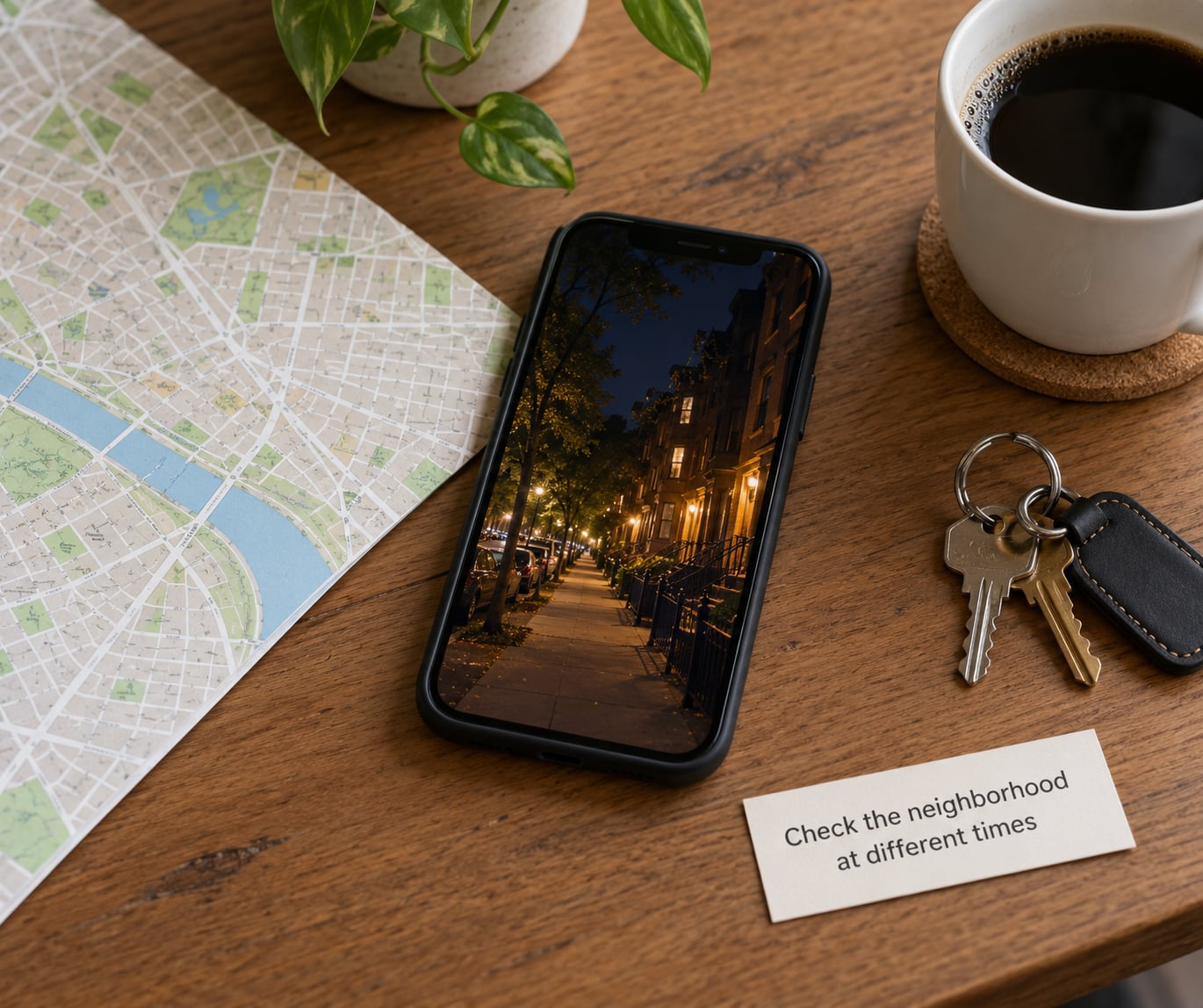
A neighborhood that looks good at noon can be loud at 2 a.m. and empty at 9 p.m., so judge it in daylight, at night and in the evening.
Use Street View and drop the pin at the hotel, not the district centroid. Look at the intersection immediately outside: are there lit shopfronts, or blank walls and garages? Then check recent photos, not the ones the property uploaded. Nighttime crowds can be seen in review photos, street-level video and satellite imagery of how dense the buildings are.
Then read neighborhood-level reviews, not property reviews. Search recent reviews of nearby restaurants, bars and shops for words about the streets themselves. People complain about noise from a bar two doors down and about litter and bins left out overnight far more honestly than they complain about their own room. Noise is the single most common thing travelers discover only after check-in, and it is entirely avoidable in advance.
5. Set a realistic budget beyond the room price
Compare areas on total daily cost, not on the nightly rate. A cheaper room outside the core often loses once you add daily transport, taxis home from dinner, parking, local taxes and fees, and the cost of the hours you spend in transit.
Run the arithmetic per day, not per night. Meals near a tourist core cost more, and late-night taxis from a quieter outer district can be frequent and awkward after the last service ends.
Do not forget time. Forty minutes of travel each way is nearly an hour a day that never becomes anything you remember about the city. For a three-night trip, time cost is small. For a three-week stay it will decide the trip.
6. Shortlist neighborhoods, then shortlist hotels
Narrow to two or three neighborhoods, then compare hotels inside each one. Working in this order keeps you from falling for one great room in the wrong area.
Open the map and drop a pin on three candidate neighborhoods. Now look at hotels inside each and apply the same filter to all of them: room size, recent review complaints, breakfast options, 24-hour front desk, free cancellation, and step-free access if it matters. Apply an identical filter across all three areas, or you will compare one carefully vetted hotel against a random one.
Read the location description on the listing closely. A property ten minutes outside the city on the airport road and one ten minutes from the cathedral are both “ten minutes from the center.” Then check the map position against the address. Some listings place the pin on a building a few streets away, which is exactly how you end up dragging luggage through an unfamiliar alley at midnight.
7. Test the choice against your itinerary
Before booking, assign the chosen neighborhood to each day and check whether the day as planned actually works.
Take each day of your trip and write down the plan, then add realistic door-to-door times including the walk from the hotel. Day one and the last day deserve extra care because they involve luggage, unfamiliar transport at an odd hour, and the check-in or check-out queue.
Then ask the awkward questions. What if the trains stop early? What if I eat dinner in the neighborhood and walk back at midnight? What if the weather turns and I do not want a 40-minute ride? If you have a backup bus, tram or a well-lit late route, a slightly further-out area becomes much easier to justify.
Common Mistakes Travelers Make With Hotel Locations
These are the errors I see most often, and each one has a simple fix.
Choosing on total price alone. The nightly rate hides transport, meals, taxis and time. Compare daily totals across two or three areas instead of chasing the cheapest room in the city.
Trusting the word “central”. Central is relative to what you want to do. Define it yourself as walkable to your top three anchors, then treat any area failing that test as outer, however prestigious its name.
Ignoring transfer time. Twenty-five minutes each way sounds trivial until you do it four times a day. Add it up before deciding that a cheaper outer neighborhood is the better deal.
Believing the map pin. The pin tells you where the listing thinks the hotel is. Walk the route from the station to the entrance on Street View and check for steps, construction, unlit stretches and multiple entrances.
Booking the scenic-view outlier. Properties advertising sweeping city views are frequently high up on the outskirts, where everything is a cab ride away and the view replaces convenience. A view you look at from a room you are not in is not worth a daily commute.
Not checking the street after dark. Review photos of the shops and bars two doors down, and look for signs of how the block empties in the evening. An area that shuts at 9 p.m. is a different product than one that stays busy.
Skipping accessibility and family needs. A fourth-floor walk-up with no lift, a stair-heavy neighbourhood, a road too busy for a stroller, or a quiet residential block ten minutes from any playground. Check these early, because they are almost impossible to fix after booking.
Booking a no-cancellation rate far in advance. A free cancellation window is the cheapest insurance available for a neighborhood decision made sight-unseen. Hold a cancellable booking if you are booking a busy area well ahead of travel.
Frequently Asked Questions
How far from the center is too far to stay?
Judge distance by your anchors, not by kilometers. If you can reach your top three must-do places in under half an hour door to door, the distance is fine, even if the hotel is technically outside the tourist core. Trips of a week or more punish long commutes far more than short ones, so stay closer the longer you are there. Trips of two nights can absorb a longer ride in exchange for a better room.
Is it better to stay near a train or metro station?
Usually yes, provided the walk from the platform to the hotel door is short and lit. Station-adjacent is not the same as station-adjacent: a hotel eleven minutes from an exit can mean eleven minutes of unfamiliar streets with luggage. Check the walking route on Street View, count the steps, and confirm what happens after the last service if you plan to be out late.
How do I check if a neighborhood is safe before booking?
Read reviews of nearby shops, bars and restaurants rather than only the hotel, and search those reviews for words about the surrounding streets. Look at Street View and satellite imagery to judge lighting, density and how many entrances the block has. Check local crime statistics for the district, then map your actual route to the hotel for the hour you will arrive. Lighting, foot traffic and a 24-hour front desk matter as much as published statistics.
What matters most for families and travelers with limited mobility?
Short, level walks and reliable step-free transport beat proximity to sights. Look for a neighborhood with a lift, a bathroom you can reach without stairs, a pharmacy and a supermarket close by, and a smooth pavement route to a bus stop. Check the last train home and whether evening services are frequent, because a long walk back from a dinner reservation can decide the day.
Should I stay in the tourist district or a residential area?
The tourist district puts the main sights within walking distance and keeps evenings simple, but it is usually noisier, pricier and full of restaurants aimed at visitors. A residential area gives you markets, cheaper food and a stronger sense of the city, at the cost of a longer ride each morning. Pick the tourist core for a short first trip and the residential side for longer stays or trips built around food and local life.
Do hotel prices get cheaper the closer you get to travel?
Sometimes, but the reliable saving is in how flexible your dates are. Shifting your stay by a night or two away from the busiest days often changes the rate more than booking early or late. If you can be flexible on the neighborhood as well as the dates, that flexibility is usually worth more than booking the cheapest room in the most popular district.
Start tonight: write down your two or three anchors, drop them on a map, and look only at the neighborhoods from which all of them are close. That single exercise usually eliminates half the city before you have looked at a single hotel, and everything after it gets easier.