If you are asking how long does a passport take to arrive, the short version is this: routine US passport processing takes 4 to 6 weeks, expedited processing takes 2 to 3 weeks, and either figure can add up to two weeks in each direction for the mail. The clock starts when the Department of State receives and accepts your application, not when you drop it in a mailbox.
I have watched enough people miscount this to say it plainly: the 4 to 6 week number people quote is a processing estimate, not a delivery promise. If you are flying on a specific date, count the mail legs too.
Information current as of October 2026. Processing estimates move with staffing and seasonal volume, so verify the live figures at travel.state.gov before you commit to non-refundable travel. Everything below reflects the published US service tiers and reported real-world outcomes as of this writing.
Table of Contents
- How Long Does a Passport Take to Arrive?
- What Processing Time Should You Expect?
- Routine processing: 4 to 6 weeks of processing, not door to door
- Expedited processing: 2 to 3 weeks, and what it does not cover
- Urgent travel appointments: the 14 calendar day rule
- Passport cards and passport books can move on different clocks
- What travelers actually reported, in their own words
- How the Passport Processing Clock Works
- The four legs of every passport timeline
- What each application status actually means
- Acceptance facility, passport agency, passport center
- How to Work Back From Your Flight Date
- A worked example for a traveler leaving from the continental United States
- What to do when you are already behind schedule
- When to Choose Expedited or Urgent Service
- Expedited processing: the middle option
- Urgent travel: the hard 14-day threshold
- Life-or-death emergency service
- Why a private courier cannot beat the government clock
- Tips to Avoid Passport Delays
- Frequently Asked Questions
- What is the quickest I can get a passport?
- How long is the current wait for a US passport?
- How long does it realistically take to get your passport?
- What’s the difference between routine and expedited passport service?
- What is considered urgent travel for a passport?
- What is the one color you should not wear in a passport photo?
How Long Does a Passport Take to Arrive?
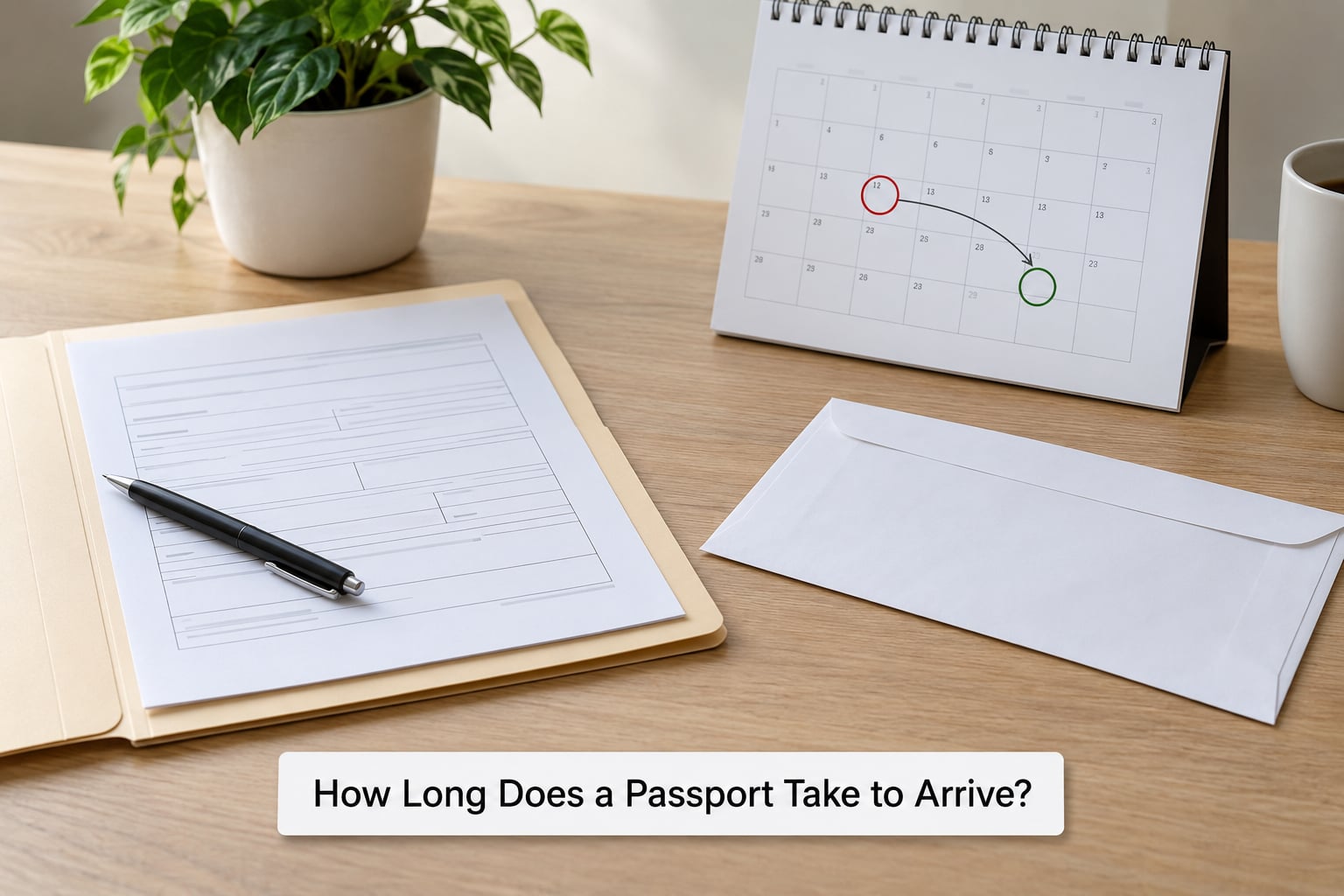
A routine US passport application takes 4 to 6 weeks to process, and you should plan on 6 to 8 weeks from the day you mail it to the day it lands in your mailbox. Expedited processing cuts the government-side time to 2 to 3 weeks, but the mailing legs stay the same. The fastest legitimate route is a regional passport agency appointment, which can issue a passport in as little as one to two days when you qualify and an appointment is available.
That is the whole answer. The confusion starts when people treat four separate steps as one number, so here they are broken out:
- Your application travels to the facility. Up to two weeks if you mail it yourself, less if you hand-deliver it.
- The application is received and accepted. Until this happens, nothing is being processed, and the status locator usually shows nothing at all.
- The Department of State reviews, decides and prints. This is the leg the official estimate actually measures, and it is 4 to 6 weeks for routine, 2 to 3 weeks for expedited.
- The finished passport is mailed back to you. Up to two weeks on ordinary delivery, or a few days on the faster shipping options you can select.
Here is how the four US service levels compare. Nothing in this table is a guarantee; all of it is an estimate published by the U.S. Department of State.
| Service level | Processing time | Mailing time | Realistic door-to-door | Who it is for |
|---|---|---|---|---|
| Routine | 4 to 6 weeks | Up to 2 weeks each way | 6 to 8 weeks | Anyone with three months or more before departure |
| Expedited processing | 2 to 3 weeks | Up to 2 weeks each way | 3 to 5 weeks | Travel booked 4 to 10 weeks out |
| Urgent travel agency appointment | Same day to a few days | Hand-carried, no mail leg | 1 to 2 days | International travel within 14 calendar days |
| Life-or-death emergency | Same day to a few days | Hand-carried | 1 to 2 days | Qualified emergency, proof required |
One caveat before you plan around that table. Expedited processing changes only the third leg. Your application still has to reach the facility and your passport still has to reach you, and both of those are measured in days and postal weeks, not in queue position.
What Processing Time Should You Expect?
Routine processing: 4 to 6 weeks of processing, not door to door
Routine is the default for eligible first-time applicants, mail-in renewals using form DS-82, and eligible online renewals. It carries no additional government fee, which is why most people start there and discover later that the date did not work.
The Department of State describes 4 to 6 weeks as a median estimate rather than a promise, and the practical reality is that the range is wider in both directions. Quiet periods run closer to the fast end. Summer travel season and the December holiday window are reliably slower, and one traveler on r/Passports applied on 14 December, paid for express shipping but not expedite, and still waited 20 days to receive a passport, blaming the holidays and counting roughly ten business days of actual processing once weekends were removed.
Expedited processing: 2 to 3 weeks, and what it does not cover
Expedited processing moves your application into a faster queue at the same facilities that handle routine work. You are buying queue position, not manpower. If you see a page claiming expedited takes five to seven weeks, that page is wrong about the current estimate.
What the extra fee does not do is shorten the trip your envelope makes. Travelers on the Rick Steves forum reported an expedited application that took 43 days end to end, with the shipping notification arriving separately and quoting its own two-week delivery window. Paid processing got the application moving; the mail still had its own schedule.
Urgent travel appointments: the 14 calendar day rule
If you have international travel scheduled within 14 calendar days, you can request an appointment at a regional passport agency. You must show proof of imminent international travel, usually a flight itinerary with your name and a departure date inside the window. Same-day or next-day issuance is possible in principle; in practice it depends on appointment availability and whether the facility is open.
This is the answer to what is considered urgent travel for a passport: a booked international trip inside two weeks, with the paperwork to prove it. Weddings, a funeral abroad, a sick relative, or military orders can also qualify under the emergency service, which is handled separately.
Passport cards and passport books can move on different clocks
A passport card is a smaller, limited-purpose document that cannot be used for international air travel. Adults normally get a 10 year passport book, children get 5 year books, and cards are issued on a shorter validity. If you need a book for a flight, the card is not a substitute and does not speed anything up. Book first, card second, if you need both.
What travelers actually reported, in their own words
These are anecdotal accounts posted to r/Passports, the Rick Steves community forum, Cruisecritic boards and the Tripadvisor air travel board. They are not official figures, they span several years, and they are included because they show the spread the published range hides.
| Scenario | Reported duration | Source and note |
|---|---|---|
| Online renewal, routine service | 6 business days | r/Passports, most recent report |
| Expedited processing, mailed Monday, delivered Friday | About 5 days | Tripadvisor air travel board; expedited processing only, ordinary shipping |
| Renewal with expedited processing | 7 days | r/Passports |
| Family of three, first-time applications, routine only | 8 days | r/Passports |
| Online renewal, expedited processing | 2 weeks | r/Passports |
| Online renewal, express shipping but no expedite, applied 14 December | 20 days | r/Passports; holiday period, shipped from Arizona |
| Renewal with expedited handling, 2023 | 43 days | community.ricksteves.com; six days short of a seven-week estimate |
| Online renewal, 2023 | 11 to 12 weeks | Cruisecritic boards, well beyond the published estimate |
| Routine processing, 2019 baseline across six users | 11 days to just under 6 weeks | Tripadvisor thread; summer renewal rush cited as the cause of longer waits |
The range runs from about five days to twelve weeks. The variables that explain most of it are season, whether expedite was actually paid for, and which processing facility handled the application. Nobody in those threads got a guarantee, and nobody who planned against the headline number alone felt protected by it.
How the Passport Processing Clock Works
A passport application is not a single transaction that starts and ends at one desk. Once you mail it, it moves through several facilities, and each handoff is a place where time can quietly accumulate.
The four legs of every passport timeline
First, the application reaches a passport acceptance facility. First-time applicants and anyone renewing with form DS-11 must appear in person at a participating post office, library or clerk of court; that appearance is the start of the clock, not the day you signed the form at home. Renewals by mail using form DS-82 skip the appointment and go straight out.
Second, the facility forwards it to a processing center. Eligibility, photo and fee are checked, and a locator number is issued. Applications can sit in this queue for a noticeable stretch, particularly during peak season.
Third, the Department of State adjudicates and prints. Citizenship evidence, identity, name history and any prior passport records are reviewed. Complex cases, name changes after marriage, and applications with questions about citizenship documents take longer here than clean renewals.
Fourth, the finished book is personalized and mailed back. Your shipping choice affects this leg, not the processing leg. That distinction trips up a lot of people who upgrade delivery and then wonder why nothing changed.
What each application status actually means
The status locator is where most applicants lose sleep, because the vocabulary is thin and the gaps are long.
- Nothing showing at all. Usually means the mail has not arrived yet or has arrived and not been keyed in. Days of silence here are normal, unfortunately.
- Application received. Your paperwork is in. Nothing has been printed and nothing has been decided.
- In process. A reviewer is working on it. This is where the 4 to 6 weeks, or 2 to 3 weeks, is actually spent.
- Printed and shipped. Printing is done. From here it is delivery time only, and your tracking number is the useful signal.
You can check status online with your locator number, or by phone through the National Passport Information Center. Readers report hold times of 40 minutes or more, so treat the phone line as a fallback rather than a monitoring tool.
Acceptance facility, passport agency, passport center
These three terms get used interchangeably and they are not the same thing. A passport acceptance facility is the local post office, library or clerk of court where you present identification, sign the form in front of an agent, and hand over citizenship evidence. It is the starting point only.
A passport agency is one of a small number of regional facilities that handle urgent travel appointments and, in some cases, same-day issuance. A passport center is a full processing facility that adjudicates and prints passports for a region. Your application ends up at a center regardless of which acceptance facility started it, and which center handles it occasionally shows up in how long things seem to sit.
How to Work Back From Your Flight Date

Count backward from departure using three numbers, then add a cushion. The three numbers are the current processing estimate for your chosen service level, the realistic inbound mail leg, and the realistic outbound mail leg. The cushion is a handful of days for something going wrong, and going wrong is common.
| Time until departure | Realistic path | What to watch |
|---|---|---|
| 90 days or more | Routine, mailed early | Comfortable even in a slow season |
| 60 to 90 days | Routine | Fine outside peak season, tight in summer and December |
| 30 to 60 days | Routine plus faster shipping, or expedited | Pay for expedited, and watch the photo rules closely |
| 14 to 30 days | Expedited only | Still not guaranteed, and mail legs eat into it |
| Under 14 days | Regional passport agency appointment | Requires proof of imminent international travel |
A worked example for a traveler leaving from the continental United States
Say you are departing from Seattle on a date eight weeks out. Eight weeks is 56 days. Routine processing alone is up to 42 days of that, and you still have mail in both directions, so routine is not the right call.
With expedited processing at up to 21 days, you have 35 days of margin. If you hand-deliver the application to an acceptance facility rather than mailing it, you remove the inbound leg entirely. If you take the faster return shipping option, the outbound leg shrinks to a few days rather than a couple of weeks. That combination puts you inside your date with a cushion, and it costs less than a courier and carries far less risk.
If you are departing from overseas, add much more. You are likely dealing with a visa process on top of the passport, and a visa appointment may require the passport book in hand before it can be issued. Work backward through both, not just the passport.
What to do when you are already behind schedule
Check the status locator first, because the answer changes what you do next. If it still shows nothing, your application probably has not been received yet and a call may confirm that. If it shows in process, expedited processing can sometimes be added by phone if your travel is within a qualifying window, and the request is worth making even though it is not always granted.
Next, look at whether a regional passport agency appointment is realistic. These are scarce, and the ones that release slots at short notice are the least reliable. Do not build a plan that depends on one appearing.
Finally, be honest about the booking. Once you know your passport will not arrive before departure, contact the airline about rebooking or holding, and check whether any travel insurance you bought covers cancellation for documentation reasons. Nine out of ten trips can be saved with a phone call; the ones that cannot are usually the ones where the fare was non-refundable and the deadline was guessed.
When to Choose Expedited or Urgent Service
Expedited and urgent are not two speeds of the same option. Expedited is a fee you attach to a normal application. Urgent is an appointment at a limited set of facilities, gated by a hard date and supporting documents.
Expedited processing: the middle option
Expedited makes sense when you have between roughly four and ten weeks, when the trip is booked but not imminent. It moves your application to the front of a queue, and it does nothing at all about the mail. Order of operations matters: pick the faster return shipping at the same time, or you will pay for speed you never receive.
Urgent travel: the hard 14-day threshold
International travel scheduled within 14 calendar days is the threshold for a regional passport agency appointment. The proof usually required is a flight itinerary showing your name and a departure date inside the window. Reservations without a date and a name do not qualify, and neither does a booking made after the fact to create the appearance of urgency.
This rule catches people out because the window is calendar days, not business days, and because the trip must be international. A domestic flight is not urgent travel, no matter how close it is.
Life-or-death emergency service
A separate emergency service exists for situations such as a death or serious illness abroad, a dying relative, or military deployment, and it requires a death certificate, physician letter, orders, or equivalent documentation. The same appointment system handles it. Expect to present original documents and to be turned away if they do not match the situation.
Why a private courier cannot beat the government clock
Private expediting services pre-review your paperwork, submit it, and track it. Some are authorized couriers, some are not, and the difference matters. What none of them can do is move a file through adjudication faster, because that queue belongs to the Department of State. A courier is useful when your real problem is a rejected photo or a wrong fee payee, and useless when your real problem is that you are applying 20 days before a flight.
Tips to Avoid Passport Delays
Almost every avoidable delay traces back to something that could have been checked at a kitchen table before the application went in the mail.
Use the current form version. Agencies reject outdated form editions, and a rejected application is returned to you, which adds weeks to both directions of the mail.
Sign the form in front of the acceptance agent if you are applying in person. A signature that was signed at home is a common rejection reason for DS-11 applications.
Get the photo right the first time. Photos are returned constantly, and each return costs time. The background must be plain white or off-white, which is why light gray, beige and white clothing is the trap people fall into. Dark, high-contrast clothing is the safe choice. Ask for two photos if you can afford the spare, because the second one is your insurance policy.
Check the fee payee and the amount before mailing. Fees go to specific entities and a payment to the wrong one is treated as no payment at all.
Send original citizenship evidence with tracking, and expect it back. A birth certificate sent without a photocopy or tracking plan is a genuine risk to that document.
Remember what renewal does to your old passport. Renewing by mail cancels the old book and returns it, often with a hole punched through the cover. Any valid visas inside it are cancelled with it and may need to be transferred or reissued, which is a separate process with its own lead time.
Do not wait for the six-month rule to surprise you. A large number of countries require six months of remaining validity beyond your arrival date, plus a blank page. That rule changes when you need to renew, independent of how long processing takes. If your passport is close to expiry, the clock starts earlier than most people think.
Do not book non-refundable travel until the passport and any required visas are in hand. Everything else on this list is a mitigation. This one is the fix.
Frequently Asked Questions
What is the quickest I can get a passport?
A regional passport agency appointment is the fastest legitimate route, and same-day to one or two day issuance is possible when you qualify. You need international travel within 14 calendar days plus proof, usually a flight itinerary. Life-or-death emergencies use a separate service. No private company can issue a passport faster than the government can.
How long is the current wait for a US passport?
Routine processing is currently estimated at 4 to 6 weeks and expedited at 2 to 3 weeks. Add up to two weeks for your application to reach the facility and up to two weeks for the printed passport to reach you, which puts routine at 6 to 8 weeks door to door. Figures are current as of this article and can shift, so confirm on travel.state.gov.
How long does it realistically take to get your passport?
Reported outcomes span roughly five days to twelve weeks. The published routine estimate is a median rather than a promise, and the spread comes down to season, whether expedite was actually paid for, and which processing facility handled the file. The most common reason people get caught short is forgetting that the mailing legs are not included.
What’s the difference between routine and expedited passport service?
Routine takes 4 to 6 weeks and carries no extra government fee. Expedited takes 2 to 3 weeks and costs more, but only moves your application to a faster queue at the same Department of State facilities. Neither includes mailing time in either direction, so faster return shipping is a separate decision you make at the same time.
What is considered urgent travel for a passport?
International travel scheduled within 14 calendar days qualifies you to request a regional passport agency appointment. You must show proof of imminent international travel, typically a flight itinerary carrying your name and a departure date inside the window. The deadline is calendar days rather than business days, and a domestic flight does not count.
What is the one color you should not wear in a passport photo?
The background must be plain white or off-white, so avoid light gray, beige and white clothing that blends into it. Dark, high-contrast tops are the safest choice. This matters for timing because a returned photo costs a full rejection cycle, and photos are one of the most common reasons an application is sent back.
Start by picking your real departure date and counting backward with the mail legs included, not just the processing estimate. If that math leaves you under eight weeks, pay for expedited processing and faster return shipping on the same day you submit. And hold off on flights you cannot change until the book is actually in your hands.