Groceries in Hawaii cost roughly 30% to 50% more than the U.S. mainland, and about 90% of the food consumed in the islands is imported. Hawaii grocery prices are the single most common budget surprise on a trip, mostly because visitors plan restaurant meals carefully and then pick up a week of snacks, water and breakfasts without a plan. This guide covers Hawaii grocery prices and how to eat cheap on vacation: what a basket actually costs, which stores keep the gap smallest, and how to build a week of meals from a handful of inexpensive staples. Prices checked October 2026.
Two things make Hawaii different from the mainland. Nearly everything on the shelf crossed an ocean, and the islands have a small population that cannot support mainland-scale pricing. Understanding those two facts is what turns a sticker-shock trip into a trip where food costs about what you planned.
Table of Contents
- Hawaii Grocery Prices and How to Eat Cheap on Vacation: What a Basket Costs
- What Hawaii Grocery Price Differences Mean for Your Budget
- Where the gap is widest and where it barely exists
- Island-by-island price differences
- Turning a price gap into a per-day number
- Grocery Store Types That Can Help You Save
- Easy Low-Cost Meals for a Hawaii Vacation
- Breakfasts you can eat standing up
- Lunches that survive a beach bag
- Dinners from five staples
- Food safety in a warm kitchen
- Ways to Save on Hawaii Groceries and Food
- Frequently Asked Questions
- Are groceries in Hawaii cheaper than eating out for most visitors?
- Which Hawaii island usually has the lowest grocery prices?
- Are farmers markets and local markets actually cheaper for tourists?
- Which foods are most expensive in Hawaii grocery stores?
- How much should I budget for groceries for a week in Hawaii?
- Conclusion
Hawaii Grocery Prices and How to Eat Cheap on Vacation: What a Basket Costs
The cleanest yardstick is the C2ER Grocery Price Index, which puts Hawaii at the top of the list for grocery costs in the US, running about 31% above the national average. On that index, a basket that costs about $92 in the comparison market runs roughly $130 in Hawaii. Most visitors recognize this immediately: a single cucumber at a Hawaii Walmart has been reported at around $4, and cereal receipts from Honolulu stores are a running joke in the local subreddits.
Here is what the everyday items look like, based on ranges shoppers report for Hawaii stores:
| Staple | Typical Hawaii price | What mainland shoppers often pay |
|---|---|---|
| Milk, per gallon | About $6 to $9 | About $3 to $5 |
| Eggs, per dozen | About $6 to $11 | About $3 to $6 |
| Loaf of bread | About $5 to $10 | About $3 to $5 |
| Chicken breast, per pound | About $5.79 to $8.49 | About $4 to $6 |
| Ground beef, per pound | About $8.99 and up | About $5 to $7 |
| Bag of rice, 5 to 20 lb | About $10 to $30 | About $4 to $12 |
| Coffee, 12 to 16 oz | About $12 to $20 | About $5 to $12 |
| Local produce, per item | About $1 to $4 each | About $1 to $3 each |
For one person on a week-long trip, a realistic food budget works out to roughly $160 to $220 total if you mix grocery breakfasts and lunches with a few casual dinners. That is about $25 to $35 per person per day, which matches what most travelers report succeeding on. It also fits in a week for a couple or a family, because the big-ticket items are portable and shareable.
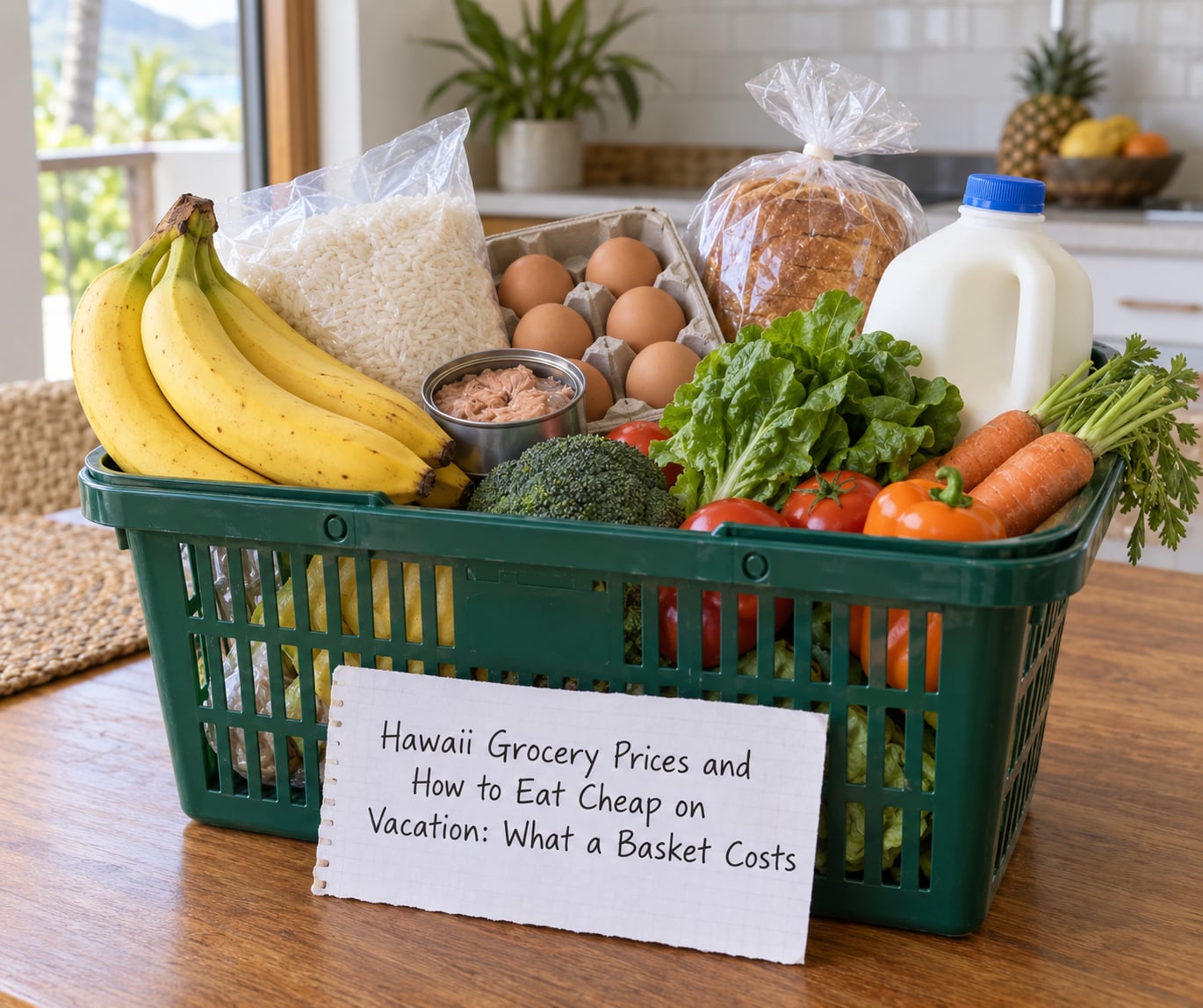
The list itself is short because a vacation basket is not a household basket. Tuna, rice, tortillas, beans, eggs, bananas, bread, milk and a rotisserie chicken will cover most of a week for two people. Everything else is a decision, not a necessity.
What Hawaii Grocery Price Differences Mean for Your Budget
The markup is a supply chain story, and once you understand it you stop treating individual items as random. The Jones Act requires goods shipped between US points to move on US-flagged vessels, which limits the carriers available to Hawaii routes. Food then travels by barge or by air, arrives in small quantities, and gets split across a retail market with a fraction of the volume a mainland chain moves. Every one of those steps adds cost to the shelf tag.
Where the gap is widest and where it barely exists
Imported and specialty items carry the steepest markup. Anything with a mainland brand, a specific flavor or a long ingredient list inherits the freight cost twice. Fresh produce can be wild in either direction, since local items like papayas, bananas and sweet potato can be cheap while out-of-season mainland items arrive refrigerated and expensive. Alcohol is a consistent drain, on top of state laws that make drinking on any Hawaii beach a ticketable offense.
Store brand versions of milk, rice, tortillas, canned beans and cereal are the quietest savings on the shelf. The freight cost is baked into the brand you did not ask for, and a no-name gallon is usually a few dollars less than the name it mimics.
Island-by-island price differences
Honolulu is not the whole story. Each island has a different set of chains, and rural areas pay more for the same basket because the freight leg is longer and the shelf space is smaller.
| Island | Cheapest options | What to expect |
|---|---|---|
| Oahu | Costco, Walmart, Foodland, Don Quijote, 7-Eleven | Most competition and the widest chain selection; island markup still applies everywhere |
| Maui | Costco, Foodland, Safeway, local independents | Fewer big-box options, so independent grocers carry more of the load |
| Big Island | Costco, Safeway, Foodland, Hilo-area stores | Cheapest potential basket if you shop away from resort areas, weakest selection in Kona resort zones |
| Kauai | Costco, Safeway, Foodland, local markets | Smallest market on the chain list, so the gap between stores is narrow and the prices are high |
Honolulu Walmart prices have been measured at about 14% above Los Angeles for a comparable grocery list, which is the clearest single illustration of the problem. Shopping the cheapest mainland chain still leaves a real island premium.
Turning a price gap into a per-day number
Take a seven-day trip for two people, mixed approach. Spend about $95 on one grocery run covering breakfasts, lunches, snacks, water and two dinners. Add five plate lunches at roughly $11 each, two casual dinners out at about $20 per person, and a few breakfast counters at $6 each. That lands near $300 for the week, or roughly $43 per person per day, and it covers every meal without cooking more than twice.
That math is the point. Hawaii food cost is not decided by the price of a single item, it is decided by how many meals you take off the restaurant tab.
Grocery Store Types That Can Help You Save
Different store formats carry different price tiers and different rules. Knowing which one you are standing in saves more than clipping any coupon.
| Store type | Price tier | Best for | Watch out for |
|---|---|---|---|
| Warehouse club | Lowest | Families, longer stays, bulk basics like rice, meat, paper goods | Membership fee, bulk sizes, bulk packaging wipes food in a vacation rental fridge |
| Discount supermarket | Low to mid | Mainland brand items at near-mainland pricing, one-stop shopping | Still about 14% above mainland pricing; produce can still surprise you |
| Neighborhood supermarket | Mid to high | Convenience, local produce, a single item you did not plan for | Resort-area stores and higher-traffic locations cost noticeably more |
| Asian market | Mid, item-specific | Rice, fish sauce, tofu, dried goods, specialty ingredients used in local cooking | Value depends entirely on the item; not a general grocery substitute |
| Farmers market | Low for produce | Produce you will eat fresh, specialty items, prepared foods at stalls | Cash, early hours, no packaged goods, and prices are not low on everything |
| Convenience store | Highest | One emergency item, water, a cooler, gas station snacks near town | Snacks add up fast across a week; ABC Stores are the local version of this |
Community consensus across Hawaii travel forums is consistent: Costco is the default answer, with Foodland and Safeway as the fallback. A Maui forum post put it plainly, noting that Costco carries a good amount of Hawaii-grown produce and that prices are best there. The caveats that come up in the same threads are worth remembering too. Pali Safeway comes up often as an unpleasant shopping experience, and Foodland Ala Moana is perceived as overpriced, so location matters as much as the banner on the building.
Bulk buying is the trap. A warehouse club’s price per unit is genuinely lower, and it is still wasted money if the extra bag of rice sits in a rental kitchenette for six days and goes in the bin. Buy big only what two people can finish before the checkout date.
Grocery pickup and delivery apps need their own line in the budget. Instacart and similar services add a service fee, a delivery fee and a tip on top of the shelf price, and Hawaii shoppers post about that surcharge constantly. For a vacation-length shop of twenty items, walking in is almost always cheaper than paying for the convenience.
Easy Low-Cost Meals for a Hawaii Vacation
This is a framework, not a recipe roundup. The meals below are built from five or six staples that survive a trip, need one pot, and work in a room with a sink.
Breakfasts you can eat standing up
Overnight oats, a banana and a hard-boiled egg runs about $3. Yogurt, granola and fruit lands around $5 and keeps for hours in a cooler bag. A bagel with store-brand cream cheese is roughly $4. All three need no kitchen beyond a spoon, which is the point when you are paying resort rates for a room with two cups and a mini-fridge.
Lunches that survive a beach bag
A tortilla wrap with canned tuna, store-brand mayo and shredded baged slaw is about $4 to $5. A peanut butter and jelly sandwich with fruit is closer to $3. A container of leftover rice with canned beans reheated in a microwave is about $3.50. These are the meals that keep a family of four under $20 a day without anyone feeling punished.
Dinners from five staples
A rotisserie chicken is the single best value locals and visitors mention, and a whole one feeds two to three people. Add rice, a bagged salad, tortillas and a jar of sauce, and dinner costs about $14 for three. Tacos with canned fish, a taco kit and shredded cabbage run about $12 for four. A boxed take-and-bake pizza with a salad is about $9 for two. Vegetarian version: rice, canned beans, a can of diced tomatoes and shredded cheese, about $10 for four, ready in one pot.
Hot shrimp and garlic from a food truck is the best splurge-adjacent dinner under about $15. Shave ice runs a few dollars and is the cheapest dessert in the state.
Food safety in a warm kitchen
Heat is the thing that ruins a cheap food plan. Keep seafood and raw meat at or below 40°F in a cooler with ice, and cook poultry to 165°F (74°C), ground meat to 160°F (71°C), and whole cuts and fish to 145°F (63°C). Refrigerate leftovers within two hours, and plan to eat refrigerated ready-to-eat food within three or four days of purchase. Buying smaller packs more often beats one large pack you cannot keep cold.
Ways to Save on Hawaii Groceries and Food
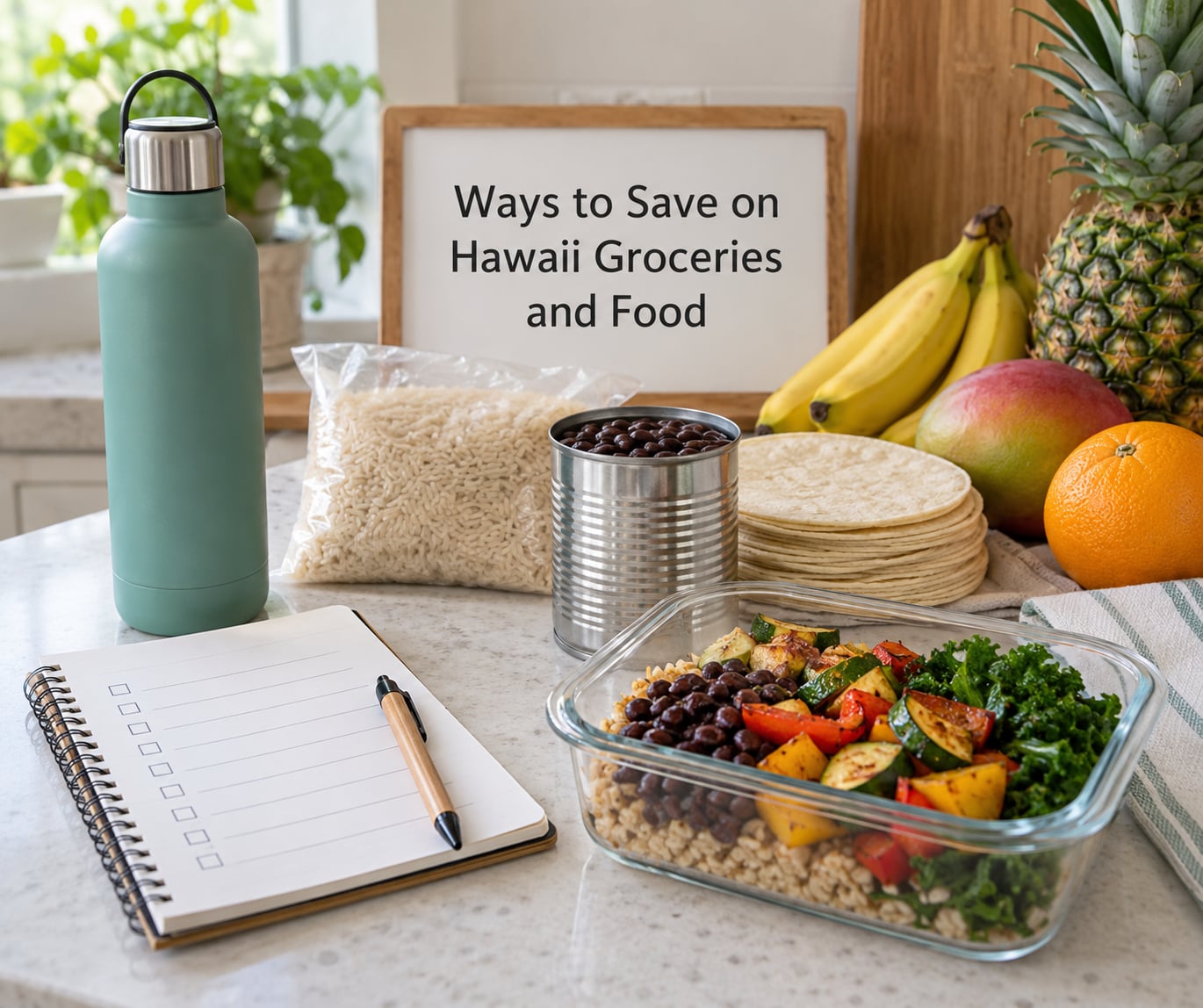
These are ordered by how much they reliably return. The reliable ones first, the ones that can backfire last.
- Set a daily number and shop once. Pick a per-person, per-day figure and buy groceries for the whole stay in a single trip. Multiple small shops on the same island are the most expensive way to buy the same items.
- Price one basket at two stores. Compare a discount supermarket with a neighborhood store on the way from your lodging. Members of the Hawaii community consistently rank warehouse clubs lowest, so if a club is practical for you, start there.
- Switch to store brands for milk, rice, tortillas, beans and cereal. This is the simplest change on the list and it applies to the four or five items you will buy every trip.
- Build meals around a few inexpensive staples first. Rice, tortillas, canned tuna, canned beans and eggs handle more meals per dollar than almost anything else you can carry.
- Buy larger packages only when they get eaten. Bulk pricing is real; waste at a rental fridge is also real. Check your mini-fridge shelf space before you buy.
- Skip delivery and use pickup where it exists. Fees, service charges and tips turn a modest shop into a pricey one.
- Keep water and coffee out of convenience stores. Buying a case at the supermarket and refilling a bottle each morning is the cheapest fix in this list.
- Cut back on alcohol and resort-area impulse buys. Both are where vacation food budgets quietly break, and both are optional.
- Balance groceries with cheap local meals. A plate lunch is a two-article meal, typically around $8 to $12. Dollar menus, shave ice and happy hour pricing fill the gaps a cooking-free trip needs.
- Use farmers markets for produce, not for the whole shop. Markets like KCC, Kailua and Hilo are good for fresh items and prepared stall food. Come early, bring cash, and do not plan a full grocery run around them.
Two of these create waste if you get them wrong. Bulk buying and market shopping both save money only when the extra volume matches what your group actually eats in the time you are there.
Frequently Asked Questions
Are groceries in Hawaii cheaper than eating out for most visitors?
Usually for breakfast and lunch, and it depends on the day of the week. Grocery breakfasts and lunches typically run $3 to $6 a meal per person, while a sit-down breakfast runs $10 to $20. Cooking every dinner saves more but costs time, and a plate lunch is hard to beat for a no-cook day. If your room has no kitchen, cook three or four meals and cover the rest with plate lunches.
Which Hawaii island usually has the lowest grocery prices?
The Big Island usually has the lowest potential basket, mostly because you can shop away from resort zones where the selection is thin and the markups are high. Oahu has the most competition and the widest range of chains, which usually keeps the big-box prices competitive. Kauai has the smallest market, so the gap between stores is narrow and every option sits high. Shop where you can, not where the hotel is.
Are farmers markets and local markets actually cheaper for tourists?
For produce and prepared stall food, yes, often enough to be worth a stop. For a full grocery run, no. Markets such as KCC, Kailua and Hilo are strongest on fresh fruit, vegetables and ready-to-eat stalls, and weakest on pantry basics, dairy and packaged snacks. Arrive early, bring cash, and treat the market as a supplement to one supermarket trip rather than a replacement for it.
Which foods are most expensive in Hawaii grocery stores?
Imported and specialty items come first: specific brands, imported cheese, specialty sauce, and anything with a long ingredient list shipped from the mainland. Dairy, eggs and bread also run well above mainland pricing, with a gallon of milk often landing between $6 and $9. Alcohol carries a heavy markup on top of that. Produce is the wildcard, since locally grown fruit can be cheap while off-season items arrive expensive.
How much should I budget for groceries for a week in Hawaii?
About $160 to $220 for one person on a self-catering week, or roughly $25 to $35 per day when you mix in casual meals out. That range is what most people settle on once they plan Hawaii grocery prices and how to eat cheap on vacation before they fly. A couple lands near $200 to $280, and a family of four closer to $400 to $550.
Conclusion
Start with one number. Pick your per-person daily food budget, then price one real basket at a discount supermarket and one at a nearby neighborhood store. That comparison takes fifteen minutes and tells you more than any generic list of tips.
From there, build the week around a handful of inexpensive staples, shop once, and spend the meals you do not cook on plate lunches rather than full restaurants. Hawaii grocery prices stay high no matter what you do, but the gap between a planned food budget and an unplanned one is entirely under your control.
Prices change, and they change by island, neighborhood, store and week. Current local listings and a receipt from the store you plan to use are the best verification before a major purchase.