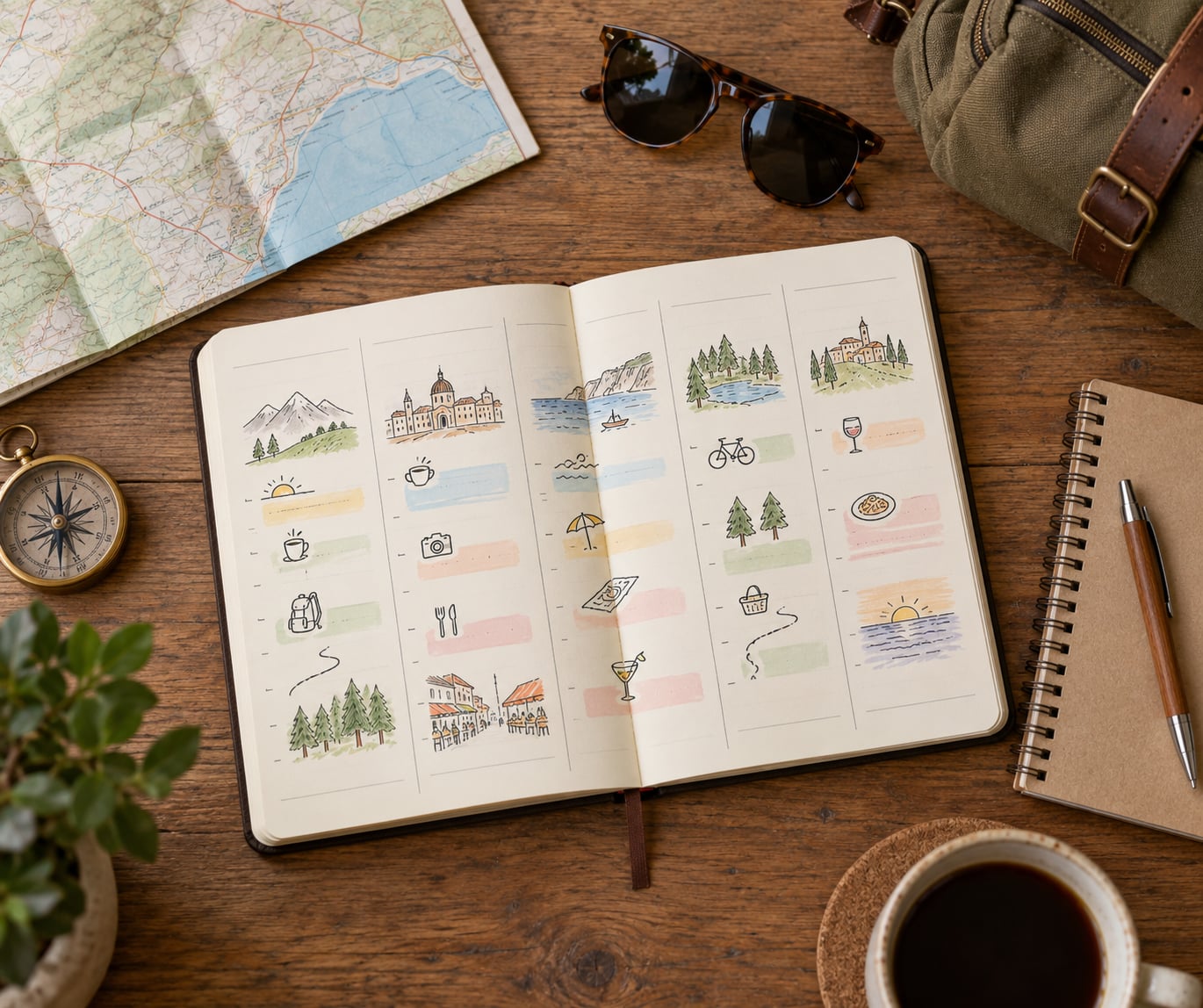
To build a realistic daily vacation itinerary, give each day one anchor activity, add honest travel time between stops, and leave room for meals, rest, and delays. That is the whole trick. Most blown-out itineraries were built as a list of attraction names, so they ignore the boring parts of a day that eat it: transit, waiting, walking, and the fact that you are human by hour six.
A realistic day is not an ambitious day. It is a day where you finish it glad you went. I’ve watched people with eight-item itineraries spend the whole afternoon in a queue and never see the neighborhood two streets away, while a friend with three items walks home happy. Here is the method I use when I plan a multi-day trip.
Table of Contents
What You Need Before You Build the Day
You need real logistics for every candidate activity, not just its name. An itinerary built on attraction names alone is fiction, because the name tells you nothing about how long the visit takes or how far it is from your hotel.
Gather these before you schedule anything:
- Opening days and hours for every site, including the last entry time. Many museums close on one weekday and stop selling tickets before closing.
- Real transit and walking times from where you will actually start, usually your accommodation, not the airport or the city center.
- Reservation rules for anything with timed entry, plus how far ahead it books out.
- Typical visit length, taken from recent traveler reports rather than the marketing page, which always sounds quick.
- One or two meal options near each anchor, since finding lunch near a timed entry is where days fall apart.
- Accessibility details if anyone in the group has mobility needs: step-free routes, elevator availability, and how much ground a site covers.
- Your honest energy limit on a normal day, not your best day.
The last one matters most and gets skipped. Write down what a full day actually looks like for you at home, because a vacation day with transit and crowds costs more than a workday does. Planning for an idealized version of yourself is how day three turns into a nap in a hotel lobby.
Step-by-Step: Build a Realistic Daily Vacation Itinerary
Step 1: Choose Three Priorities for the Day
Limit each day to one main attraction, one secondary experience, and one flexible slot for a meal or a walk. Three is not arbitrary. It leaves room for the unknown without turning the day into a waiting room.
Your anchor is the thing you would regret missing. Your secondary is good but substitutable. Your flexible slot is the shock absorber: a market, a long lunch, a coffee stop, or a detour you spotted that morning. A typical setup looks like a landmark in the morning, a neighborhood walk near it in the afternoon, and an unstructured dinner stop wherever you land.
You can tell the day is balanced when you can name three things without opening your notes app. If you need a list of nine, you are describing a wish list, not a day.
Step 2: Map the Day by Geography
Put every candidate activity on a map first, then decide the order, not the other way around. Sequencing before mapping is what creates days where you cross the same city twice and spend an hour in transit for a fifteen-minute walk.
Pick the day’s geographic anchor, usually your main attraction, and pull everything else within a short radius of it. A workable example: the museum opens at ten, so it anchors the morning. The park behind the museum is a natural second stop because you are already there. Lunch is a ten-minute walk from the park, not a tram ride across town. The evening district is chosen last and only because it is on the way back toward your accommodation.
That single layout removes about forty minutes of pointless transit and makes the whole day feel calmer, even though nothing changed but the order.
Step 3: Add Travel Time Between Activities
Add the travel block before you add the activity, and never use the raw mapped estimate. Take the transit or walking time the map gives you, then add 25 to 50 percent for a first visit, because you will be finding the entrance, dealing with parking or a ticket gate, using a restroom, and walking further than you think.
Worked example: the map says 32 minutes from your hotel to the museum. Add 30 percent and you have about 42 minutes door to door. Add parking and a stop at the entrance and a realistic block is 50 to 55 minutes. Scheduling the museum at ten with a 55-minute block means you leave at 9:05, not 9:30.
Airports, trains, and ferries need more. Include the trip to the station, bag drop or bag collection, security, and boarding time. Forum travelers repeat one warning more than any other: transit estimates that look fine on a screen are consistently short on the ground, especially during rush hours or with luggage.
Step 4: Add Meals, Rest, and Recovery Time
Unscheduled time is what makes a daily vacation schedule realistic. Leave breakfast unhurried, book lunch near where you already are, and protect at least one low-effort block between two demanding things.
Compare two versions of the same afternoon. The rushed version: museum until 14:00, tram at 14:15, viewpoint at 15:00, gallery at 16:30, dinner reservation at 19:00 with a 40-minute transfer. The realistic version: museum until 14:00, a sit-down lunch at 14:20 that runs to 15:30, a flat walk through the park, then an hour of nothing before an early dinner nearby.
Same city, same sights, one version leaves you tired and slightly resentful, the other leaves you with an actual memory. Carry water and plan an evening wind-down, because the hours after dinner are when people decide the whole trip went well.
Step 5: Check Reservations, Hours, and Current Conditions
Verify the day on official sources shortly before you go, not from memory of a blog post you read months ago. Closing days, last-entry times, timed ticket rules, and transit disruptions all change, and a schedule built on stale hours is worse than no schedule.
Check the items that quietly break days: whether a site is closed on the day you picked, whether entry requires a timed slot, whether your reservation is refundable, whether transit lines are running reduced service during your window, what the weather is actually forecast to do, and whether a local event will crowd the district you planned to eat in. Check accessibility details too, since step-free routes and elevator details are not always published clearly and are much easier to confirm before arrival.
Never build a day around opening hours you did not look up. Guessing is the single easiest way to spend a day standing outside a locked gate.
Step 6: Create a Flexible Backup Plan
Prepare one nearby alternative for each anchor activity, written down before you leave. The replacement should match the original on area, time of day, and energy level, so swapping it in costs you nothing but a walk.
Match the five things: same neighborhood or a short ride, same indoor or outdoor feel in case that is the issue, similar duration, similar cost level, and the same general interest. An indoor museum can swap for another indoor museum. A market walk can swap for a different market. A scenic ridge hike with no equivalent on a rainy day is a bad anchor, which is worth knowing before you commit to it.
Keep the list short and written somewhere you can reach without a signal. Backups fail when you have to research them at the moment you need them.
Common Mistakes That Make Vacation Days Overpacked
Nearly every overpacked day comes from one of a handful of habits. Here are the ones I see most, and the fix for each.
- Scheduling attractions back-to-back. Every stop feels free in the abstract, but each one costs transition time. Fix: leave at least one clear block between consecutive activities, and treat the first hour of the day as travel and settling in, not sightseeing.
- Ignoring what happens outside the attraction. Entry queues, coat checks, security, and gift shops are part of the visit. Fix: add 20 to 30 minutes of overhead to any large site and check whether timed entry means queueing.
- Pairing distant stops on the same day. Two great things three hours apart is not a full day. Fix: cluster by area and accept one of them on another day.
- Skipping meals. No one plans a lunch and then spends an hour wandering looking for it. Fix: name the meal, name the location, and put it on the schedule like any other activity.
- Treating every hour as productive. A day with no gaps produces a person who stops enjoying it by evening. Fix: keep roughly a quarter of the day unplanned and treat that as part of the trip, not wasted time.
- Planning for the weather and your stamina you do not have. A full outdoor day is a bad bet in an unfamiliar climate, and day four of a trip is not day one. Fix: build one indoor anchor per day and leave the second half of each day lighter than the first.
One habit fixes most of the others: write the itinerary, then cut one item. Almost nothing is missed, and you get the walk back.
Frequently Asked Questions
How many activities should I schedule in one day?
For most trips, two is a good target and three is the ceiling: one anchor attraction, one secondary experience, and one flexible slot for a meal or a walk. Beyond that, transit time starts eating your day and the later items get rushed. If you are touring a city where everything is compact, three scheduled activities plus a meal can work. If you are moving between distant stops, keep it to one anchor and let the rest float.
How much time should I leave between places?
Take the mapped transit or walking time and add 25 to 50 percent for a first visit, then add ten to fifteen minutes for parking, finding the entrance, a restroom, or a ticket gate. A 30-minute mapped trip usually costs 45 minutes in practice. For airports, trains, and ferries, add the trip to the station, security, and boarding time on top. If a day has three transfers, build five to ten extra minutes per transfer.
How do I plan a vacation day for bad weather?
Give every day one indoor anchor that holds up in rain, and keep outdoor time for the morning when forecasts are most reliable. Carry the backup list you wrote before departure so you can swap activities without researching on the spot. Replace an outdoor stop with something in the same neighborhood, roughly the same length, with a similar feel. Check the forecast the night before and the morning of, then adjust rather than cancel.
How do I build an itinerary with kids or limited mobility?
Plan around energy limits rather than opening hours: one demanding activity per half-day, with a rest block between. Confirm step-free routes, elevator availability, and restroom locations before you go, since these are not always published clearly. Allow more transition time because strollers, wheelchairs, and children slow every move. Shorter days beat ambitious ones with small travelers, and a hotel pool afternoon can be a scheduled activity rather than lost time.
What do I do when a reservation is cancelled or sold out?
Check the cancellation email or booking page first, because released timed slots often reappear a few hours later or the morning of. Then work down your backup list in order, matching the original on area, duration, and cost level. Ask the venue about standby or waitlist options. If nothing works, keep the structure of the day and swap the anchor for something already nearby rather than rebuilding the whole day around one missing booking.
Start tonight with three things: pick tomorrow’s anchor, look up its real hours and entry rules, then write the travel block before the activity. Once one day looks realistic, build the rest the same way, and your vacation itinerary will feel completely different by day two.