You cannot make peak season quiet, and anyone who promises that is selling something. What you can do is change your relationship to the crowds: move your trip by three or four days, see the headline sights in the first and last third of the day, keep one famous stop from sitting directly next to another, and book the few things that actually have a ceiling on capacity before they fill. This guide walks through how to travel during peak season without crowds, in the order you need to act.
Most of it takes less than an hour of planning. The parts that matter most, though, are the boring ones: dates and bookings. Do those first and everything after gets easier.
Table of Contents
- What you need to travel during peak season without crowds
- Step-by-Step: a low-crowd plan you can copy
- Common mistakes that make peak season worse
- Frequently Asked Questions
- How do I avoid crowds while travelling during peak season?
- Is it better to travel on weekdays or weekends during peak season?
- Should I book attractions and transport in advance?
- What is the best way to find quieter travel times?
- How can I handle unexpected crowds during a trip?
- Does staying outside the city centre really help avoid crowds?
- Start with your dates
What you need to travel during peak season without crowds
Most crowd problems are decided before you land, not on the ground. These four things do most of the work.
- Flexible dates, even by a few days. Friday-to-Sunday travel inside a holiday week can be double the demand of a Tuesday-to-Thursday trip in the same week. Flexibility is the single biggest lever you have, and it costs nothing if you own your calendar.
- Confirmed bookings for anything with a capacity limit. Flights, accommodation, trains and ferries with seat reservations, airport transfers, and the two or three experiences you would be genuinely upset to miss.
- Local knowledge of your exact dates. Event calendars, attraction opening and timed-entry rules, and the port or station arrival schedule if your destination receives them.
- An offline copy of the practical stuff. Maps, tickets, reservation confirmations, and the address and phone number of your accommodation saved on your phone, because mobile data and phone signal are the first things to fail when thousands of people arrive at once.
A note on tickets: timed entry does not mean a quiet visit. It means a shorter, more predictable queue and a guaranteed slot. Both are still worth having, but plan the rest of the day as if the place will be busy.
Step-by-Step: a low-crowd plan you can copy
Choose quieter travel dates and times to avoid crowds during peak season
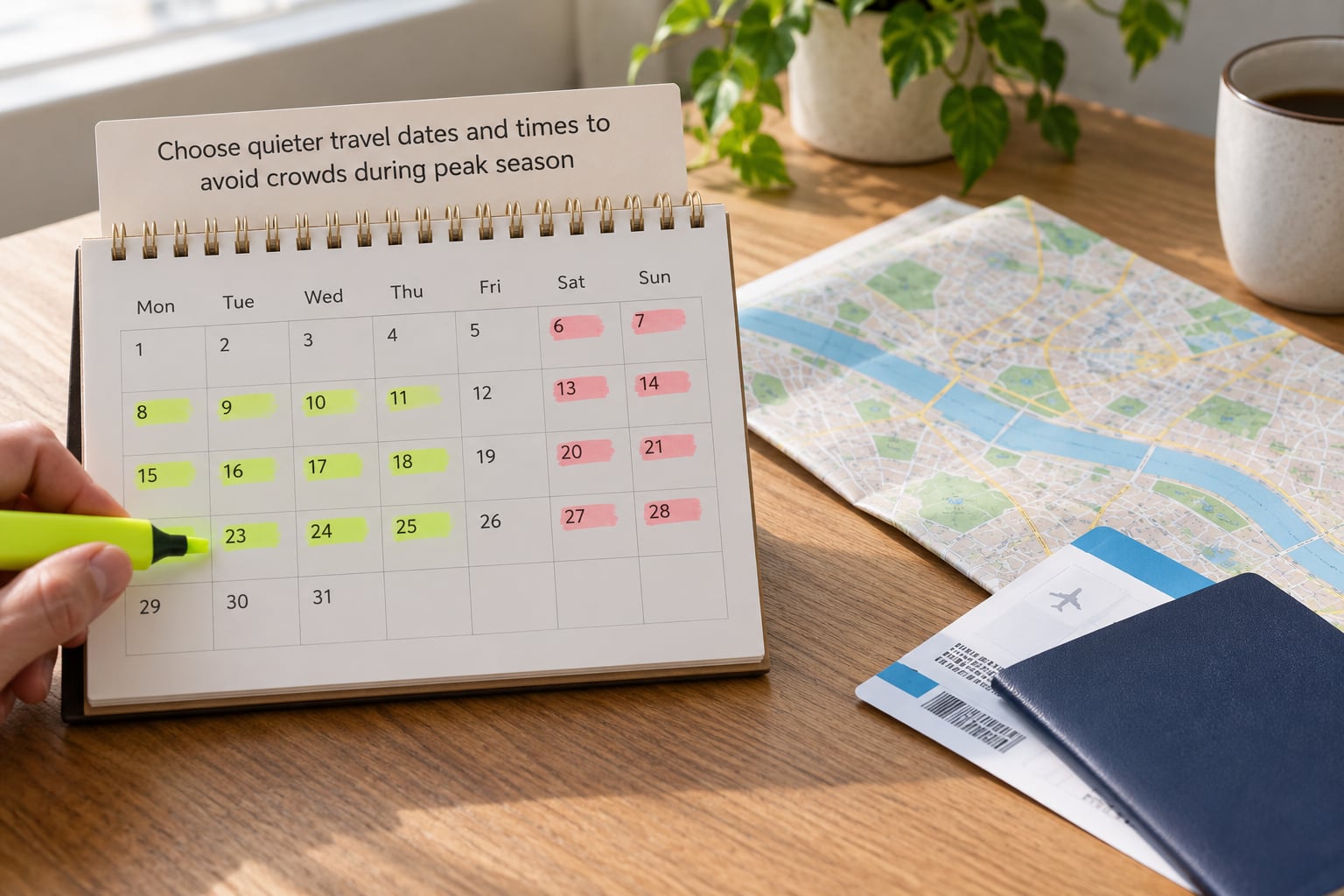
Start by comparing a few date sets instead of committing to the first one that works. Look at the days either side of any weekend, any public holiday and any school holiday block, because the busiest stretch is rarely the week people assume.
In practice, moving from a Saturday arrival to a Wednesday arrival often does more than any other single change you can make. It shifts your airport arrival, your hotel check-in queue, your first attraction visit and your restaurant bookings all at once, without you losing a single day of the trip.
Then fix the shape of your days. Decide before you fly which sights sit in the morning block and which sit in the late afternoon block, and protect the middle of the day for something indoors, shaded or seated. That single habit is what separates a comfortable peak-season trip from an exhausting one.
How do you know it worked? Check the arrival pattern on the evening you land. If the airport queue moves without stalling, and the walk from your accommodation to dinner is calm rather than compressed, your timing landed well.
Book the essential parts early, in the right order
There is an order to this, and getting it wrong wastes money. Book in this sequence:
- Flights and long-distance transport first. These set the dates everything else has to fit around.
- Accommodation next, with a free-cancellation window where possible, so you can still shift the rest of the plan without losing the booking.
- Anything with a hard capacity ceiling — timed-entry attractions, guided tours with limited group sizes, booked restaurants.
- Airport transfers, parking and rail or ferry seat reservations. These are cheap to hold and painful to leave until the last day.
- Everything else, when it appears.
Read the cancellation terms at step two, not after. A non-refundable rate protects the price but traps your dates, and a trip you cannot move is often less enjoyable than a slightly pricier one you can.
Use transport to avoid the busiest hubs
Crowds concentrate at nodes, and nodes are easy to route around. Staying a few stops outside the tourist core, or one suburb out, means your daily travel passes through quieter stations and platforms instead of the main concourse during the rush.
Off-peak departures matter more than people expect. A train at a quiet hour empties a platform; the same train forty minutes later arrives with it full. If you have a choice between two arrival times, take the awkward one.
At airports, build in more slack than you think you need for the first and last days of the holiday period, when queues at check-in, security and baggage reclaim are longest. Departing the night before a morning flight, or arriving a day early, removes the single most stressful queue of the trip for very little cost.
Visit flexible attractions at off-peak hours
The pattern is simple: the first hour after opening and the last two hours before closing hold the fewest people, and the hours around midday hold the most.
Two habits make this work. Be at the entrance early rather than aiming for opening, since arrival queues often form before the doors open. And leave the big sight in the late block instead of the morning block, so the midday heat and the tour-group wave both pass while you are indoors eating lunch.
Keep a second, quieter option booked or noted for each headline stop. Not a backup for disappointment — a genuine second choice, like a smaller viewpoint, a side museum or a long lunch in a residential quarter, so you can pivot without losing an hour to research.
Pack and plan for a smoother day
Pack as if queues will happen, because they will. Comfortable shoes, a refillable bottle, a small snack, a light layer for cold indoor spaces, and identification and documents that are in one place rather than spread across four pockets.
Save everything offline: the map, the day’s tickets, the confirmation emails, and the address of your accommodation in the local language. Then check crowd conditions once in the morning and once before you leave for the evening, using the local tourism office’s notices or a crowd data layer, and adjust rather than abandon.
And slow down. Rushing between four attractions in one afternoon makes crowds feel worse, not better, because you spend the whole time queueing and none of it looking at anything.
Common mistakes that make peak season worse
Booking everything at one moment. If you book flights, hotel, tours and dinner in a single evening, one late release date and your entire week collapses. Space the bookings out and check the cancellation window each time.
Relying on one attraction per day. If the day depends entirely on one booking, rain, a closure or a delayed ticket ruins it. Pair every headline stop with something low-stakes nearby.
Arriving at the busiest possible moment. Landing on the same day as a major event, or checking in at the height of the afternoon rush, front-loads the trip with congestion. Arrive the day before where you can.
Treating a reservation as a guarantee of quiet. Timed entry controls entry, not atmosphere. On the busiest days a reserved slot can still be inside a packed building.
Scheduling every hour. The most common complaint from experienced travellers is that over-planning turns a busy week into a stressful one. Leave two unplanned blocks a day.
Eating at peak hours. Reserve, or arrive at opening or after the dinner rush. A table booked for 19:00 and an early booking for 18:00 are the difference between an evening you enjoy and one you queue for.
Assuming weekdays solve everything. Weekdays help at sights and hotels, but during school holidays and public holiday weeks the difference narrows sharply. Check the specific holiday calendar for your destination.
Frequently Asked Questions
How do I avoid crowds while travelling during peak season?
You cannot remove crowds, but you can change your relationship to them. Move your trip by three or four days if you can, visit headline sights in the first hour after opening and in the last two before closing, keep one famous stop away from the next, base yourself outside the tourist core, and book the limited-capacity items first. Plan for a slower pace, with two unplanned hours a day.
Is it better to travel on weekdays or weekends during peak season?
Weekdays are usually quieter at sights, restaurants and transport, and accommodation rates often reflect it. The exception is school holiday weeks and around public holidays, where weekday demand can approach weekend levels and midweek is the only slot with any slack. Check the holiday calendar for your specific destination before assuming a weekday is automatically quieter.
Should I book attractions and transport in advance?
Yes for anything with a capacity limit: timed-entry attractions, guided tours with fixed group sizes, rail and ferry seats, airport transfers and popular restaurants. Check each release schedule and the cancellation terms before you pay, because non-refundable rates lock your dates in place. Everyday walking sights and markets do not need booking and are often calmer unbooked.
What is the best way to find quieter travel times?
Compare the weeks either side of your dates and look for the gap between holiday weekends rather than the peak itself. Then check the local event calendar, attraction opening rules and any port or station arrival schedule for your exact dates. Shoulder-season months are quieter, but they come with weather, short daylight and closed services, so weigh that trade-off honestly.
How can I handle unexpected crowds during a trip?
Keep a flexible alternative for every headline stop, plus somewhere shaded, indoors or seated nearby. Check crowd conditions once in the morning and again before your evening plans, and move the flexible stop earlier if the morning looks worse than expected. Eating off-peak and walking a route away from the main flow takes pressure off without losing the day.
Does staying outside the city centre really help avoid crowds?
It helps more than most travellers expect. A base one or two stops out, or a quieter neighbouring town with a short commute, keeps your daily travel off the busiest platforms and puts the peak crowd in front of you only during planned visits. The cost is extra travel time, so check that your accommodation is on a line you can use late at night and early in the morning.
Start with your dates
If you only change one thing, change the days you travel. Everything else on this list — booking order, time-of-day blocks, a quieter base — works far better once the biggest variable is already settled.